23 October, 2026 | 6:44 AM


Nasha Mukt Bharat by 2029: Amit Shah
07-09-2026 12:00:00 AM
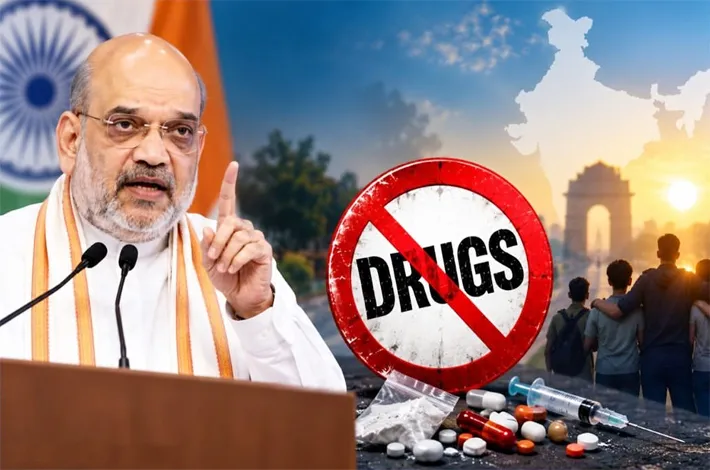
Union Home Minister Unveils Roadmap
metro india news I Panaji/Dona Paula (Goa)
Union Home Minister Amit Shah on Sunday outlined an ambitious three-year roadmap to make India drug-free by 2029, framing the fight against narcotics as a national security priority essential to realising Prime Minister Narendra Modi’s vision of a Viksit Bharat by 2047.
Addressing the media in Goa, Shah said the Modi government is committed to eliminating the drug menace just as it has tackled Naxalism and terrorism. “It is Narendra Modi’s objective that drug-free youth power will lead to Viksit Bharat in 2047,” he stated.
The government has prepared a detailed roadmap spanning 2026-2029, built on coordinated action involving central agencies, states, and multiple ministries. Shah emphasised that narcotics trafficking destroys future generations and generates “dirty money” that funds terrorism, giving rise to narco-terror modules worldwide. Before 2014, he noted, the fight was fragmented and limited to catching small-time offenders.
Since 2019, it has become a sustained national campaign through systemic overhauls. Key measures already implemented include the four-tier Narco Coordination Centre (NCORD) mechanism, dedicated anti-narcotics task forces models shared with states, a Joint Coordination Committee, the MANAS helpline (1933) for rehabilitation, restructuring of the Narcotics Control Bureau (NCB), and the NIDAN portal for a national database of offenders.
Authorities now pursue both “bottom-to-top” and “top-to-bottom” investigations—tracing small seizures to larger networks and bulk intercepts down to end users—while intensifying financial probes under the PIT-NDPS Act and targeting darknet, crypto, and encrypted channels. The new vision document rests on four pillars: intelligence- and operations-based enforcement; control of precursor chemicals and synthetic drugs; demand and harm reduction; and capacity building with coordination.
Specific targets include training one lakh ‘Nashamukti Mitras’ (Drug-free India Ambassadors) through the NCC, NSS, and My Bharat platforms; making educational campuses drug-free in partnership with the Ministries of Education and Youth Affairs & Sports; and establishing fully equipped Anti-Narcotics Task Forces (ANTFs) in every state by March 2027, with 100% central assistance for capacity building.
Enforcement goals are equally sharp. The Ministry of Home Affairs and NCB aim to dismantle 100 international and inter-state drug networks and extradite 100 narcotics-linked fugitives. Central agencies including the CBI, Enforcement Directorate, and Financial Intelligence Unit will pursue drug mafias and financial trails. Risk-based profiling scanners will be deployed at airports and cargo terminals.
Authorities have set a target to destroy 100 clandestine laboratories producing precursors and synthetic drugs, involving the Department of Revenue, Central Bureau of Narcotics, GSTN, and Excise departments. Forensic reports are to be made available within 30 days, with over 25 time-bound action points identified. Shah highlighted past gains to underscore momentum.
Between 2014 and 2026, seizures of synthetic drugs and overall narcotics rose dramatically compared with the previous decade, with large quantities destroyed. The broader Nasha Mukt Bharat Abhiyan has already reached tens of crores of citizens through awareness drives, community participation, and expanded rehabilitation services. The new campaign seeks to reach 50 crore people.
Linking the drug war to internal security successes, Shah said separatism in Jammu and Kashmir has declined sharply after the abrogation of Article 370, with terrorism metrics approaching zero and development accelerating.
The five-decade Naxal problem has become a thing of the past, with those who envisioned a “Red Corridor from Tirupati to Pashupatinath” surrendering and joining the mainstream. In the Northeast, around 10,000 youth have laid down arms under more than 14 agreements, bringing calm and progress. “We have eradicated Naxalism and will deal with the menace of narcotics in the same manner,” he asserted.
He also noted success in extraditions: 274 fugitives brought back from 36 countries between 2019 and July 2026, alongside hundreds of Red Corner Notices and the sealing of assets worth nearly Rs 18,000 crore, facilitated by the Bharat-Pol system connecting central agencies and state police.
Shah expressed confidence in nationwide cooperation for the three-year ‘Drug-Free India’ campaign. Demand reduction will rely on expanded public awareness, education, rehabilitation, and a sympathetic approach toward affected youth, led by the Ministry of Social Justice and Empowerment and others. Strict monitoring of pharmaceutical diversion and online pharmacies will continue.
The announcement builds on earlier steps, including the Vision Document on Drug Control (2026-29) unveiled in June 2026 at an NCORD meeting, which stressed detecting, disrupting, and destroying the entire narcotics ecosystem so it cannot recover for decades. With youth at the centre of India’s demographic dividend, officials view a Nasha Mukt Bharat as indispensable to national progress and security. The coming three years, Shah indicated, will determine whether India decisively defeats the drug trade.