19 October, 2026 | 11:02 AM


Oldest octopus is nautilus
10-04-2026 12:00:00 AM
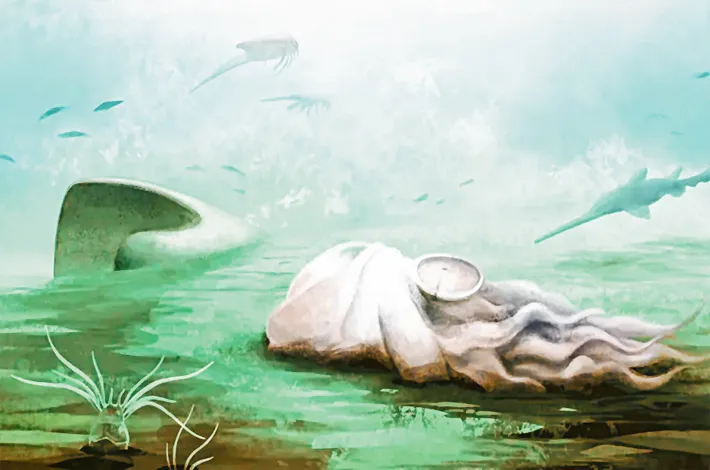
London: The 300-million-year-old Pohlsepia mazonensis has lost its title as the world's oldest octopus. According to new research led by Thomas Clements, a zoologist at the University of Reading, the fossilised remains actually belong to a relative of the nautilus, AP reported.
Found in Illinois’ fossil-rich Mazon Creek, the creature resembles a “white mush” roughly the size of a human hand. While it superficially looks like a deep-water octopus, its classification in 2000 created a massive evolutionary gap, as the next oldest octopus fossil is only 90 million years old. To settle the debate, researchers utilised a synchrotron, an advanced tool using high-speed electrons, to peer inside the rock. They discovered a radula (a ribbon of teeth) containing 11 teeth per row. Since octopuses possess only seven or nine teeth, the math simply didn’t add up.
Instead, the dental structure perfectly matches Paleocadmus pohli, a fossil nautiloid. Clements suggests the confusion likely occurred because the creature's shell decomposed before fossilisation, leaving behind a deceptive “blob”. Consequently, the search for the true ancestor of the eight-tentacled cephalopod continues, as the timeline of their evolution shifts back by millions of years.