22 October, 2026 | 5:56 AM


Remembering Rajkumari Indira Devi Dhanrajgir
15-01-2026 12:00:00 AM
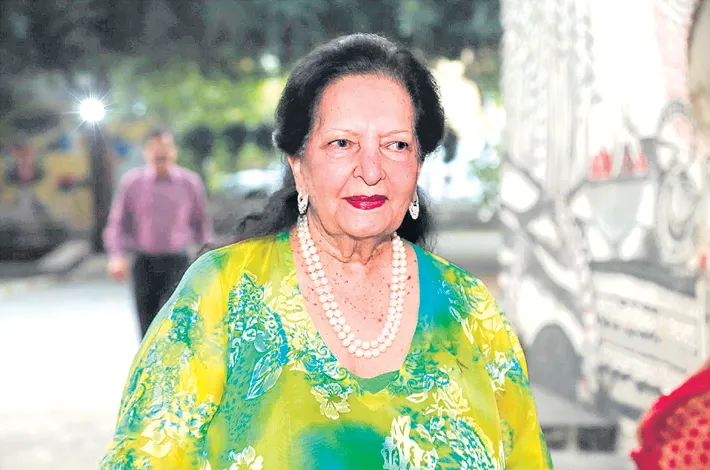
A life of poetry, heritage, and grace
Inspired by the works of Allama Iqbal, Ghalib, and Sri Aurobindo, Princess Indira taught herself to type in the lawns of Gyan Bagh Palace and began composing couplets in Urdu. From her teenage years, Indira had an interest in photography
The renowned Hindi and English poetess, and the life companion of the famous poet Guntur Seshendra Sharma, Rajkumari Indira Devi Dhanrajgir (95), is no more. Our princess has departed to realms from which there is no return! She had been suffering from ill health for the past few days and breathed her last on Tuesday evening at 5:30 PM in Gyan Bagh Palace. Tributes and heartfelt homage to her! As the daughter of Raja Dhanrajgir, one of the prominent nobles in the Nizam's court, Indira Devi belonged to a lineage deeply connected to court culture, philanthropy, and literature.
She was the wife of the late poet Guntur Seshendra Sharma and spent most of her life in the eight-acre Gyan Bagh Palace, also known as Dhanrajgir Palace—a 165-year-old ancient estate that remains one of the few symbols of Hyderabad's aristocratic past. As a painter and poetess, she wrote with the authority of vivid memories. The Dhanrajgir family were scholars in the Goswami Raja tradition. This community served as a bridge between religious orders, finance, and the Nizam's court.
Indira Devi Dhanrajgir was born on August 17, 1930. Known as Princess Indira, she was an Indo-Anglian poetess and photography enthusiast from Hyderabad, India. She was nominated for the Nobel Prize in Literature in 1973.Born to the philanthropist Raja Dhanrajgirji Bahadur and his wife Rani Premila Devi, her father was famous for introducing many Western ideas and the sport of cricket to Hyderabad, serving in the court of Nizam Mir Osman Ali Khan.
She was the eldest of four daughters and was educated at home by an English governess. Her grandfather, Raja Saheb Narsingji Bahadur, was considered the "Rockefeller of the South." The Dhanrajgirs owned royal residences in Bombay, Hyderabad, and Pune.In her childhood, Indira met influential figures: she played carrom with Kishan Pershad, who served twice as Prime Minister of Hyderabad; Mir Yusuf Ali Khan, Salar Jung III, gifted her a Shetland pony on her first birthday; and she listened to recitations by prominent poets.
Inspired by the works of Allama Iqbal, Ghalib, and Sri Aurobindo, Princess Indira taught herself to type in the lawns of Gyan Bagh Palace and began composing couplets in Urdu. From her teenage years, Indira had an interest in photography and started a collection of fine photographs, which she said were worth sharing in a book.In 1945, Princess Indira married Sri Kishan Seth, nephew of Hyderabad's Prime Minister Kishan Pershad, but he proved unsuitable for married life, leading to the dissolution of their marriage.
Shortly after the wedding, she quarreled with Sri Kishan and separated from him, with her family and relatives consenting to the decision.In 1964, her first poetry collection, The Apostle, was published, followed by Return Eternity and Yearnings, Other Poems in 1965 and 1966, respectively. During this time, she created a circle of poets around her, turning Gyan Bagh Palace into a hub for local poets, including her future husband Guntur Seshendra Sharma, Aziz Qaisi, Makhdoom Mohiuddin, and Jwalamukhi, where they met to read, discuss, and translate poetry.
Later, her fourth publication, Partings in Mimosa, gained recognition in literary circles. Literary critic Usharbudh Arya described it as "a truly promising talent with a conscious restraint that desires the use of free verse, giving her 483 lines an active rhythm, a long, thoughtful enthusiasm. The related control of structure."During her literary success in the 1970s, she married Telugu poet Guntur Seshendra Sharma in 1970. He had three children from a previous marriage.
She lived her entire life in Gyan Bagh Palace. Their wedding took place at the Hoysaleswara Temple in Karnataka.After marrying Guntur Seshendra Sharma, she abruptly stopped writing poetry, stating: "There should not be two poets in one family." For this, Osmania University professor Kausar Azam said of her, "As a poetess belonging to the Aurobindo school of poetry, she received some critical attention, but now, sadly, only a select few know about it.
"Her latest publication was a coffee table book about her family titled Memories of the Deccan, dedicated in October 2008 to the eighth Nizam's heir Mukarram Jah, Princess Esra Birgen, Princess Azmet Jah, and Shehkar.In 1970, her marriage to Telugu poet Guntur Seshendra Sharma took place, and the couple resided in Gyan Bagh Palace. In 1987, along with Seshendra, she attended a literary conference in Greece, where she had the fortune to meet poets Yiannis Ritsos and Nikiforos Vrettakos.
In 1973, Krishna Srinivas, president of the World Poetry Society Intercontinental (WPSI), nominated her for the Nobel Prize in Literature, making her the first Indian woman to receive such an honor.In November 2019, she funded the restoration of a lecture hall at Golden Threshold, Sarojini Naidu's residence in Nampally, Hyderabad, which was donated to the University of Hyderabad. Linking heritage with public education, she established an annual lecture series.
The hall was inaugurated in her honor as Princess Indira Devi Hall and transformed into a cultural and literary center. Asaf Jahi family heir and long-time family friend Raunak Yar Khan said he had known Indira Devi for three decades. "She was a very beautiful person, a very regal woman. She had an amazing presence. If she sat in a room with 40 people, your eyes would go straight to her," he said.
- Mohammad Ghouse Digital Artist