18 September, 2026 | 9:42 AM


Shadows over Indian democracy: Psephologists’ stark warning
16-12-2025 12:00:00 AM
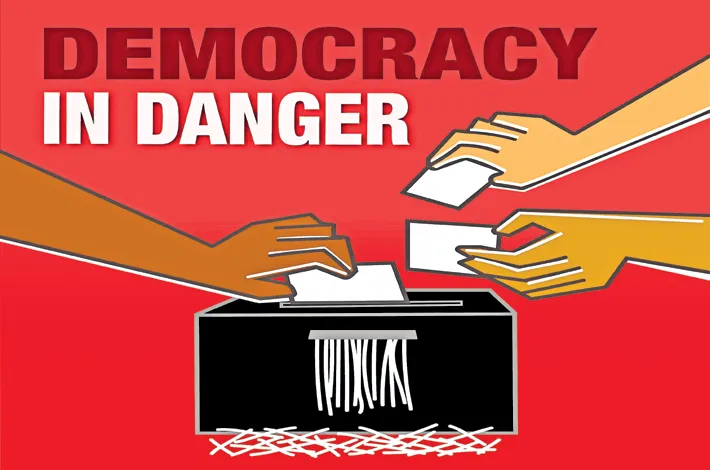
In the digital corridors of X (formerly Twitter), where political discourse, debate and discussion often erupts like a storm, a single tweet from trader and Congress supporter Ravinder Kapur (@RavinderKapur2 ) on December 15, 2025, featuring a compelling two-minute clip from a TV interview has ignited fierce debate. The guest? None other than Yogendra Yadav, the renowned political activist and founder of Swaraj India, whose measured yet powerful words cut through the facade of post-election normalcy.
The conversation unveils a chilling blueprint for what Yadav perceives as the Bharatiya Janata Party's (BJP) post-2024 Lok Sabha "solutions" to electoral setbacks. With sarcasm flowing abundantly, Yadav says without mincing words that these manoeuvres ensure "democracy will remain, elections will be held—and a BJP victory will also be guaranteed!". In an era where India's political environment feels rather arbitrary and artificial, this exchange is sure to raise few eyebrows.
The backdrop to Yadav's caution is the BJP's underwhelming 2024 performance. Despite Prime Minister Narendra Modi's towering persona, the party secured only 240 seats, falling short of the 272 needed for a solo majority and relying on a fractious National Democratic Alliance (NDA) coalition. This "setback," as Yadav terms it, shattered the aura of invincibility that had enveloped the saffron brigade since 2014. Voter fatigue, economic disillusionment over unemployment and inflation, and a resurgent opposition under the INDIA bloc—buoyed by Rahul Gandhi's Bharat Jodo Yatra—exposed cracks in the BJP's fortress.
Yet, rather than introspection, Yadav argues, the government's response is a triad of structural sleights-of-hand designed to tilt the scales permanently. The tweet's virality underscores a public hunger for such critique; replies range from helpless agreement—"It's a strangled democracy to keep a despotic regime in power," laments one user—to defiant dismissals questioning why voices like Yadav's are sidelined. As the video loops on screens across urban cafes and rural WhatsApp groups, it poses a fundamental query: Is India's democracy evolving, or is being “prevented from further decay” ?
Yadav's first "solution"—delimitation of constituencies—strikes at the heart of representational equity. For the beginners, delimitation is the periodic redrawing of electoral boundaries to reflect population shifts, a process enshrined in Article 82 and 170 of the Constitution. The last comprehensive exercise occurred in 2002, freezing seat allocation to favour states with better family planning records, ostensibly to encourage population control in high-growth regions like Uttar Pradesh and Bihar. But Yadav, drawing from his days as a political scientist at Jawaharlal Nehru University, warns that the BJP is eyeing a post-2026 census delimitation to slash seats in opposition bastions.
Imagine Uttar Pradesh, a BJP stronghold yet riddled with pockets of Samajwadi Party dominance, seeing its 80 Lok Sabha seats reconfigured to dilute Yadav heartlands or Muslim-majority areas. Historical precedents abound: the 1976 emergency-era amendments under Indira Gandhi infamously manipulated boundaries, earning bipartisan scorn. Today, with the BJP controlling the Delimitation Commission via the Union Law Ministry, critics fear a manipulation spree akin to America's partisan map-rigging. "Reduce the number of seats where they don't get votes," Yadav emphasizes.
This isn't mere allegations; a 2023 parliamentary committee report hinted at "freezing" southern states' seat shares despite their demographic discipline, punishing non-BJP allies like the DMK in Tamil Nadu. If implemented, it could add 200-odd seats to northern BJP fiefs, engineering a perpetual Lok Sabha skew. In a nation of 1.4 billion, where one vote can topple dynasties, such distortions aren't just procedural or administrative—they're takeovers.
Equally concerning is Yadav's second prong: the push for "One Nation, One Election" (ONOE). Championed by Modi since 2016 and formalized via the 2024 Kovind Committee report, ONOE proposes synchronizing Lok Sabha, state assemblies, and local polls into a single mega-event. Proponents tout efficiency—slashing the Rs 4,500 crore annual election bill and minimizing governance disruptions from the model code of conduct. Yet, as Yadav goes deep in the interview, this masks a deeper agenda: stifling the opposition's cycle of resurgence. Frequent state elections, he notes, allow regional satraps like Mamata Banerjee in West Bengal or Arvind Kejriwal in Delhi to harness local grievances against the Centre.
The 2024 Maharashtra and Haryana assembly polls, mere months after Lok Sabha, amplified anti-incumbency waves that nearly sank the NDA. By bundling everything into one ballot, ONOE would drown state-specific narratives in the BJP's nationalistic din—think Ram Temple fervor or "Viksit Bharat" slogans overwhelming bread-and-butter issues. Replying to a probing question on federalism, prompting Yadav to retort: "To avoid frequent elections, implement One Nation-One Election, meaning manage everything in one go.
A "solution" he alleges, that consolidates power under the guise of uniformity. Legal hurdles abound—the Supreme Court has historically guarded staggered polls as a federal safeguard—but with the BJP's Rajya Sabha sway and a compliant Election Commission, bills could sail through. Dissenters, including the Congress and Trinamool, decry it as a "one nation, one government" trojan horse, echoing Yadav's viral punchlines. The third “weapon” as per Yadav, is the shadowy "Special Identification Register" (SIR)—a veiled nod to the National Register of Citizens (NRC) or its precursor, the National Population Register (NPR).
The 2019 NRC in Assam, touted as a citizenship purge, left 1.9 million—mostly Bengali Muslims and Hindus— on statelessness, their lives left to the mercy of Foreigners Tribunals. To be implemented nationally, as hinted in Home Minister Amit Shah's 2024 speeches, it becomes a disenfranchisement dragnet, targeting "infiltrators" while conveniently excising dissenters via Aadhaar-NPR linkages. Imagine Dalits in Bihar or Adivasis in Jharkhand vanishing from rolls under biometric scrutiny. Yogendra Yadav alleges that this isn't voter suppression; it's erasure. Data from the 2024 elections already shows 40 million deletions from rolls, disproportionately affecting minorities.
Yogendra Yadav’s track record—co-authoring the 2011 Jan Lokpal Bill, leading election analytics for Congress in 2004—lends credence. The BJP's retorts, predictably, brand such critiques as "anti-national," but data bites back: Pew's 2023 survey revealed 65% of Indians value fair elections, yet trust in institutions plummets. Citizens must demand transparency in delimitation, federal safeguards for ONOE, and judicial oversight for registers.