10 October, 2026 | 1:42 PM


Suvendu, the Giant Killer!
09-05-2026 12:00:00 AM
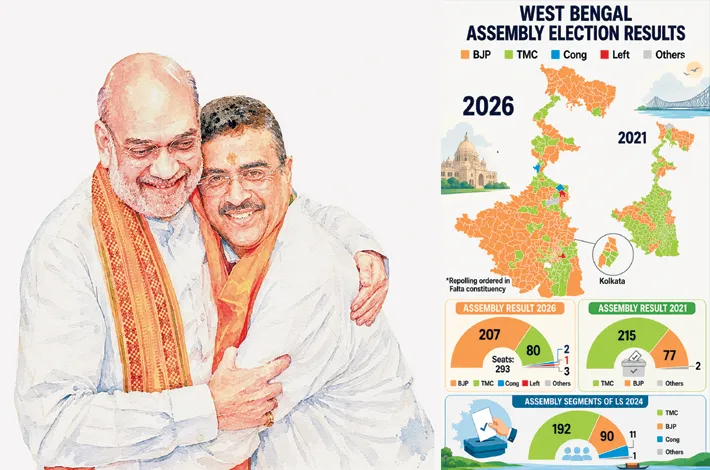
Suvendu Adhikari Stamps His Adhikar, Set to Become WB’s BJP CM
metro india news I KOLKATA:
In a landmark shift that redraws the political map of West Bengal, Suvendu Adhikari is poised to take oath as the state’s 9th Chief Minister onSaturday at the Brigade Parade Ground. The Bharatiya Janata Party (BJP) Legislature Party formally elected him as its leader on Friday in the presence of Union Home Minister Amit Shah, marking the dawn of the first BJP government in the state’s history and bringing the curtain down on Mamata Banerjee’s 15-year reign.
Former state BJP president Dilip Ghosh proposed Adhikari’s name at the meeting, which was seconded amid thunderous applause from newly elected MLAs. Amit Shah announced the decision, triggering celebrations among party workers across the state. Senior BJP leaders described Adhikari’s elevation as a natural choice, citing his grassroots connect, organisational skills, administrative experience, and repeated symbolic victories against Banerjee.
The BJP’s stunning victory in the April 2026 Assembly elections delivered one of the most dramatic upsets in Indian electoral history. Contesting in two phases on April 23 and 29, with results declared on May 4, the saffron party secured 207 seats out of 294, crossing the majority mark of 148 comfortably. The Trinamool Congress (TMC) was reduced to just 80 seats, a massive loss of 135 from its 2021 tally of 215. Voter turnout reached a record 92.93%. BJP’s vote share rose to approximately 45.84% (around 29.22 million votes), while TMC managed 40.80%.
For Adhikari, this moment crowns a remarkable political journey from TMC insider to the “Giant Killer” who dethroned his former mentor. Born on December 15, 1970, in Contai (Purba Medinipur) to Sisir Adhikari, a veteran politician and former Union Minister, Suvendu entered politics in the mid-1990s. He began as a Congress councillor in Kanthi Municipality in 1995 before joining TMC in 2000.
His big break came during the 2007 Nandigram anti-land acquisition movement. As a key organiser of the Bhumi Uchhed Pratirodh Committee, Adhikari helped lead protests against the Left Front government’s plans for a special economic zone. The agitation, which saw violence and drew national attention, propelled Mamata Banerjee and TMC to power in 2011. Adhikari’s organisational prowess in Jangalmahal further expanded TMC’s base.
He won the Tamluk Lok Sabha seat in 2009 and 2014 with impressive margins. In 2016, he shifted to the Assembly, winning Nandigram and becoming Transport Minister in Banerjee’s cabinet, later handling Irrigation as well. Differences, particularly with Abhishek Banerjee, led to his dramatic exit in late 2020. He resigned from TMC on December 17, 2020, and joined BJP the next day in the presence of Amit Shah.
The 2021 elections cemented his reputation. Contesting against Banerjee herself in Nandigram, Adhikari defeated her by a narrow but historic 1,956 votes. He served as Leader of the Opposition from 2021 to 2026, building BJP’s organisational strength from the booth level, especially in his East Midnapore stronghold.
In 2026, Adhikari contested both Nandigram and Bhabanipur — Banerjee’s traditional bastion. He won Nandigram comfortably and delivered a decisive blow in Bhabanipur, defeating Banerjee by over 15,000 votes (73,917 to 58,812). The result, coming after intense round-by-round counting where leads fluctuated, symbolised the complete erosion of TMC’s dominance even in urban strongholds. BJP also made deep inroads in Kolkata, winning five of 11 seats there.
Analysts point to several factors behind BJP’s surge: anti-incumbency after 15 years of TMC rule, issues like corruption scandals (including the school recruitment scam), women’s safety concerns post the RG Kar case, unemployment, and governance failures. Border security, infiltration, and the Special Intensive Revision (SIR) of electoral rolls — which removed millions of dubious entries — became flashpoints that BJP effectively leveraged. Promises around CAA implementation and outreach to communities like Matuas also resonated.
Adhikari’s personal appeal as a local strongman with administrative experience proved crucial. Senior leaders noted his ability to translate grassroots networks into electoral gains. Other names like Samik Bhattacharya were considered, but central leadership, including Prime Minister Narendra Modi and Amit Shah, backed Adhikari for his proven track record.
The transition has not been without drama. Banerjee initially refused to accept the verdict, alleging irregularities and interference, and declined to resign immediately. The Governor eventually dismissed her cabinet as the Assembly term ended. Adhikari is expected to lead a stable government focused on industrial revival, job creation, law and order, and addressing infiltration.
Reports suggest the BJP may appoint two Deputy Chief Ministers, a rarity in recent Bengal politics. The last was Buddhadeb Bhattacharjee under Jyoti Basu. This move could help balance regional and community interests in the diverse state.
Adhikari’s rise embodies the volatility and resilience of Indian politics. From co-founding TMC’s success story to becoming its most formidable adversary, he has traversed ideological and personal battles. His “adhikar” — claim — over Bengal’s political future now stands affirmed by a decisive mandate.
As he prepares to assume office, expectations are high. Supporters see a leader who understands Bengal’s aspirations for development without compromising on security and cultural identity. Critics will watch closely for governance delivery amid the state’s complex socio-political fabric.