30 September, 2026 | 7:36 PM


Swept by the winds of time
29-04-2026 12:00:00 AM
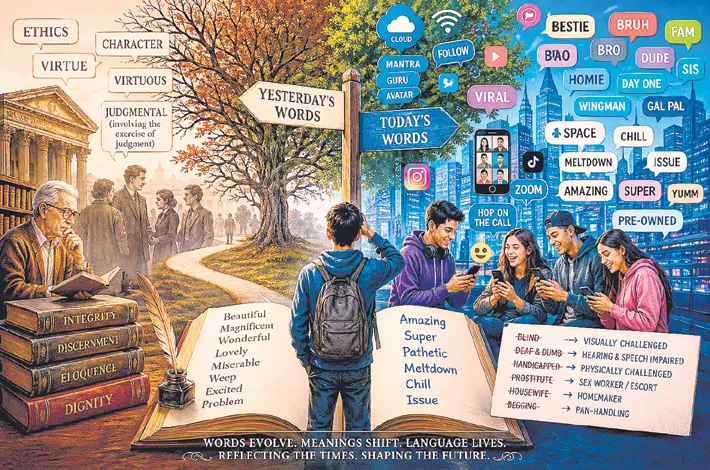
How English words have lost their old meanings in the digital age
In an era shaped by technology, social media, and generational change, English is undergoing a subtle but significant transformation. Once prized for precision and classical richness, it now reflects speed, informality, and cultural shifts.
Consider moral vocabulary. “Ethics” has largely migrated to corporate jargon—invoked in compliance sessions or ESG reports rather than personal conduct. “Character,” once a measure of moral strength, now often refers to a certificate of good conduct or a role in entertainment. Words like “virtue” and “virtuous” feel dated, confined to religious or historical contexts.
Even “judgmental,” which entered English in the 19th century as a neutral legal term, now carries a negative connotation—implying unfair criticism or moral superiority. Today, calling someone “judgmental” often shuts down value-based discussion in favor of non-confrontational empathy.
Technology has reshaped meanings. “Virtually,” once meaning “almost,” now refers primarily to digital environments. “Share” has expanded from splitting something tangible to broadcasting personal updates or content online. “Contact” has evolved into a curated network of acquaintances, often defined by utility rather than closeness.
Traditional friendship terms have given way to Gen Z expressions like “bestie,” “homie,” “fam,” “bruh,” “bro,” “dude,” “Day One,” “wingman,” “gal pal,” and “sis,” reflecting immediacy and chosen bonds in a hyper-connected yet often isolating world.
The idea of “privacy” has softened into “space,” a term widely used across age groups, especially by teenagers seeking emotional or physical distance. Emotional vocabulary has shifted too: people no longer simply “cry” or “weep,” but have “meltdowns.” Someone once described as “miserable” might now be called “pathetic.” Instead of being “excited” (in the sense of anxious), one is told to “chill” over an “issue,” a vague term replacing more precise words like problem or dilemma.
Superlatives have flattened. Words like “beautiful,” “magnificent,” or “lovely” are often replaced by the catch-all “amazing,” applied equally to everyday food and global landmarks. “Super” has become a universal intensifier—super cold, super-hot, super good. “Awesome,” once reserved for awe-inspiring experiences, now simply means “great.” Similarly, “issue” has broadened to cover everything from minor inconvenience to serious crisis.
Consumer language reflects a desire for positivity. “Second-hand” goods are now “pre-owned,” softening stigma. Transport terms have simplified: motorcycles are “bikes,” bicycles “cycles,” and auto-rickshaws just “rickshaws,” as older distinctions fade.
Efforts toward inclusivity have led to widespread renaming. “Blind” becomes “visually challenged,” “deaf and dumb” evolves into “hearing and speech impaired,” and “handicapped” gives way to “physically challenged.” “Prostitute” is replaced by “sex worker” or “escort,” “housewife” by “homemaker,” and even “begging” by “pan-handling.” While these changes aim to preserve dignity, critics argue they sometimes obscure reality.
Corporate language has developed its own dialect. Meetings no longer “begin”; they are “kicked off” or “kept up.” Poor connections lead to “you’re breaking up on my end.” Discussions are postponed with “let’s circle back,” agreement becomes “I’m on the same page,” problems are “blockers,” and impossibility is softened to “a bit challenging.” These phrases prioritize politeness but often sacrifice clarity.
Spiritual and traditional terms have also shifted. A “mantra” is now any guiding phrase, a “guru” an expert in any field, and an “avatar” a digital identity. “Viral” describes online popularity rather than disease, while “cloud” refers more to data storage than the sky. “Follow” means subscribing to online content, and “Zoom” has become synonymous with video calls, giving rise to phrases like “hop on a call.”
“Application,” or “app,” now more commonly means software than a formal request. Fashion vocabulary mirrors this fluidity: “dress” has evolved into “outfit” or “OOTD” (outfit of the day). Traditional attire like salwar-kameez may be called a “suit,” while coordinated sets are “co-ords.” Food is rarely “delicious”—it is simply “yumm.”
Cultural shifts around identity have accelerated linguistic change. “Gay,” once meaning carefree, now primarily denotes sexual orientation. Singular “they/them” is widely used as a gender-neutral pronoun, and “queer,” once derogatory, has been reclaimed as an inclusive, empowering term.
For older speakers, this evolving vocabulary can feel disorienting. Yet language has always adapted to social realities—technology, inclusivity, and changing interpersonal norms. What one generation sees as loss of precision, another views as flexibility and relevance.
Ultimately, English is not static. It is shaped continuously by its users, reflecting their values, technologies, and ways of life. Whether these changes enrich or dilute the language is open to debate. What remains certain is that English, like the society it serves, is always in motion.

(Ranee Kumar, senior journalist based in Dehradun)