4 October, 2026 | 2:40 PM


Telangana taps tech for Census 2027
15-03-2026 12:00:00 AM
Metro India News | Hyderabad
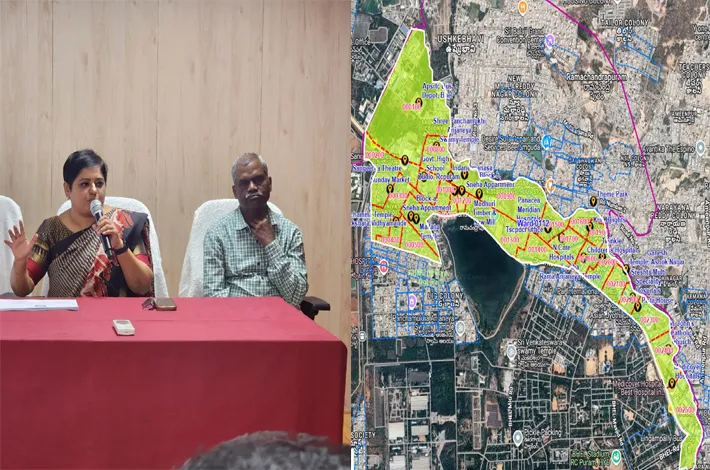
Telangana is preparing for its first Census since the state’s formation, and officials are emphasizing technology, accuracy, and public participation to make Census 2027 a success. An orientation session for media representatives was conducted on Saturday by Bharati Hollikeri, IAS, Director of Census Operations, Telangana, who detailed the key features of the upcoming exercise and the critical role of citizens in supporting it.
The Director explained that Census 2027 will introduce several innovative measures, including mobile-based data collection, self-enumeration, caste enumeration, and improved data validation processes. “These initiatives are designed to make the Census faster, more accurate, and more efficient than ever before,” Hollikeri said, noting that this will also be the first Census in Telangana conducted entirely after the state’s formation.
The exercise will be implemented in two phases. Phase I, the House Listing and Housing Census, begins with self-enumeration from April 26 to May 10, 2026, allowing households to submit information online. This will be followed by house listing and housing census from May 11 to June 9. Phase II, the Population Enumeration, is scheduled from February 9 to February 28, 2027, with a special enumeration of houseless populations during the night of February 28. A revisional round from March 1 to March 5, 2027, will update information, including births, deaths, and visitors, using March 1 as the reference date.
Hollikeri outlined a multi-tiered training framework for the exercise. Two national trainers will guide 66 master trainers, including 17 from the Directorate of Census Operations and 49 from the state. These master trainers will then train 1,220 field trainers, who in turn will prepare 3,728 district authorities, charge clerks, and technical assistants. This cascade will finally reach around 88,000 enumerators and supervisors, including reserve staff, who will handle the field-level census operations.
Confidentiality and clarity were stressed repeatedly. The Director assured that all information collected will remain strictly confidential under the Census Act, 1948, and will be used solely for statistical purposes. She clarified that census data will not affect welfare schemes, taxation, or eligibility for any government benefits. Citizens are encouraged to provide accurate information to ensure reliable demographic and housing data, which will be crucial for planning, policy-making, and governance.
Technology at the Core
Census 2027 will rely heavily on modern tools to streamline operations. Key platforms include the Jurisdictional Changes Portal, the Census Management and Monitoring System, mobile apps for house listing and population enumeration, and the self-enumeration web portal. Enumerators will use mobile apps with offline functionality, secure device registration, multiple language support, and automatic verification features. These tools allow for real-time monitoring, geo-referenced data collection, and improved accuracy.
The Census will also produce the District Census Handbook, providing detailed demographic and socio-economic data for villages and towns. Information will include housing conditions, household assets, amenities, education, health, agriculture, industry, and infrastructure. Special categories such as institutional households, normal households, and houseless households will be covered to ensure comprehensive data collection.
The Director urged citizens to actively participate and cooperate with census officials. Accurate information from households will not only help the state government in planning and resource allocation but also support democratic processes, from local governance to national policy formulation. Census 2027 is being positioned as a modern, efficient, and inclusive exercise—a high-tech leap forward in India’s largest administrative operation.