25 October, 2026 | 12:57 AM


The Somnath Wonder Of Faith, Destruction & Unyielding Resilience
11-01-2026 12:00:00 AM
CL Rajam
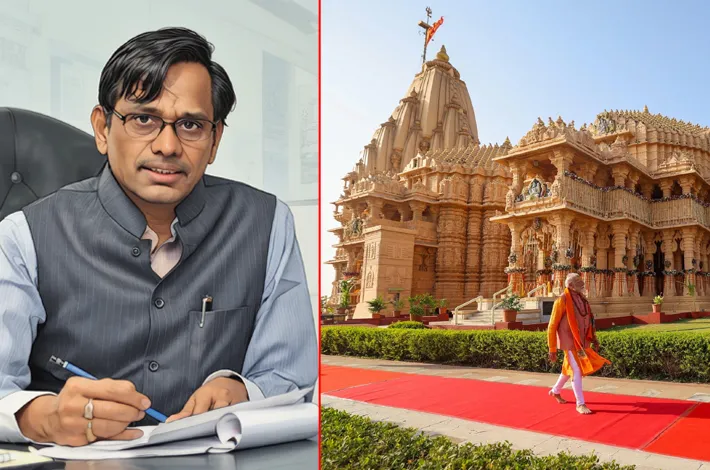
On the eve of Prime Minister Narendra Modi's visit to the historic Somnath Temple in Gujarat, the nation pausesto reflect on a symbol that embodies India's eternal spirit. Scheduled for January 11 Modi's pilgrimage coincides with the Somnath Swabhiman Parv, a four-day celebration marking 1,000 years since the temple's first major assault in 1026 CE. This event not only honours the temple's endurance but also underscores its role as a beacon of cultural revival in modern India.
As the Prime Minister, who serves as the chairman of the Somnath Temple Trust, offers prayers and leads the Shaurya Yatra—a ceremonial procession honouring the warriors who defended the shrine—the world witnesses a living testament to resilience. Somnath, the first of the 12 Jyotir lingas dedicated to Lord Shiva, has risen from ruins time and again, defying invaders, natural calamities, and the sands of time.
The Mythical Origins: A Shrine Born from Divine Legend
The Somnath Temple's roots trace back to ancient Hindu mythology, predating recorded history. According to the Shiva Purana and Skanda Purana, the temple was originally built by the Moon God, Soma, as an act of devotion to Lord Shiva. Legend holds that Soma, cursed by his father-in-law Daksha to wane eternally, sought Shiva's blessings at Prabhas Patan—the site of modern Somnath. Shiva, pleased with Soma's penance, restored his luster, and in gratitude, Soma constructed a grand temple of gold. This mythical foundation elevates Somnath beyond a mere structure; it represents cosmic balance and divine grace.
Archaeological evidence supports the temple's antiquity. Excavations by the Archaeological Survey of India (ASI) in the 20th century unearthed artifacts dating to the 8th century BCE, including seals and pottery reminiscent of the Indus Valley Civilization. The Rigveda, one of the oldest sacred texts (composed around 1500-1200 BCE), mentions Prabhasa as a holy tirtha (pilgrimage site), linking it to early Vedic rituals. By the Gupta Empire era (4th-6th century CE), Somnath had evolved into a prosperous center of Shaivism, adorned with intricate carvings and patronized by kings like the Maitrakas of Vallabhi.
The temple's name, "Somnath," derives from "Soma" (Moon) and "Nath" (Lord), symbolizing Shiva as the protector of the moon. Its coastal location on the Arabian Sea in Gujarat's Gir Somnath district added to its allure, drawing pilgrims from across the subcontinent. Ancient texts describe it as a "Jyotirlinga," a self-manifested lingam of light, making it the foremost among Shiva's sacred abodes.
The Invaders' Fury: Detailed Accounts of Desecration
Somnath's history is punctuated by brutal invasions, each leaving scars but failing to extinguish its flame.
Mahmud of Ghazni
(1026 CE):
Mahmud's campaign was meticulously planned. Departing from Ghazni in September 1025, he crossed the Thar Desert, facing harsh conditions that killed many camels. At Somnath, defenders barricaded the temple, but Mahmud's forces breached it after fierce combat. The lingam, said to weigh 2,000 maunds (about 80 tons), was shattered; fragments were sent to Ghazni to pave mosque entrances. Estimates peg the loot at 20 million dinars—equivalent to billions today. Hindu chroniclers like Hemachandra lamented the loss, while Mahmud's biographers hailed it as a jihad against idolatry.
Alauddin Khilji
(1299 CE):
Ulugh Khan's army, 20,000 strong, overwhelmed Gujarat's Vaghela king Karna. The temple was plundered, its priests massacred, and the idol desecrated. Khusrau's verses describe the scene vividly: "The stones of the temple were broken into pieces, and the idol was thrown into the dust."
Aurangzeb's Edicts (1665-1706 CE):
Aurangzeb's farman (decree) explicitly ordered the temple's annihilation to suppress "infidel practices." The site was mosque-ified, with minarets added. Local resistance persisted, with hidden rituals continuing in secret.
Lesser-known heroes emerged, like an anonymous Hindu warrior who avenged Ghazni's raid by infiltrating his court and assassinating a guard, symbolizing quiet defiance.
These assaults were not isolated; they reflected broader patterns of iconoclasm during medieval invasions, as noted by historians like Richard Eaton in "Temple Desecration and Muslim States in Medieval India."
The Modern Revival: Patel, Prasad, and the Birth of a New Era
Post-1947, Somnath's reconstruction became a cornerstone of India's nation-building. On November 13, 1947, during a public meeting in Junagadh, Home Minister Sardar Vallabhbhai Patel vowed to rebuild the temple, framing it as a symbol of national unity after Partition. Patel, the "Iron Man" who integrated princely states, saw Somnath as a reclaiming of cultural heritage. He established the Somnath Trust in 1949, mobilizing funds from across India—donations poured in, including from farmers and industrialists.
Dr. Rajendra Prasad, India's first President, played a pivotal role in the inauguration. On May 11, 1951, Prasad performed the pran pratishtha (consecration) of the lingam, declaring: "The reconstruction of Somnath is a symbol of the revival of our ancient culture and traditions." His address emphasized unity: "Somnath has been a sacred place from time immemorial... Its restoration is a matter of national pride."
Notably, Mahatma Gandhi supported the effort but insisted on public funding, not government money, to maintain secularism. Jawaharlal Nehru opposed it, fearing "Hindu revivalism" and communal tensions, as revealed in his letters. In one missive to Prasad, Nehru wrote: "I do not like your associating yourself with the inauguration of the Somnath Temple... It savors too much of Hindu revivalism." Despite this, Patel and Prasad proceeded, with the project costing ₹5 million (about ₹500 crore today), employing 1,000 workers.
The new temple, designed by architect Prabhashankar Sompura in Chalukya style, features a 150-foot shikhara (spire) and earthquake-resistant foundations. It was completed in 1951, marking 75 years in 2026.
Prime Minister Modi's Commentary and Contemporary Relevance
In a recent blog post titled "Somnath Swabhiman Parv: 1,000 Years of Unbreakable Faith," published on January 5, 2026, Prime Minister Narendra Modi reflects on the temple's legacy. He writes: "Somnath stands as a powerful symbol of India's resilience, self-belief, and unwavering faith, having risen time and again despite repeated attacks." Modi highlights how the temple survived "1,000 wounds" yet embodies the nation's "indomitable spirit." He connects it to modern India: "From the revival of Somnath emerged a timeless lesson that India cannot be broken... We move forward to build a Viksit Bharat."
Modi, as trust chairman since 2011, has overseen developments like the Rs 89 crore Prabhas Patan Museum and enhanced pilgrim facilities. His visit includes Omkar chanting, a drone show, and the Shaurya Yatra with 108 horses, symbolizing valor.
Architecture: A Masterpiece of Chalukya Splendor
The current temple, spanning 3.5 acres, exemplifies Chalukya (Solanki) architecture with Nagara-style elements. The main sanctum houses the Jyotirlinga, surrounded by mandapas (halls) adorned with 1,000+ pillars carved with mythological scenes. The exterior features a 50-meter kalasha (pinnacle) and wave-like motifs symbolizing the sea. Materials include Kota stone and marble, with gold-plated doors donated in 1999.
Culturally, Somnath hosts festivals like Maha Shivratri, attracting millions. It's a hub for Sanskrit learning and Vedic rituals, preserving intangible heritage.
Somnath as India's Eternal Flame
As Prime Minister Modi visits on January 11, 2026, Somnath stands not as ruins of the past but as a promise of the future. Over 1,000 years, it has weathered 17 major attacks, natural furies, and political debates, emerging stronger. From Ghazni's plunder to Patel's vision, from Modi's blog to millions of pilgrims, Somnath encapsulates India's soul—resilient, devotional, and united. In Modi's words, "There can be no better example of our civilisation's indomitable spirit." As we commemorate this milestone, Somnath reminds us: Faith rebuilds what force destroys.
A Timeline of Triumph and
Tribulation: 1,000 Years of History
To comprehend Somnath's saga, one must chart its timeline—a chronicle of destruction by foreign invaders and reconstructions fueled by indigenous resolve. Here's a detailed chronology, drawn from historical records, Persian chronicles, and Indian epics:
■ Pre-8th Century CE: Ancient Foundations – References in the Mahabharata and Puranas indicate multiple early constructions, possibly in wood or stone, ravaged by time or minor raids. The site was a thriving port town, Prabhas Patan, integral to maritime trade.
■ 8th Century CE: First Recorded Destruction – In 725 CE, Al-Junayd, the Arab governor of Sindh, sacked the temple during his incursions into Gujarat and Rajasthan. This marked the onset of foreign assaults, with the temple's wealth—gold, jewels, and idols—looted.
■ 9th-10th Century CE: Reconstructions – Local rulers, including the Chaulukyas (Solankis), rebuilt the temple in red sandstone, enhancing its grandeur. By 997 CE, it was a architectural marvel with towering spires.
■ 1026 CE: Mahmud of Ghazni's Infamous Raid – The most notorious attack came from Mahmud of Ghazni, the Turkic ruler from Afghanistan. In his 15th invasion of India, Mahmud marched 1,000 miles across deserts with 30,000 troops, battling Rajput forces en route. Reaching Somnath in January 1026, he slaughtered defenders and smashed the lingam, carting away treasures worth millions in gold and gems. Persian historian Al-Bruni described the idol as suspended by magnets, a myth debunked but emblematic of the temple's mystique. This raid, lasting three days, killed an estimated 50,000 Hindus. Mahmud's motives blended plunder with iconoclasm, as chronicled in his court poet Firdausi's Shahnameh.
■ 11th-12th Century CE: Solanki Revival – King Bhima I of the Solanki dynasty rebuilt the temple by 1042 CE. His successor, Kumarapala (1143-1172 CE), further embellished it with silver gates and intricate sculptures.
■ 1299 CE: Alauddin Khilji's Assault – Under Sultan Alauddin Khilji of the Delhi Sultanate, general Ulugh Khan razed the temple again. Sufi poet Amir Khusrau, in his Khazain-ul-Futuh, glorified the destruction, noting the lingam's fragments
were embedded in Delhi's Jama Masjid steps as a symbol of subjugation.
■ 14th-15th Century CE: Multiple Raids and Rebuilds – Zafar Khan (Muzaffar Shah I), founder of the Gujarat Sultanate, attacked in 1395 CE. The temple was partially rebuilt by local communities, but faced further desecration under Mahmud Begada in 1459 CE.
■ 1665-1706 CE: Mughal Emperor Aurangzeb's Final Blows – Aurangzeb ordered the temple's demolition in 1665 CE, converting the site into a mosque. It was briefly restored but destroyed again in 1702 CE. By the 18th century, only ruins remained, overgrown and forgotten.
■ 19th Century CE: British Era Neglect – Under British rule, the site languished. In 1842, Governor-General Lord Ellenborough attempted to retrieve "Somnath Gates" from Ghazni (actually from a different site), but the effort fizzled.
■ Post-Independence: 1947-1951 Reconstruction – The modern era began with India's freedom.
This timeline reveals a pattern: each destruction targeted not just stone but the cultural heart of Hinduism. Yet, reconstructions were swift, often within decades, driven by devotion and royal patronage.
Defying Nature's Wrath:
Resilience Beyond Human Foes
Somnath's endurance extends to natural disasters, amplifying its mythical invincibility. Gujarat's coast is prone to cyclones and earthquakes.
■ Earthquakes: The 1819 Rann of Kutch earthquake (7.8 magnitude) damaged structures, but the temple's ruins held. In 2001, the Bhuj quake (7.7 magnitude) affected nearby areas, yet the modern temple, built with anti-seismic designs, remained unscathed.
■ Cyclones and Tsunamis: Historical records mention tsunamis in 1024 CE (just before Ghazni) and cyclones in 1702 CE that eroded the coast. The 1998 Cyclone 03A battered Prabhas Patan, but community efforts restored access.
■ Coastal Erosion: The Arabian Sea's tides have claimed land, but modern seawalls and afforestation by the temple trust mitigate this. Data from the India Meteorological Department shows Gujarat faces 2-3 cyclones annually, yet Somnath's pilgrim footfall remains steady.
This natural resilience mirrors its human one, as if divine forces shield it.