22 September, 2026 | 4:45 PM


Zomato CEO’s remarks on gig workers-ground reality or exploitation?
08-01-2026 12:00:00 AM
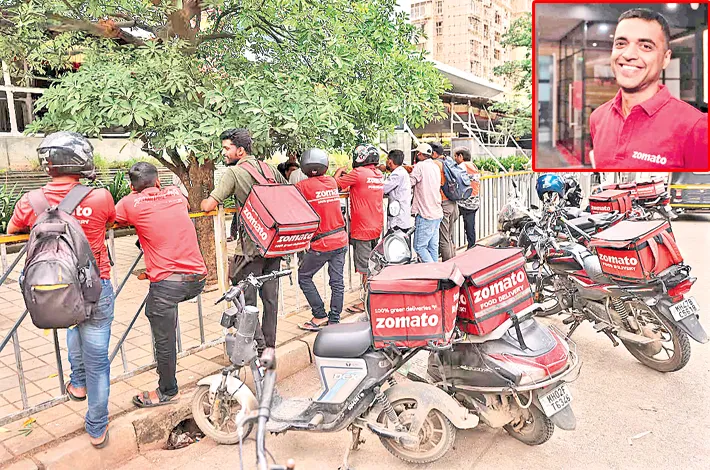
A statement by Zomato CEO Deepinder Goyal on New Year's Day has sparked intense controversy across India, highlighting deep divisions over the treatment of gig workers in the country's booming delivery and quick-commerce sector. On January 1, Goyal took to social media to announce that Zomato and its quick-commerce arm Blinkit achieved record-breaking performance on New Year's Eve (December 31, 2025), despite calls for a nationwide strike by gig workers. He reported that more than 4.5 lakh delivery partners fulfilled over 75 lakh orders for more than 63 lakh customers — an all-time high — without any additional incentives beyond the usual New Year's Eve payouts.
Goyal credited the smooth operations to the dedication of delivery partners who "showed up despite intimidation" and to support from local law enforcement, which he said helped keep a "small number of miscreants" in check. Goyal further defended the gig economy model, arguing that if the system were "fundamentally unfair," it would not attract and retain so many workers. He urged the public not to be swayed by "narratives pushed by vested interests" and described the platform as one of India's largest organized job creation engines, particularly for unskilled labor in a country with high unemployment.
The comments came in response to a nationwide strike called by unions such as the Gig and Platform Service Workers Union and the Indian Federation of App-Based Transport Workers on December 31, 2025. The action followed earlier protests on December 25 and was aimed at pressing demands for better working conditions amid the rise of ultra-fast delivery models. Gig workers across platforms like Zomato, Blinkit, Swiggy, and others are demanding an end to the 10- to 20-minute delivery mandates, which they say pose serious safety risks by encouraging rushed driving. Other key demands include a minimum per-kilometre pay of Rs 20, a guaranteed minimum monthly earning of Rs 40,000, maternity benefits and emergency leaves (especially for female workers), recognition as employees under labour laws rather than mere "partners," abolition of peak-hour pressures and performance penalties, and compensation for customer cancellations without impacting metrics.
Goyal's use of "miscreants" to describe disruptors — whom he later clarified as largely former partners terminated for abuse or fraud, allegedly instigated by political interests — drew sharp backlash. Critics, including politicians like Aam Aadmi Party’s MP Raghav Chadha, accused him of dismissing legitimate labor demands as law-and-order issues and labelling protesting workers derogatorily. Social media erupted with calls for boycotts, while unions claimed the high volumes reflected worker desperation amid falling payouts. A leader of Gig and Platform Workers Union, countered by highlighting the lack of transparency in earnings data, short tenures for many workers, and the real pressures they face, including low per-order pay and arbitrary penalties.
He emphasized that the system's design often leaves workers with little choice. A senior executive at a recruitment and HR firm traced the evolution of platform-based gig work in India over the last 15 years, noting that early models offered fixed hourly or daily rates due to lower volumes. As order density grew, platforms shifted to per-order or per-ride payments, benefiting both sides through flexibility and variable costs. He acknowledged four key challenges: stagnant wages relative to inflation, safety risks from rushed 10-minute deliveries (a phenomenon largely post-2020), inadequate social security (despite recent labour code provisions), and lack of transparency in penalties and deactivations.
He noted that gig workers, often working 9 hours a day for 26 days a month, typically earn between Rs 20,000 and Rs 40,000 monthly, aiming for around Rs 1,000 per day after personal expenses like fuel and vehicle depreciation. While no statutory minimum wage currently applies specifically to gig workers, he suggested the need for a "living wage" framework that better reflects actual living costs, especially in urban areas.
A startup investment consultant called for a balanced redesign of incentives, criticizing the current model as skewed toward investors and CEOs. He warned that portraying the company as "squeezing" workers — akin to Walmart's reputation — is unsustainable ethically and practically, leading to high turnover costs. He advocated for "compassionate capitalism" with better protections, arguing that workers' limited choices reflect broader economic constraints rather than true voluntarism.
The debate revealed no clear "winner" in this grey area. While the gig economy provides rapid employment for millions in a country with high unskilled labour, persistent concerns about fair pay, safety, and social security remain. Goyal's posts defended the model's flexibility and job creation potential, but critics and unions argue for structural reforms to ensure dignity and sustainability for workers.