22 September, 2026 | 4:21 PM


Elections 2026- Tamil Nadu politics at cross roads
07-01-2026 12:00:00 AM
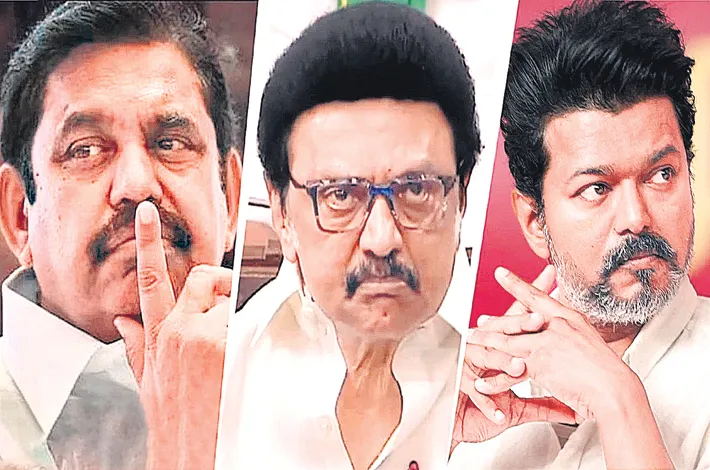
The political landscape in Tamil Nadu is heating up significantly as the state gears up for the crucial 2026 Assembly elections, with alliances shifting, welfare schemes being rolled out, and sharp exchanges dominating the discourse. Union Home Minister Amit Shah recently visited Tiruchirappalli (Trichy), delivering a strong message against the ruling DMK government led by Chief Minister M.K. Stalin.
Shah emphasized the need for a united NDA front to unseat the DMK, criticizing it for corruption, dynastic politics, and alleged failures in governance. He asserted that the NDA — comprising the BJP and its allies — would form the next government in the state, framing the battle as an ideological and anti-corruption fight rather than one centered on a single personality.
Notably, Shah did not meet AIADMK general secretary Edappadi K. Palaniswami (EPS) during the visit, sparking speculation about the BJP's intent to broaden the anti-DMK coalition by including other fragments, such as the AMMK and leaders like O. Panneerselvam, while asserting the NDA's collective strength over individual leadership. The DMK swiftly hit back, dismissing Shah's remarks as evidence of his limited understanding of Tamil Nadu politics.
Senior DMK leaders accused the BJP of pursuing an anti-Tamil and anti-Hindu narrative (in a twist on the usual accusations), insisting that the people of the state would reject the BJP's attempts to gain power, as they have historically done. In a major welfare push seen as a pre-election strategy, Chief Minister M.K. Stalin relaunched the free laptop scheme originally introduced by former AIADMK leader J. Jayalalithaa . This comes alongside other announcements, including a Rs 3,000 Pongal festival cash gift for ration card holders and the expansion of monthly assistance for women to cover more beneficiaries.
The moves are widely interpreted as efforts to consolidate support among youth, who may be increasingly drawn to emerging forces like actor Vijay's Tamilaga Vettri Kazhagam (TVK), which has positioned itself as a fresh alternative. The TVK responded critically to the Pongal cash announcement, calling it a desperate ploy born out of fear of defeat rather than a genuine solution to people's issues, further sharpening the DMK-TV K confrontation.
Meanwhile, tensions are brewing within the ruling INDIA bloc. Sections of the Tamil Nadu Congress have openly demanded a greater role, moving beyond mere seat-sharing to power-sharing in the state government if the alliance wins. Congress MP Manickam Tagore prominently stated that it is "time for share of power, not just share of seats," arguing that the party is not an NGO and has aspirations after decades out of direct power in the state.
A BJP spokesperson reaffirmed EPS as the NDA's chief ministerial face and highlighted the alliance's expansion plans, insisting it would form the government to counter the DMK's five-year rule. Congress leaders defended the power-sharing demands as natural political aspirations, while DMK described the alliance as a long-standing "marriage" with the Congress that remains solid, dismissing internal murmurs as routine negotiation and economic criticisms as isolated views refuted by data on Tamil Nadu's strong metrics like per capita GDP growth and fiscal health.
A DMK leader defended the government against corruption charges, pointing out the lack of convictions despite central agencies' probes and highlighting revenue growth as evidence of good governance. He countered BJP accusations of "family rule" by noting widespread nepotism across parties, including in BJP-ruled states, and emphasized that Udhayanidhi Stalin's elevation as Deputy CM stemmed from legislative support and electoral success. BJP leader and movie star Kasuri Shankar hit back, accusing the DMK of normalizing corruption at high levels and describing the state as suffering from "dynastic misrule" and a breakdown in law and order. The exchange of words highlighted ongoing narratives of corruption and family politics dominating the campaign.
A section of journalists and political analysts viewed the Congress push as strategic brinkmanship, leveraging the emergence of TVK as an alternative to negotiate better terms, such as more seats (potentially pushing beyond the previous 25). At the same time, there is another section which stresses the BJP's focus on unseating the DMK through a broad, stable alliance rather than personality-driven campaigns.
Adding intrigue, TVK has reiterated no alliance with BJP (its "ideological enemy") or DMK (its "political enemy"), positioning the contest primarily between DMK and TVK. However, sources indicate strong interest from a large number of Congress and AIADMK workers in tying up with TVK, provided Vijay is the CM face. With fluid alliances, public demands, and cultural events like Pongal being leveraged politically, Tamil Nadu's 2026 elections promise a multi-cornered, high-stakes battle. The coming months will test the ability of major players to unite their ranks and sway voters on issues of governance, corruption, and power-sharing. The people of Tamil Nadu will ultimately decide which narrative prevails.