21 September, 2026 | 11:06 AM


AP records robust growth in 2025
30-12-2025 12:29:58 AM
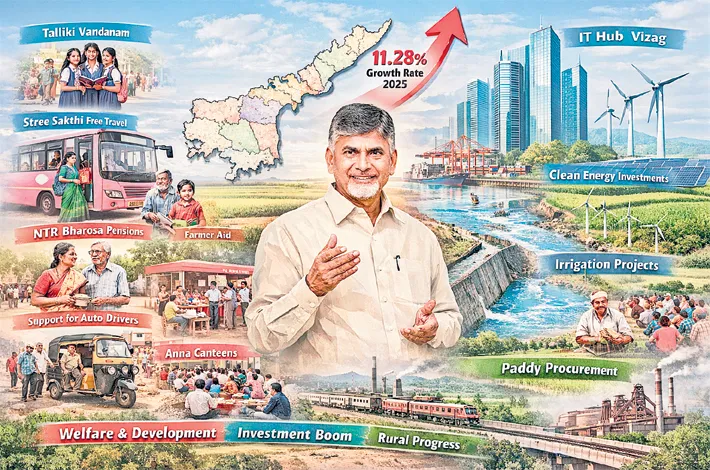
Andhra Pradesh recorded a robust growth rate of 11.28 per cent in 2025, reflecting rapid progress across sectors under the coalition government. The year marked a renewed focus on speed of governance, balancing welfare and development for the integrated growth of the State. Reviewing the year’s performance, the State Cabinet discussed achievements and future programmes, with Chief Minister N. Chandrababu Naidu directing ministers to ensure effective implementation of welfare schemes at the grassroots level.
Welfare Takes Centre Stage
The coalition government accorded top priority to welfare, rolling out the “Super Six” schemes, which quickly gained popularity. Under the Talliki Vandanam programme, financial assistance of Rs 10,090 crore was disbursed to benefit 67.27 lakh students.
Women empowerment received a major boost with the launch of the Stree Sakthi free travel scheme in RTC buses on August 15. So far, 3.25 crore women have availed free travel, with the government spending Rs 1,144 crore. Free travel was also extended to persons with disabilities. In addition, three free LPG cylinders per year were provided to nearly two crore women, involving an expenditure of Rs 2,684 crore.
Farmers benefited significantly, with Rs 6,310 crore credited directly into the accounts of 46 lakh farmers. Under the NTR Bharosa Pension Scheme, the government has spent nearly Rs 50,000 crore, distributing about Rs 33,000 crore annually or Rs 2,750 crore per month. The Fishermen Bharosa scheme provides Rs 20,000 per year to 1.25 lakh beneficiaries, with an allocation of Rs 250 crore.
To support traditional occupations, the government supplied 500 units of free power per month to power looms and 200 units to handlooms. Assistance of Rs 15,000 each was provided to 2.90 lakh auto drivers, costing Rs 436 crore. Food security was strengthened through 204 Anna Canteens, which have served over four crore subsidised meals.
Social Welfare Measures
Key social initiatives included 10 per cent reservation of liquor shops for toddy tappers, smooth implementation of SC categorisation, and the establishment of a separate corporation for goldsmiths. Minority welfare received Rs 3,670 crore, including monthly honorariums of Rs 5,000 for pastors, Rs 10,000 for Imams, and Rs 5,000 for Muezzins, with an annual allocation of Rs 90 crore. Priests’ salaries were enhanced to Rs 15,000, Nayee Brahmins to Rs 25,000, and junior lawyers received a Rs 10,000 honorarium.
Employment & Infrastructure
Employment generation was prioritised through the Mega DSC, resulting in the recruitment of 15,941 teachers and 5,757 constables. Gratuity benefits were extended to Anganwadi workers and ASHAs. Under Swarna Andhra and Swachha Andhra, nearly 84 lakh tonnes of garbage were cleared. The government spent Rs 1,000 crore on road repairs and Rs 3,000 crore on new road construction.
Investment Boom & Growth
Andhra Pradesh emerged as a top investment destination by introducing 23 industry-friendly policies, escrow accounts and investor facilitation mechanisms. At the CII Summit in Visakhapatnam, 610 MoUs were signed, attracting investments worth Rs 13.25 lakh crore and generating 16.13 lakh jobs. The State Investment Promotion Board approved investments of Rs 8.55 lakh crore across 13 meetings, while MSME parks were planned in all 175 Assembly constituencies.
Visakhapatnam is set to emerge as a global IT hub, with Google–Reliance data centres, expanded TCS operations, and the foundation stone for Cognizant. A Quantum Valley is also being developed in Amaravati.
Panchayati Raj, Water and Irrigation
The revival of Panchayati Raj saw 4,000 km of village roads taken up under Palle Panduga. A record 13,326 Gram Sabhas were held on a single day, initiating nearly 3,000 development works. Connectivity to tribal habitations was improved under Adivithalli Bata, along with the rollout of 4G networks in remote villages.
Under Amarajeevi Jaladhara, tap water connections will be provided to every household at a cost of Rs 3,050 crore, benefiting 1.21 crore people. In irrigation, the Handri Neeva canal expansion was completed in 100 days, groundwater levels rose by 6.08 metres, and progress accelerated on Polavaram, Veligonda, and Rayalaseema irrigation projects.
Agriculture, Health, Power and Governance
The State achieved record paddy procurement of 34.23 lakh metric tonnes, paying Rs 8,120 crore to 5.48 lakh farmers within 24 hours. Market intervention support exceeding Rs 1,100 crore was extended for crops like tobacco, mango, cocoa and onion.
Healthcare reforms included digital healthcare, a Universal Health Policy with the Gates Foundation and Tata Sanjeevani, while education saw reforms such as Mega Parent–Teacher Meetings, midday meal upgrades, student kits, transparent teacher transfers and health check-ups for 75 lakh students.
Power sector reforms aim to reduce unit costs from Rs 5.19 to Rs 4.80, attract Rs 3 lakh crore in clean energy investments, and provide free rooftop solar units to 20 lakh SC/ST families.
Speed of Governance & Central Support
Crime rates declined following a crackdown on drugs through the Eagle Task Force. Initiatives like WhatsApp Governance, data-driven decision-making, disaster preparedness, and a three-region development strategy—Visakhapatnam, Amaravati and Tirupati—earned public appreciation. With strong Centre–State coordination, Andhra Pradesh secured support of Rs 11,440 crore for the Vizag Steel Plant and nearly Rs 1 lakh crore for national highways and railway projects. The State also decided to reorganise districts, increasing their number from 26 to 28 with public consent.