14 October, 2026 | 2:30 PM


Click, Order, Protest Gig Workers Take on Big Apps
31-12-2025 12:00:00 AM
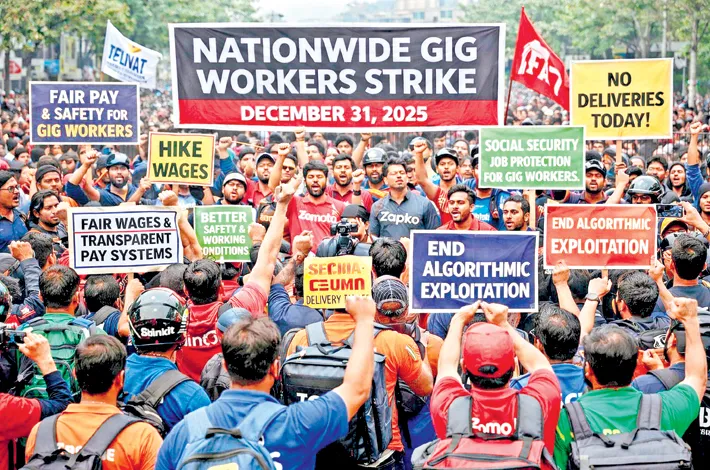
As India prepares to welcome the New Year, a nationwide strike announced by gig workers has brought renewed attention to the realities behind the country’s fast-growing platform economy. Delivery executives, cab drivers and home service providers working with platforms such as Swiggy, Zomato, Amazon, Flipkart, Blinkit and Zepto have called for a strike on December 31, 2025, following a similar protest on Christmas Day. Led by organisations including the Indian Federation of App-based Transport Workers and the Telangana Gig and Platform Workers Union, the agitation has triggered a broader debate on worker rights, safety and fairness in app-based employment.
The timing of the strike, during the peak festive season, is expected to affect consumers who rely heavily on online services for food, groceries and transport. During the December 25 strike, disruptions were reported in several regions, including Gujarat, Maharashtra, Delhi and Noida. Union leaders argue that festivals generate record revenues for platform companies, while gig workers face rising workloads, shrinking earnings and growing uncertainty.
According to the unions, working conditions in the gig sector have steadily deteriorated. Workers complain of long and irregular hours, frequent changes in incentive policies and sudden account suspensions without clear justification. They allege that opaque, algorithm-driven systems determine pay, ratings and order allocation, leaving workers with little control over their incomes. Despite being essential to last-mile delivery, gig workers say they remain outside the protection of standard labour laws.
Safety has emerged as a major concern, particularly during winter. Unions have demanded restrictions on late-night deliveries after 11 p.m. in fog-prone conditions, citing increased risks of accidents due to poor visibility. They are also calling for an end to ultra-fast delivery models, such as 10-minute guarantees, which they say promote reckless driving in congested urban areas. Other key demands include wages aligned with minimum wage standards, a transparent per-kilometre pay system for ride-hailing drivers, an eight-hour workday with overtime pay and access to comprehensive social security, including health and accident insurance.
The strike comes as the Union government moves to formally recognise gig and platform workers through labour reforms. Proposed measures under the Social Security Code include welfare funds, Aadhaar-linked universal account numbers and benefits such as health, accident and maternity coverage. While unions have welcomed the intent behind these proposals, they argue that the reforms do not adequately address crucial issues such as guaranteed minimum wages, safety enforcement and protection from arbitrary deactivation by platforms.
Legal experts have offered a counterpoint to the strike-led approach. A senior Supreme Court lawyer noted that under the Social Security Code of 2020, gig workers are not classified as traditional employees and therefore fall outside the scope of minimum wage laws, which are governed by states. While acknowledging exploitation within the sector, he cautioned that repeated strikes could discourage investment and accelerate automation, potentially leading to increased reliance on AI and robotic delivery systems in the coming years.
The lawyer suggested alternative strategies such as sustained dialogue with labour departments, legal challenges to unfair contractual terms and the use of media campaigns to expose exploitative practices. He also criticised rapid delivery models, arguing that they compromise public safety by encouraging risky driving, and urged lawmakers to consider banning such practices altogether.
Unions, however, maintain that strikes are a last resort after repeated attempts to engage with platform companies failed to produce results. They point to the Christmas Day strike as evidence that collective action can disrupt operations and force public attention on demands for dignity, safety and social security. Union leaders have dismissed the idea that robots can replace human workers in India’s complex urban environments, citing poor infrastructure and unpredictable traffic conditions.
Workers have also raised allegations of exploitative practices at the ground level, including claims that store managers sometimes accept orders on riders’ devices without consent, exposing them to penalties if deliveries are delayed. They further allege that platforms operate separate algorithms for customers and workers, offering speed and discounts to users while penalising workers for delays and low ratings.
As India’s platform economy continues to expand rapidly, the strike has highlighted a deeper dilemma: whether a business model built on speed and convenience can coexist with fair wages and safe working conditions. The New Year’s Eve protest underscores the urgency of finding a balance that protects workers without undermining innovation or growth.