22 October, 2026 | 11:42 PM


Dr. BR Ambedkar & Indian Rupee
14-04-2026 12:00:00 AM
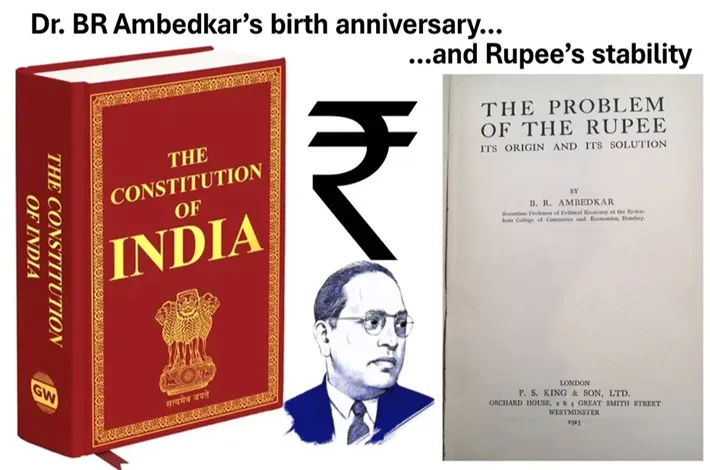
Dr. BR Ambedkar was a multifaceted economist and rendered valuable contributions. He was the chairman of Indian Constitution’s 7-members drafting committee. Dr. Ambedkar played key role in adopting and refining the draft authored by the constitutional expert BN Rau. The refined version became formal constitution for the world’s largest democratic country. Ambedkar supported unique mixed economy system for India with state-led industrialization and licensing mechanism for private sector.
Until World War 1, Indian Rupee had a stable exchange rate situation. But it suffered systemic challenges and experienced huge volatility with the war. British government fixed artificial high value for Rupee. The overvaluation helped British Officials to convert fewer Rupees for more Shillings and remit to UK. Thus, India used to give them more Shillings at the cost of Indian domestic purchasing power.
Also, overvaluation of Rupee is effectively undervaluing goods within India. This double whammy weakened Indian monetary system. On receipt of complaints and representations, British formed ‘The Royal Commission on Indian Currency and Finance’ in year 1926. Dr. Ambedkar was not a member in the Commission.
But he was consulted on most of the terms due to his doctoral research work at London School of Economics (LSE) on same issues. That thesis of Dr. Ambedkar published in year 1923 as ‘The Problem of the Rupee: Its origin and its solution’ brought him global recognition as an expert on monetary and economic aspects. For the Hilton Young Commission, the book had almost all the solutions the Commission had to finally find.
Dr. Ambedkar formally testified before the Commission that India should have a central bank. He supported that the central bank should have monopoly over currency issue, should be the banker to commercial banks and to the government. Having noted his views, the Commission’s report favored stabilizing Rupee, and centralized management of currency and banking reserves. Commission’s report resulted in the enactment of Reserve Bank of India (RBI) Act 1934 and creation of RBI on 1st April 1935.
While insisting that currency issuance should be monopoly of nation’s central bank, Dr. Ambedkar explained how unrestricted minting of currency by government causes economic problems internally. On external front, he explained that without backing of gold standard, rigidly pegging exchange rate of Rupee to Pound Sterling is unreliable and is a manipulation. He advocated in favor of stable purchasing power of Rupee than stable exchange rates.
As Dr. Ambedkar’s Birth Anniversary will be commemorated on 14th April, the challenges of stability, fair exchange rate, and value for the Rupee continue.
-Dr. Kishore Nuthalapati
CFO, BEKEM Infra Projects Pvt Ltd