31 August, 2026 | 3:40 PM


Economic survey 2026 Is the picture really bright?
31-01-2026 12:00:00 AM
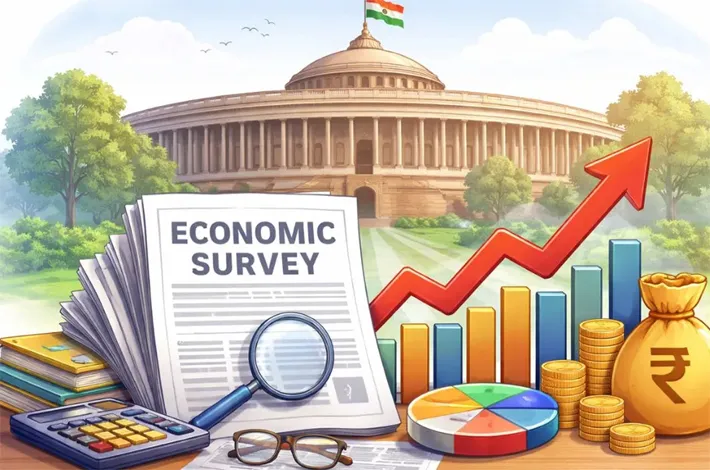
The Economic Survey 2025-26, tabled in Parliament by Finance Minister Nirmala Sitharaman on January 29, 2026, presents a cautiously optimistic assessment of India's economy amid persistent global uncertainties. The document reaffirms India's position as the fastest-growing major economy for the fourth consecutive year, highlighting robust domestic fundamentals despite geopolitical tensions, trade fragmentation and financial market volatility.
According to the survey's First Advance Estimates, real GDP growth for FY26 stands at 7.4%, with Gross Value Added (GVA) at 7.3%. The medium-term potential growth rate has been revised upward to around 7%, reflecting sustained reforms, policy stability, and structural improvements. For FY27, growth is projected in the range of 6.8% to 7.2%. The survey describes this as a period of "steady momentum with caution, not pessimism," emphasizing that India's performance stands out positively against other major economies in a geopolitically divided world.
Key drivers include robust domestic demand, with Private Final Consumption Expenditure reaching a decade-high of 61.5% of GDP, fueled by low inflation—headline CPI averaged just 1.7% from April to December 2025—and stable employment. Investment grew by 7.8%, with broad-based sectoral gains. The banking sector has shown remarkable improvement, with Gross Non-Performing Assets (GNPA) declining to a multi-decade low of 2.2% in September 2025, reflecting healthier balance sheets and higher recovery rates. Exports have achieved record levels through market diversification, while fiscal prudence keeps the government on track to meet its 4.4% GDP fiscal deficit target.
The survey advocates for continued reforms to elevate potential GDP, including deregulation, full implementation of labor codes, logistics enhancements, and efficiency gains. It highlights opportunities in global supply chain shifts via Free Trade Agreements (FTAs) to boost manufacturing competitiveness. Chief Economic Adviser V. Anantha Nageswaran described "Swadeshi" (self-reliance) as a legitimate and disciplined policy tool when global trade is no longer reciprocal and markets are not neutral—positioning it as strategic resilience rather than blanket protectionism, particularly in critical sectors like batteries, magnets, and solar, while phasing import substitution where viable.
The rupee's depreciation to around 92 per dollar was noted as not accurately reflecting India's strong fundamentals, with the survey stating it is "punching below its weight." Nageswaran emphasized that such movements align with trends in other emerging markets and stem from global factors rather than domestic weaknesses, though building manufacturing strength could strengthen the currency over time. Investor caution despite favorable growth and controlled inflation was flagged for further examination, given India's reliance on foreign capital for balance of payments stability.
In post-tabling discussions and briefings, experts provided nuanced perspectives. A senior economist described the survey as balanced, acknowledging economic security amid Trump-era tariffs, geopolitical risks, an potential AI bubble, rupee underperformance, and the need for urbanization to create growth centers, while praising export diversification and social protection expansions. A finance Professor highlighted bullish recent-quarter trends in GDP, tax collections, and fiscal prudence, expressing optimism that FY27 projections could be surpassed through increased developmental capex, equitable sectoral growth, and effective use of FTAs—viewing the document as a strong foundation for the upcoming Budget.
Principal Economist at a private bank outlined key risks, particularly from the external front. She referenced the survey's scenarios, warning that lingering uncertainties like trade tariffs and geopolitical tensions could drag exports and trigger capital outflows, rupee pressures and liquidity issues. With a 40-45% probability of escalation in some cases, she argued India is not fully immune despite strong fundamentals. She suggested the Budget focus on bolstering macro confidence, attracting capital (e.g., via tax rationalization on withholding or capital gains), and addressing structural issues like skilling and labor productivity.
A senior journalist interpreted "Swadeshi" in this context as targeted import substitution, especially in defense (boosting domestic content in acquisitions) and oil (developing new finds like in the Andaman region to reduce import dependence). He noted that FTAs, including with the EU and potentially the US, could significantly lift exports and integrate India deeper into global value chains, potentially pushing growth beyond 7.5% when combined with domestic strengths.
A retired top executive of RBI delved into the survey's emphasis on capital issues, arguing that lowering rates alone won't suffice—it's a structural problem requiring export surplus ambitions, policy certainty, predictability, and productivity gains in manufacturing to achieve current account surplus and reduce the cost of capital. He noted that despite positive macro performance, global markets have not fully rewarded India with stable capital flows or currency strength.
On fiscal balancing amid geopolitical revenue impacts and consumption support, a top executive from a securities trading firm viewed the government's approach as prioritizing consolidation, likely targeting a debt-to-GDP ratio near 55% and fiscal deficit around 4.2% in FY27. This would allow sustained capex (11-12 lakh crore levels) while passing the baton to private participation. Nominal growth pickup (aided by stabilizing inflation and 7% real growth) should improve tax trends.
The survey urges a stance of "strategic sovereignty" over defensive pessimism, prioritizing domestic growth maximization, shock absorption, buffers, redundancy, and liquidity in an enduringly turbulent external environment. It stresses that policy credibility, predictability, and administrative discipline must evolve into core strategic assets, with India needing to "run a marathon as if it were a sprint" to maximize resilience and potential in a geopolitically divided world. The document sets a forward-looking tone ahead of the Union Budget presentation.