23 October, 2026 | 4:38 AM


Irregularities in Polavaram?
10-08-2026 12:00:00 AM
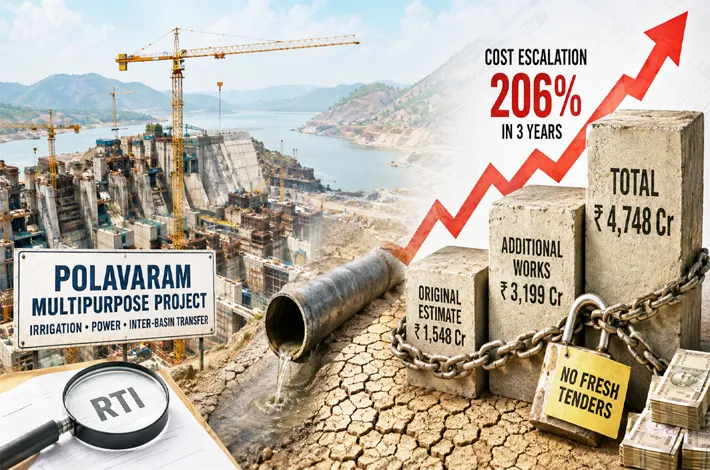
Cost estimation balloons to 206 per cent in three years
- Plundering Polavaram
- Actual works are few, side works many
- Reverse tendering
- Entrusting additional works worth over Rs 3,199 crore
- 206% increase in the value of construction works
metro india news I Amaravati
The Polavaram Multipurpose Project, long hailed as a transformative boon for Andhra Pradesh, has instead become a striking example of how public funds can cascade far ahead of the water it is meant to deliver.
As successive governments have come and gone, the project’s construction has been marked by repeated changes of contractors, the systematic addition of supplementary works, and what critics describe as an aggressive extraction of additional payments. What began as a strategically vital irrigation, power, and inter-basin transfer scheme has, according to information obtained under the Right to Information Act, seen its cost estimates balloon by approximately 206 per cent in just three years.
The pattern that has emerged is one in which core construction packages are awarded, only for a flood of ‘extra’ items to be layered on without fresh competitive bidding, raising serious questions about transparency, accountability, and the ultimate benefit to the public. When the new government assumed office following the 2019 Andhra Pradesh elections, works valued at roughly Rs 1,771.11 crore remained pending on the main construction packages of the Polavaram Project. Almost immediately, the incoming administration alleged irregularities and malpractices in the ongoing contracts and removed the existing contractor.
Fresh tenders were invited for the residual works—a process the government itself characterised as reverse tendering. After evaluating the bids, authorities awarded the package to a prominent engineering and construction company that had quoted 12 per cent below the estimated cost. This reduction was publicly projected as a saving of Rs 222.87 crore for the state exchequer. Officials at the time further asserted that, after deducting the savings, the remaining works could be completed for Rs 1,548.24 crore. That claim of fiscal prudence proved short-lived. Once the new contractor was in place, a series of additional allocations began.
Authorities determined that 41 works had not been executed in accordance with the original designs and required corrective measures; Rs 914.59 crore was sanctioned for this purpose. A further Rs 669.48 crore was allocated for additional works. Most significantly, Rs 1,615.76 crore was added for improved protection of the critical gap in the upper coffer dam—an item described as essential to the project’s structural integrity. These successive increments pushed the cumulative value of the works to Rs 4,748.07 crore.
Within a span of only three years, the cost of the residual package had risen by 206 per cent, a scale of escalation that has astonished observers and drawn sharp public attention.The Right to Information disclosures make the arithmetic unambiguous. While reverse tendering was celebrated for delivering a saving of Rs 222.87 crore, the subsequent addition of works worth Rs 3,199.83 crore—and the corresponding bill payments—effectively erased that benefit many times over.
Nine supplementary agreements were executed during this period. Under standard procurement norms, additional works up to 10 per cent of the original contract value may ordinarily be entrusted to the same contractor. Once that threshold is crossed, fresh tenders are required. In the case of Polavaram, the increase reached 206 per cent, yet every supplementary package continued to be awarded to the contractor selected through reverse tendering. No new competitive bidding process was initiated.
The analogy is straightforward. If a homeowner contracts a builder for the construction of a house and later decides to add a single door, entrusting that modest extra item to the same builder is unremarkable. But if the builder is subsequently handed the entire remaining structure—windows, floors, roofing, and finishing—under the label of “additional works” without inviting fresh quotes, the arrangement invites legitimate suspicion. That is precisely the sequence that appears to have unfolded at Polavaram: a residual package of Rs 1,548 crore was awarded through reverse tendering, after which works exceeding Rs 3,199 crore were appended without open competition.
The absence of fresh tenders despite an escalation far beyond the conventional 10 per cent limit has fuelled demands for a thorough independent inquiry.Beyond the financial irregularities, the project itself is already running four years behind schedule. The original objectives were ambitious and socially significant: irrigation coverage for 4.36 lakh hectares, generation of 960 megawatts of hydropower, supply of drinking water to 611 villages, and the inter-linking of the Godavari and Krishna rivers.
None of these benefits has yet reached the intended beneficiaries. Changes of government, successive contractor replacements, and the progressive loading of extra items have combined to inflate costs year after year. Preferential allocation of work to favoured contractors and the unconstrained expansion of expenditure have resulted in the diversion of public resources and the persistent denial of promised outcomes to farmers, households, and the regional economy.
If the present trajectory continues unchecked and if the allegations of procedural violations are not subjected to rigorous investigation, the Polavaram Project risks becoming less an instrument of development and more a perpetual mechanism for the transfer of public funds. What was conceived as a multipurpose engineering achievement of national importance is in danger of being reduced to a golden goose for a limited circle of political and contracting interests.
The water that was meant to flow into the fields and homes of Andhra Pradesh remains distant; the funds, by contrast, continue to flood. A transparent, time-bound audit and accountability process is essential if the project is ever to deliver the benefits for which it was originally sanctioned.