11 October, 2026 | 1:09 PM


Joseph Replaces Stalin
11-05-2026 12:00:00 AM
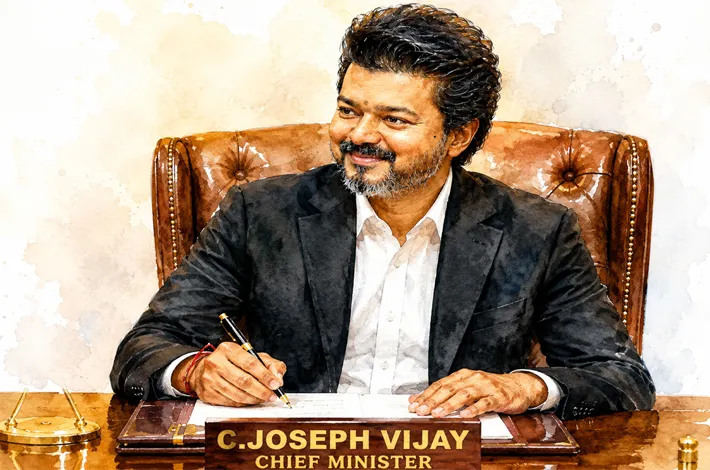
Vijay sworn in as first non-dravidian chief minister in nearly six decades
In his maiden address as Chief Minister, Vijay struck a humble still resolute tone. “I am a common man, not from any royal lineage. That is why the people have accepted me.”
metro india news I Chennai
In a landmark moment that has upended Tamil Nadu’s political landscape, Tamilaga Vettri Kazhagam (TVK) chief C. Joseph Vijay was sworn in as the state’s Chief Minister today at the Jawaharlal Nehru Indoor Stadium in Chennai.
Administered the oath of office and secrecy by Governor Rajendra Vishwanath Arlekar amid thunderous cheers from thousands of supporters, Vijay’s ascension marks the first time since 1967 that Tamil Nadu will be governed by a non-Dravidian party and leader, ending the decades-long duopoly of the DMK and AIADMK.
The 51-year-old superstar, affectionately known as “Thalapathy” to his legions of fans, led his fledgling party to a stunning debut victory in the May 4 Assembly elections. TVK secured 108 seats in the 234-member house, emerging as the single largest party though falling short of the 118-seat majority. With support from allies including the Congress and other smaller parties, Vijay staked claim to form the government, navigating intense backchannel negotiations and preventing last-ditch efforts by the Dravidian majors to block his path.
In his maiden address as Chief Minister, Vijay struck a humble still resolute tone. “I am a common man, not from any royal lineage. That is why the people have accepted me,” he declared, positioning himself as an outsider untainted by dynastic politics. He promised an “era of real, secular, social justice,” criticized the previous regime’s unfulfilled pledges, and vowed transparent governance. Immediate measures announced include free electricity up to 200 units for domestic consumers, signaling a focus on welfare.
The rise of a political phenomenon
Joseph Vijay Chandrasekhar, born in 1974, built a cinematic empire over three decades with blockbuster films like Ghilli, Thuppakki, Mersal, and Leo, often weaving social messages on corruption, caste, and inequality into high-octane entertainment. His transition to politics began in earnest around 2024 with the launch of TVK, a party whose name translates to “Tamil People’s Victory Force.” What started as a fan-driven movement quickly gained traction through Vijay’s massive public rallies, meticulous organizational groundwork, and a narrative of anti-corruption and youth empowerment.
Analysts point to several factors behind TVK’s “blockbuster” debut. Vijay’s pan-Tamil appeal cut across caste, class, urban-rural divides, and age groups. His party’s 35% vote share outperformed the DMK’s 24% and AIADMK’s 21%, with TVK polling nearly 1.7 crore votes. The Dravidian parties, long alternating power since the late 1960s, suffered their worst showing in decades. DMK, led by M.K. Stalin, was reduced to around 59 seats, while AIADMK under Edappadi K. Palaniswami managed about 47.
The 1967 elections had ushered in the Dravidian era when C.N. Annadurai’s DMK defeated the Congress, championing Tamil identity, social justice, and federalism against perceived North Indian dominance. Subsequent governments under leaders like M. Karunanidhi, M.G. Ramachandran (MGR), and J. Jayalalithaa entrenched this dominance. MGR and Jayalalithaa, like Vijay, were film stars, but operated within the AIADMK framework. Vijay’s success breaks this mold entirely.
Challenges ahead
Forming and sustaining the government poses immediate tests. With 108 seats, TVK relies on post-poll allies. Congress has extended support, with Rahul Gandhi attending the swearing-in, but conditions reportedly include avoiding any ties with the BJP. Vijay has emphasized secularism and distanced himself from divisive politics. A trust vote is expected soon in the Assembly.
Key issues confronting the new administration include industrial revival, youth unemployment, agrarian distress, and maintaining Tamil Nadu’s reputation as an investment destination. Critics question Vijay’s administrative experience, but supporters highlight his disciplined image, philanthropic efforts, and ability to mobilize masses. “This is not cinema; this is governance,” Vijay acknowledged in his speech, requesting time from the people to deliver results.
Reactions poured in from across the political spectrum. Former Chief Minister M.K. Stalin congratulated Vijay while expressing hope for continuity in social welfare schemes. AIADMK leaders called for introspection.
National leaders, including Prime Minister Narendra Modi, extended wishes for a stable government focused on development. Film fraternity icons and celebrities celebrated the “people’s victory.”
A new chapter for Tamil politics
Vijay’s swearing-in has been described as a seismic shift. For the first time in 59 years, a party without “Dravidian” in its name or ideology holds power. TVK’s manifesto emphasized education reform, women’s safety, anti-corruption technology, and Tamil cultural pride without the overt separatism of earlier eras. Whether this translates into effective policy remains to be seen, but the mandate reflects voter fatigue with entrenched dynasties and a craving for fresh leadership.
As Vijay assumes office, Chennai’s streets buzz with optimism mixed with curiosity. Supporters waved “Thalapathy” banners and lit firecrackers outside the stadium. Political observers note that while star power opened the door, sustaining power will require coalition management, bureaucratic reform, and tangible deliverables.
Tamil Nadu stands at a crossroads. The Dravidian model delivered literacy gains, social upliftment, and industrial growth, but faced accusations of corruption, family politics, and stagnation. Vijay’s government represents an experiment in “people-centric” politics inspired by cinematic heroism meeting administrative reality.
In his closing remarks today, the new Chief Minister said, “I am not an angel. I will make mistakes, but I will not deceive the people.” With that pragmatic pledge, C. Joseph Vijay embarks on a journey that could redefine Tamil Nadu for generations. The cameras that once captured his on-screen victories now turn to a real-life political saga whose script is still being written.