23 September, 2026 | 7:20 PM


Key allies question Congress- tension in INDI block?
04-01-2026 12:00:00 AM
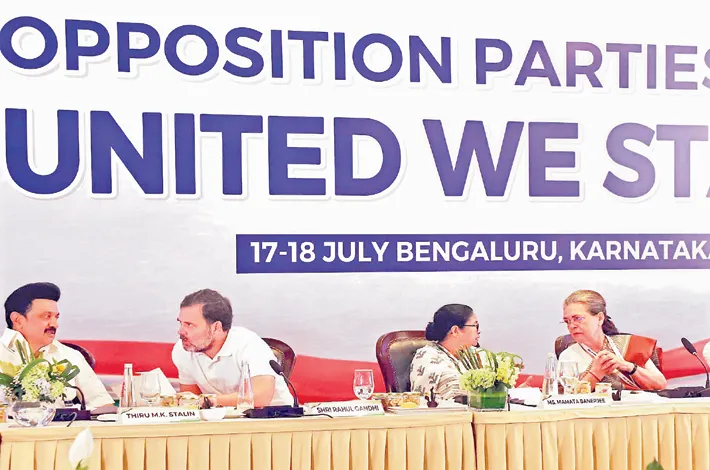
Fresh cracks have emerged in the opposition INDIA bloc, with recent public criticisms from key constituents highlighting growing frustration with the Congress party's role as the alliance's anchor. Trinamool Congress (TMC) national general secretary Abhishek Banerjee has sharply blamed Congress for contributing to opposition setbacks in recent state elections, including Haryana, Maharashtra and Bihar where the BJP achieved dominant victories.
Banerjee's remarks, made amid ongoing disputes over voter list revisions in West Bengal, accused the opposition of failing to aggressively challenge alleged electoral manipulations on the ground, leading to losses despite public support. He emphasized that such failures have weakened the INDIA bloc's unity, prompting questions about whether Congress has become more of a liability than a unifying force.
In Kerala, which is heading to polls in 2026, the Left Democratic Front (LDF) has intensified its critique of the Congress-led United Democratic Front (UDF) for failing to offer a credible governance alternative. Recent local body election results showed significant gains for the UDF and erosion for the LDF, but ongoing ideological clashes and criticisms from Left leaders underscore deeper contradictions in the national INDIA framework.
Adding fuel to the fire, Congress functionary Praveen Chakravarty sparked controversy by describing Tamil Nadu's debt under the DMK government as "alarming," claiming it now exceeds Uttar Pradesh's and remains higher than pre-COVID levels. The remarks drew fierce backlash from DMK leaders, who accused him of distorting facts and sowing confusion in the alliance. Tamil Nadu Congress distanced itself from Chakravarty's views, with state president K. Selvaperunthagai calling them "unacceptable" and filing a complaint with the party high command.
BJP, on the other hand, launched a scathing attack, describing the INDIA alliance as plagued by "commission, confusion, corruption, and ambition for position." A party spokesperson argued it lacks a shared vision, leader, or ideology—unlike the NDA under Prime Minister Narendra Modi—and accused Congress of opportunism, blackmailing allies for more seats (as seen in Bihar), and hypocrisy on issues like EVMs and vote chori. He highlighted contradictions: parties opposing each other in states like Bengal and Kerala but aligning nationally for "optics" at events like birthdays or protests. He called Congress "political kryptonite" for its allies, predicting further defections.
Congress leaders defended the bloc, crediting it for reducing the NDA to 240 seats in the 2024 Lok Sabha elections. They stressed that seat adjustments and negotiations are normal in alliances, reiterated Rahul Gandhi's evidence-based concerns over electoral irregularities (including voter list anomalies), and highlighted Congress's national strength with over 100 Lok Sabha MPs, presence in multiple state governments, and governance record. They dismissed claims of alienation, asserting strong ties with DMK and emphasizing that criticisms arise during power-sharing discussions but do not threaten the alliance.
TMC supporter and political analyst Manojit Mandal downplayed certain attacks, particularly from former Congress leader Adhir Ranjan Chowdhury, who accused TMC of "vote chori." He accused BJP of hypocrisy on political morality, citing alliances with parties it previously criticized. The whole episode exposed core contradictions: no agreed leader (with regional parties rejecting Rahul Gandhi as PM face), opportunistic alignments (e.g., Left-Congress rivalry in Kerala but alliance elsewhere), and state-specific priorities over national unity.
While some view these as temporary election-season rifts, others see structural flaws that could undermine the bloc's prospects in 2026. As regional heavyweights like TMC, DMK, and others focus on their strongholds, the INDIA bloc's ability to reconcile differences—on leadership, seat-sharing, and common issues—remains in question. With BJP capitalizing on these divisions, the coming months will test whether the opposition can transform from a loose coalition into a formidable united front.