18 September, 2026 | 11:16 AM


MGNREGA to VB-G RAM G
17-12-2025 12:00:00 AM
Progress or Political Repackaging?
- Work Days: 125 guaranteed per household, up from 100
- Cost Burden: States now cover 40% of total wages
- Funding Model: Fixed allocations replace demand-driven system
- Seasonal Break: Work can pause 60 days during harvest
- Digital Oversight: Aadhaar payments and geotagged assets mandatory
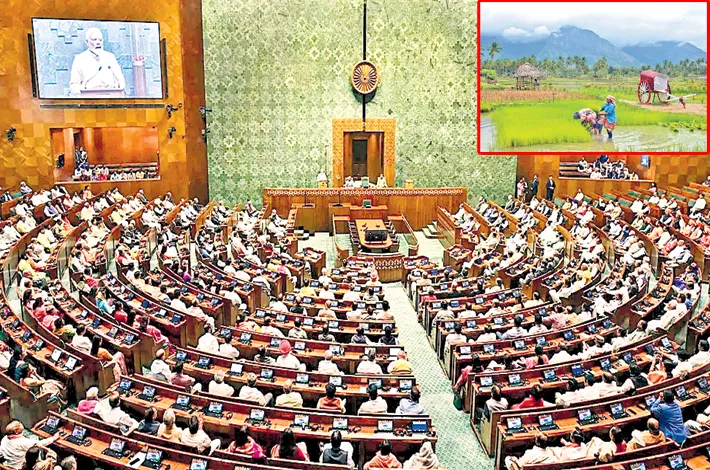
The Union government’s decision to repeal the Mahatma Gandhi National Rural Employment Guarantee Act (MGNREGA) and replace it with the Viksit Bharat—Guarantee for Rozgar and Ajeevika Mission (Gramin) Bill, 2025 has ignited a sharp political and ideological debate in Parliament and beyond. Touted by the government as a forward-looking reform aligned with the Viksit Bharat 2047 vision, the proposed VB-G RAM G framework has been branded by critics as a quiet burial of India’s most ambitious rights-based welfare law.
At the heart of the bill is an apparent expansion of entitlement. The new law guarantees 125 days of wage employment annually to rural households willing to undertake unskilled manual work, up from the current 100 days under MGNREGA. The government argues this enhancement reflects its commitment to rural livelihoods while shifting the programme’s emphasis toward durable asset creation, including water conservation, core rural infrastructure, livelihood-linked works, and climate-resilient projects. These works, according to the bill, will be aggregated into a national rural infrastructure stack, backed by GIS mapping, PM Gati Shakti layers, and digital monitoring to improve planning and accountability.
However, beneath the promise of more workdays lies a structural overhaul that has alarmed opposition parties, worker unions, and even architects of the original 2005 law. The most contentious change is the funding pattern. Under MGNREGA, the Centre bears 100 percent of unskilled wage costs, reinforcing the scheme’s character as a legally guaranteed right. The proposed VB-G RAM G shifts to a 60:40 Centre-state cost-sharing model for most states, with exceptions only for the Northeastern states, Himalayan regions, and Jammu and Kashmir, where a 90:10 ratio will continue.
Critics argue that this single change fundamentally alters the nature of the scheme. They contend that financially stressed states may hesitate to generate employment demand if they must shoulder a significant portion of the costs, effectively weakening the guarantee itself. Equally controversial is the move away from MGNREGA’s demand-driven design. Under the new framework, allocations will be fixed in advance by the Centre based on prescribed parameters, eliminating the provision for supplementary funding during emergencies such as droughts, floods, or pandemics, periods when MGNREGA has historically acted as a rural lifeline.
Adding to the unease is a clause allowing work to be paused for up to 60 days during peak agricultural seasons. While the government says this ensures labour availability for farming, opponents see it as an erosion of workers’ bargaining power, one of MGNREGA’s most transformative effects in rural labour markets. Mandatory Aadhaar-based payments and geotagging of assets have also been made statutory, raising concerns about exclusion due to technical failures, despite the government insisting these measures will curb leakages and improve transparency.
The political backlash has been fierce. CPI(M) Rajya Sabha MP John Brittas described the bill as the “sad demise” of a rights-based employment guarantee, warning that it converts MGNREGA into a typical centrally sponsored scheme where states bear the burden and the Centre claims credit. He said the removal of Mahatma Gandhi’s name was not merely symbolic but reflective of a deeper hollowing out of the scheme’s moral and constitutional foundations.
Congress leaders echoed these concerns, accusing the government of prioritising rebranding over real reform. They questioned why the bill offers no mechanism for additional funding during crises, recalling how MGNREGA absorbed millions of distressed workers during the COVID-19 lockdowns. One Congress spokesperson argued that the BJP, which once opposed MGNREGA as fiscally irresponsible, is now attempting to appropriate and dilute it, erasing its association with the UPA government that introduced it.
Beyond party politics, labour unions and social activists have warned of potential legal challenges if the bill is passed. They argue that repealing a law that guarantees employment as a right, and replacing it with a capped, centrally controlled scheme, could amount to unconstitutional overreach. According to them, the proposed framework weakens decentralisation, sidelines panchayats, and recentralises decision-making under the guise of efficiency and digital governance.
The government, however, has mounted a robust defence. Rural Development Minister Shivraj Singh Chouhan acknowledged MGNREGA’s historical role but insisted that a 20-year-old framework needs modernisation. He said the new mission addresses long-standing criticisms of MGNREGA, including allegations of misuse, poor-quality assets, and fragmented works that fail to generate lasting economic value. According to the government, convergence, saturation, and outcome-oriented spending are essential for transforming rural India rather than merely providing subsistence employment.
BJP spokespersons have also dismissed accusations of erasing Gandhian legacy. They argue that Mahatma Gandhi’s ideals are reflected in outcomes, not nomenclature, pointing to initiatives such as Swachh Bharat and infrastructure-led rural development. Defending the renaming, party leaders claim the new framework enhances wages, reduces leakages, ensures faster payments, and aligns employment generation with national development priorities. They have even suggested that the acronym VB-G RAM G subtly reflects cultural values and Gandhi’s vision of Ram Rajya.
As the bill moves through Parliament, the debate has crystallised into a broader question about the future of welfare in India. Is VB-G RAM G a necessary upgrade that trades open-ended guarantees for structured development, or does it mark a retreat from the idea of employment as a legal right? While supporters hail it as a modern, accountable, infrastructure-driven mission, critics see a carefully branded rollback that shifts costs, caps entitlements, and centralises control. The clash over VB-G RAM G is no longer just about a name change, but about the soul of rural employment policy in India.