30 September, 2026 | 9:35 AM


Paradise Lost or Regained?
25-03-2026 12:00:00 AM

Amaravati at crossroads: New CRDA Commissioner appointed, but will leadership changes deliver results?
2 years 3 Commissioners
■ Will this present Commissioner also be changed?
■ First Commissioner was Kamma, second Kapur and now Raju…Next whom?
■ People are worried. If the project is not completed under TDP led NDA rule, if there is change of guard, there will be a permanent damage to Amaravati
■ People are asking who is responsible for the delay?
■ Why CM Chandrababu Naidu has not taken any action against the erring Ministers, officers, contractors?
■ People demand the government to come out with a detailed report on date wise completion of various projects in the state including the CRDA
kiranmai tutika I hyderabad
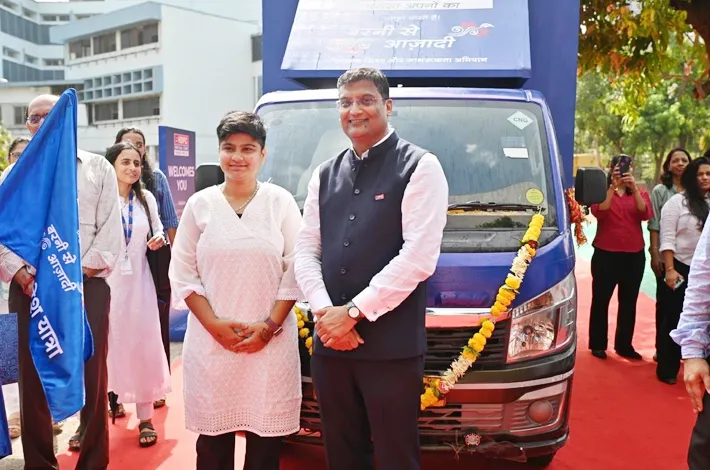
The Andhra Pradesh government has appointed V. Vijay Rama Raju as the new Commissioner of the Capital Region Development Authority (CRDA), marking yet another leadership transition in a department that sits at the heart of the state’s capital city ambitions. However, as administrative reshuffles continue, a critical question looms large, will a change in leadership finally translate into visible progress on the ground?
Since the Telugu Desam Party (TDP), along with its alliance partners Jana Sena and the BJP, returned to power in 2024, expectations across Amaravati and the wider state were high. The alliance had promised a revival of the capital city project, which had seen years of stagnation. Citizens anticipated rapid execution, large-scale infrastructure rollout, and a clear roadmap for Amaravati’s transformation into a world-class capital. Yet, nearly two years into governance, those expectations remain largely unmet.
The CRDA has witnessed a series of leadership changes during this period. Bhaskar Katamneni was initially appointed as Commissioner, but reportedly failed to align with Municipal Administration Minister Narayana, leading to his replacement. Kannababu, who succeeded him, was later relieved of his duties following what insiders describe as poor performance. Now, Vijay Rama Raju assumes charge at a time when both public patience and political stakes are running high.
Despite these changes, the reality on the ground tells a sobering story. Apart from the CRDA administrative office building in Amaravati, there is little visible large-scale construction. The gap between official claims and physical progress has become increasingly evident, fueling concerns that development remains largely confined to files, tenders, and presentations rather than actual execution.
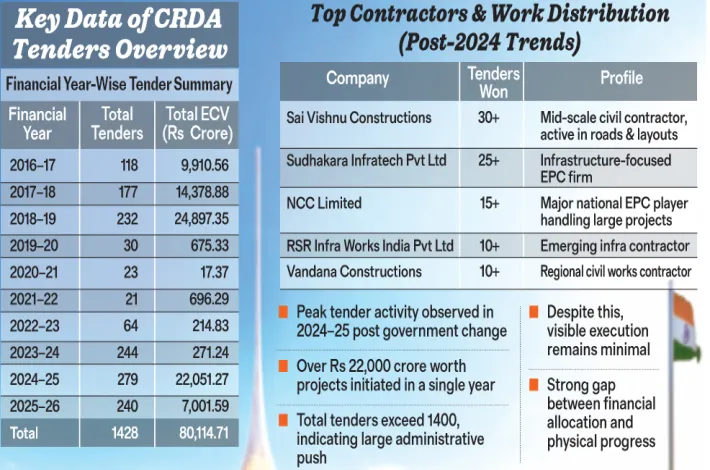
Official procurement data indicates a surge in tendering activity post-2024. Hundreds of tenders have been issued and contracts awarded across construction, maintenance, procurement, and consultancy segments. Financial summaries show a sharp spike in project value in the 2024–25 financial year, suggesting a renewed administrative push. However, this increase in activity has not translated into proportional progress on the ground.
A major criticism emerging from analysts and political observers is the apparent lack of monitoring and enforcement. While tenders are being awarded, there is limited evidence of strict tracking of project execution. Contractors facing delays are rarely penalized, and instances of blacklisting are minimal. This has led to a situation where projects are initiated but not pursued with urgency, resulting in prolonged timelines.
Concerns over transparency have further intensified scrutiny.
From Majestic to Mundane
Opposition leaders from the YSR Congress Party (YSRCP) have filed multiple Right to Information (RTI) applications seeking details on tenders, project timelines, and execution status. According to sources, CRDA officials have not provided comprehensive responses, prompting opposition leaders to escalate the matter legally.
Speaking to Metro India, Avuthu Sridhar of YSRCP RTI wing Incharge, said, “We have filed multiple RTIs to CRDA, regarding the tender details and the works awarded to companies and their progress. This is not any secret information, an essential information which any citizen of AP is curious about as the details belong to the State Capital. But the officials didn’t respond to any application of ours and didn’t give any information regarding. So we are going to appeal in the Court.”
Adding to the criticism, CPI(M) leader Baburao alleged that tender processes lack transparency and that some contracts are being awarded at inflated prices. He also claimed that non-performing companies are not being penalized, raising questions about accountability within the system.
CRDA officials, however, maintain that progress is being made. They argue that the current pace of work is significantly better than under the previous government and attribute delays to technical and operational challenges. Officials insist that corrective measures are underway and that project execution will accelerate in the coming months.
Meanwhile, Chief Minister N. Chandrababu Naidu has been actively reviewing CRDA projects, reportedly holding multiple review meetings each month. However, critics argue that these reviews have yet to produce decisive outcomes. They point to an overemphasis on master plans, visual presentations, and conceptual designs, while core infrastructure development continues to lag.
The repeated change of commissioners has also sparked a broader debate about institutional structure. Experts suggest that the issue may not lie solely with leadership but with systemic inefficiencies. There are growing calls to elevate CRDA into a dedicated ministry or autonomous body, enabling faster decision-making, stronger accountability, and more effective execution.
For the people of Amaravati, the situation is increasingly concerning. With limited visible progress and lingering uncertainty, fears are resurfacing about the future, especially in the event of political changes. The memory of stalled development under previous regimes continues to shape public sentiment.
As Vijay Rama Raju takes charge, the challenge ahead is clear: convert administrative activity into tangible development. The coming months will be critical in determining whether Amaravati’s long-delayed promise can finally move from blueprint to reality.
Amaravati today stands at a critical juncture, rich in plans, heavy on contracts, but still awaiting visible transformation. With a new commissioner at the helm, the expectation is no longer about vision, but execution. Whether this transition marks a turning point or continues a cycle of delay will define not just a project, but the credibility of governance itself.