12 October, 2026 | 6:41 PM


Per Capita Income is not enough: Human development matters more
07-07-2026 12:00:00 AM
In recent times, we frequently hear that Telangana has achieved unprecedented economic growth over the past twelve years. By citing indicators such as Gross State Domestic Product (GSDP), per capita income, IT exports, industrial investments and infrastructure development, the government portrays Telangana as one of the fastest-growing states in the country.
However, an important question arises here. Has this economic growth actually reached all sections of society equally? A state may generate enormous wealth, but that wealth may not be distributed equally among all sections of society. Per capita income reflects the average income of the people but does not fully capture inequalities.
Growth in Telangana’s Per Capita Income– Is It Real Development?
When Telangana was formed in 2014–15, the state’s per capita income stood at Rs 1,24,104, while India’s per capita income was Rs 98,405. By 2025–26, Telangana’s per capita income had increased to Rs 4,18,931, whereas India’s had reached Rs 2,19,575. Today, Telangana ranks first in India in terms of per capita income. However, a fundamental question arises. Has this increase actually resulted from an improvement in the living standards of the people? Or has the state’s average income risen primarily because of the rapid growth of a few sectors, increased borrowing and the concentration of income in a few districts and among a few sections?
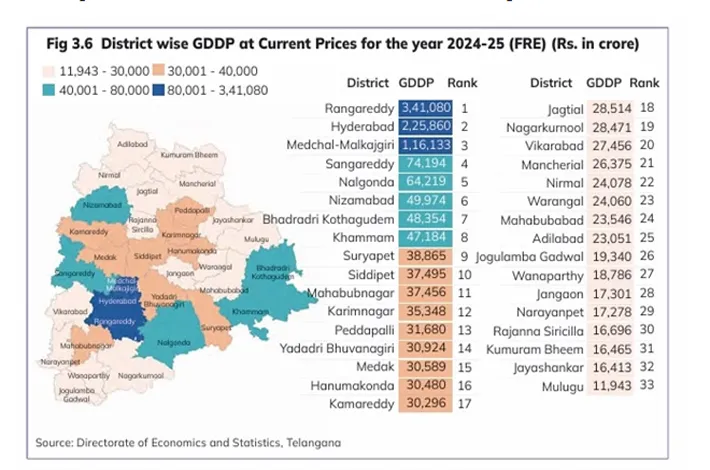
Income is mainly concentrated in the Hyderabad, Ranga Reddy, Medchal–Malkajgiri, Sangareddy and Bhadradri Kothagudem districts. Sectors such as IT, pharma, real estate, coal and financial services have rapidly increased the state’s income. At the same time, the income growth of agriculture-dependent districts, tribal areas and workers in the unorganised sector has not taken place at the same pace. The per capita income of 20 districts is below Rs 3 lakh.
Development induced through debt– Is it sustainable?
According to the CAG reports, at the time of the formation of the state the debt of the Government of Telangana was approximately Rs 91,985 crore. However, by 31 March 2025, government borrowings had increased to approximately Rs 3,91,881crore. In addition to this, borrowings raised by Special Purpose Vehicles (SPVs) and government corporations reached Rs 2,41,528 crore.
In addition, the government’s due to DISCOMS, arrears payable to employees, pending scholarships and other pending payments together is estimated at another Rs 2 lakh crore During the same period, approximately Rs 21 lakh crore was spent through the state budget. When such huge borrowings are made and government expenditure increases substantially, it is possible that per capita income would have increased to some extent.
Where Do We Stand in the Human Development Index (HDI)?
The Human Development Index (HDI) was developed by the United Nations Development Programme (UNDP). Genuine development requires balanced progress in three key dimensions: life expectancy, education, and income. According to the Human Development Report 2025 (based on 2023 data): Among 28 states and 8 Union Territories, Telangana ranks 22nd. Considering only the 28 states, Telangana stands at 15th place. What happened to development? Instead of improving, why has Telangana’s relative position declined?
The gap in social justice
A major gap still exists in Telangana. Going forward, development should also be measured through indicators such as: Income distribution, regional equity, representation of different social groups, distribution of assets, quality employment, access to education, equitable access to healthcare. If economic growth benefits only a small minority, it may qualify as high growth but it cannot be called inclusive development.
The Way Forward
What Telangana now needs is a development model centered on social justice. The state government should publish an annual Social Equity Report, containing social group-wise data on income, assets ,education, employment, distribution of benefits from government expenditure. The debate on Telangana’s development should not end with the question: “How much growth have we achieved?” It should begin with the more fundamental question: “Who has actually benefited from that growth?” That is the true measure of development of an inclusive and socially just Telangana.
- T Chiranjeevulu
The author is a retired IAS officer and Chairman of BC Intellectuals Forum Hyderabad