25 September, 2026 | 4:23 AM


Rayalaseema transformed from drought zone to prosperous agrarian region under NTR-Babu : Minister
07-01-2026 12:00:00 AM
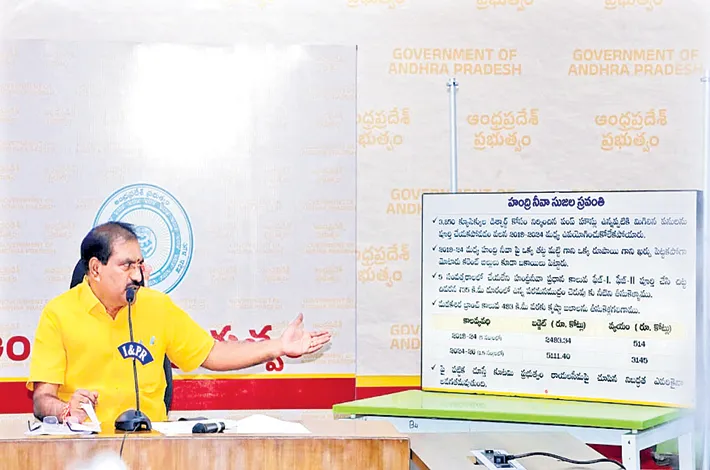
State Water Resources Development Minister Nimmala Ramanaidu on Tuesday asserted that Rayalaseema’s historic transformation, from a chronically drought-hit region to a land steadily moving towards agricultural prosperity, was laid firmly during the tenures of visionary leaders N. T. Rama Rao and N. Chandrababu Naidu. Addressing the media at the State Secretariat, the Minister said every major irrigation source that today sustains Rayalaseema bears the imprint of their planning, resolve and administrative competence.
Recalling the early initiatives, Ramanaidu said NTR, immediately after assuming office in 1983, recognised that only large-scale irrigation projects could offer a permanent solution to Rayalaseema’s recurring droughts. With that clarity, NTR laid the foundations for landmark projects such as Telugu Ganga, Handri-Neeva, Galeru-Nagari, Velugodu Balancing Reservoir, Gorakallu, Avuku and Gandikota.
Chandrababu Naidu carried forward the same vision by expanding and accelerating these projects to realise Rayalaseema’s long-cherished irrigation dream. “Even today, when people mention any reservoir or project in Rayalaseema, the names that come to mind are NTR and Chandrababu,” the Minister remarked.
Highlighting the impact of the coalition government’s focused approach since coming to power, Ramanaidu said water storage levels across Rayalaseema have improved dramatically due to efficient water management. Of the region’s 17 major reservoirs, 86 percent storage has been achieved, while medium reservoirs stand at 67 percent and minor irrigation tanks at 53 percent. With a total storage capacity of 464 TMC, Rayalaseema currently holds 366 TMC, nearly 79 percent, reflecting effective governance in the water sector.
The Minister said the Handri-Neeva project, regarded as Rayalaseema’s lifeline, suffered grave neglect between 2019 and 2024 despite pumps with a capacity of 3,850 cusecs being ready by 2019. While only Rs. 514 crore was spent on the project during those five years, the present coalition government has spent Rs. 3,880 crore in just one year, he said. An additional Rs. 3,145 crore has been invested to ensure Krishna waters reach the tail-end of the Kuppam branch canal and the Madakasira branch canal, fulfilling long-pending farmer aspirations.
Several projects neglected earlier, such as Alaganur Balancing Reservoir, Gorakallu and Avuku, are now being restored, Ramanaidu said. Funds sanctioned include Rs.58.5 crore for Gorakallu, Rs. 4.5 crore for Avuku, Rs. 36 crore for Alaganur, Rs. 54.42 crore for Tungabhadra repairs and Rs. 203 crore for Srisailam plunge pool restoration. He cited the swift replacement of a damaged Tungabhadra gate within five days as proof of the government’s responsiveness and accountability.
Addressing criticism over the Rayalaseema Lift Irrigation Scheme, the Minister dismissed opposition claims as misleading. He explained that gravity flow already brings Krishna waters up to 841 feet without lifting, while the lift scheme proposed in 2020 offered only marginal additional benefit. He alleged that the previous government began works without DPRs or environmental clearances, leading to National Green Tribunal intervention and penalties, while nearly Rs. 990 crore was spent without delivering a single drop of water.
Ramanaidu said the coalition government is now focused on sustainable revival, strengthening existing projects, speeding up lining works at the Pothireddypadu head regulator to double conveyance capacity, and planning long-term solutions such as the Polavaram-Bollapalli-Krishna link to utilise surplus Godavari floodwaters. With reservoirs filling, tanks reviving and farmers taking up second crops, Rayalaseema, once synonymous with drought, is steadily emerging as a “sasyashyamala ratnala seema,” he said, crediting the NTR-Chandrababu legacy for laying the enduring foundation.