30 September, 2026 | 1:42 PM


Retail fuel prices to rise soon; August may heal?
11-05-2026 12:00:00 AM
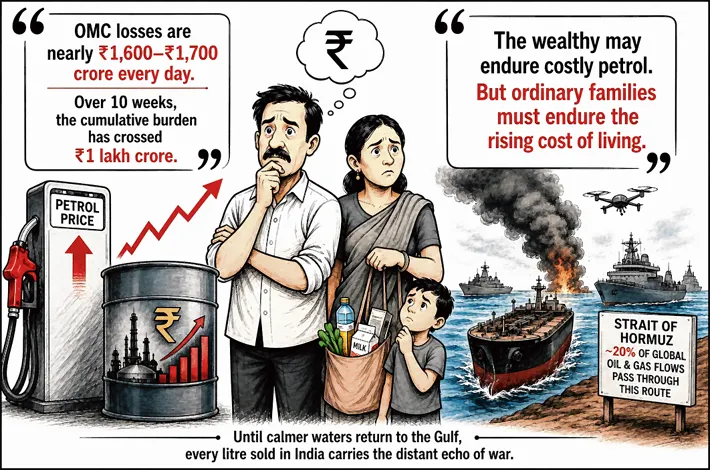
Pain Before Calm. Prices Test Patience
Mounting OMC losses sharply intensify pressure for fuel price revisions; dearer petrol looms as prolonged Gulf tensions rattle global energy and shipping markets
Households, investors and businesses prepare for temporary fuel pain while awaiting supply recovery by July-end/August
Palazhi Ashok Kumar
MUMBAI
Retail fuel prices in India may soon move upwards after ten weeks of extraordinary restraint, even as policymakers and markets increasingly hope that Gulf oil supplies could begin stabilising towards late July or August. Between these two realities— near-term pain and possible late-summer relief—stands the anxious Indian consumer, already exhausted by inflation, uncertainty and the rising cost of ordinary living.
Before the first trains arrive and before morning tea simmers inside millions of Indian kitchens, another struggle is already unfolding far beyond the horizon—through narrow waters crowded with tankers, destroyers, drones and fear. There, inside the Strait of Hormuz, the modern global economy now waits in suspended breath.
A delayed oil shipment becomes higher freight charges. Freight becomes expensive fertiliser. Fertiliser becomes costlier vegetables, transport, milk, medicines and electricity. Inflation moves softly at first, before settling heavily upon households already burdened by uncertainty.
India now stands at precisely such a moment. For much of the past year, markets were obsessed with Trump’s tariffs after his return as America’s 47th President. Trade wars disrupted supply chains and shook investor confidence across continents. Yet even those economic tensions now appear overshadowed by a far deeper anxiety — the fear that energy itself may once again become unaffordable. Oil has become the emotional pulse of economies. For ten weeks since the West Asia conflict intensified, India’s state-owned oil marketing companies — IOC, BPCL and HPCL — have protected consumers from the full force of the global energy shock.
Petrol and diesel prices have remained frozen despite a sharp rise in crude prices and severe disruption across shipping routes.
Experts estimate that the three OMCs are currently absorbing under-recoveries of nearly ₹1,600 crore to ₹1,700 crore every day on petrol, diesel and LPG sales. Over ten weeks, the cumulative burden has crossed ₹1 lakh crore. Simultaneously, the Centre has reduced excise duties sharply, sacrificing nearly ₹14,000 crore monthly in revenue to soften the blow for consumers. The revenues earned by OMCs are not merely trading income; they finance crude purchases, refinery expansion, pipelines, strategic reserves and India’s broader energy-security architecture.
If elevated crude prices persist, companies may require substantially higher borrowings simply to sustain working capital and uninterrupted fuel supplies. And yet India has avoided the harsher path taken elsewhere.
From Japan to Britain, several economies have already passed through steep fuel increases since the conflict began. Institutional surveys increasingly suggest that shipping through Hormuz may begin gradually stabilising towards late July or August if negotiations survive the present tensions.