30 September, 2026 | 12:15 AM


Secret plot to privatize RTC?
24-03-2026 12:00:00 AM
metro india news I hyderabad
The Telangana government is facing allegations of deliberately weakening the State Road Transport Corporation to pave the way for privatization. Workers claim that the state is avoiding direct purchase of electric buses, instead leasing them through private companies. Government decisions are allegedly creating conditions that push RTC into debt, potentially forcing the sale of valuable assets such as depots, workshops, commercial complexes, and land. Even though RTC has the capacity to manufacture its own buses, it is being sidelined, prompting suspicions of a calculated privatization plan.
RTC employees compare the process to cutting a tree branch by branch until the roots are exposed. Departments are weakened, debts are mounting, and the corporation is being gradually pushed toward privatization. Workers allege that political leaders and representatives support government decisions favoring corporate interests, aiming to sell RTC assets worth thousands of crores to private firms cheaply.
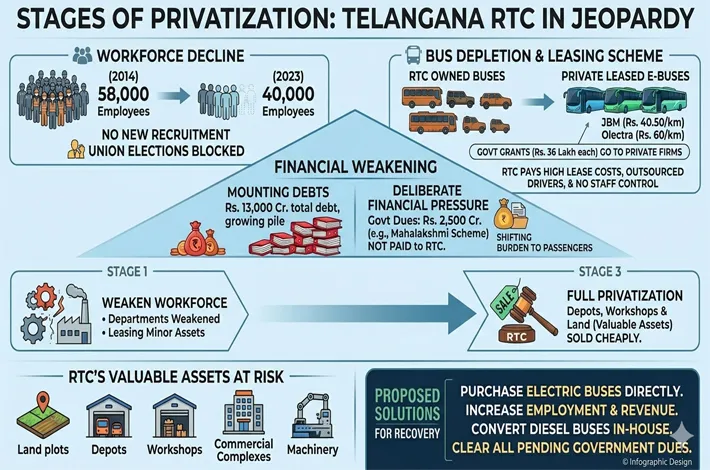
The workforce has declined drastically over the years. In 2014, at the time of Telangana’s formation, RTC had about 58,000 employees. Today, only around 40,000 remain. No significant recruitment has been conducted, and union elections have been blocked to prevent workers from voicing concerns. Meanwhile, buses, once numbering around 10,000, have been supplemented with hired vehicles. Now, electric buses are being introduced almost entirely through private corporate firms. Each electric bus receives a central government grant of Rs. 36 lakh, but instead of RTC purchasing them, the buses are leased, depriving the corporation of both revenue and operational control.
Financially, RTC pays high lease amounts per bus – for example, Rs. 40.50 per km for JBM buses and Rs. 60 per km for Olectra buses – while private companies retain profits. The workforce and the corporation are not involved in staffing these buses, as drivers, conductors, supervisors, and technicians are outsourced to the private firms. Maintenance, charging, and depot usage are handled without rental payments by RTC. Workers also point out that under schemes like Mahalakshmi, where women travel free, the government has not paid pending dues of around Rs. 2,500 crore, shifting the financial burden to passengers.
RTC owns highly valuable assets across Telangana, including land, depots, workshops, commercial complexes, and machinery, collectively worth thousands of crores. Workers allege that mounting debts are being orchestrated to force the corporation to lease or sell assets to private companies. Even the opportunity to convert diesel buses to electric is being handed to private firms, while RTC could technically handle it in-house with minor training. These steps, workers say, are intended to weaken the organization financially and operationally.
Government policies, according to employees, are being structured to favor private firms. Rules and guidelines ensure buses, depots, workshops, and staff management are aligned with corporate interests. The electric buses coming today, and thousands more planned in the future, will belong to private companies, who will outsource all necessary staff, sidelining RTC employees. Workers claim that once privatization is complete, assets and operations could also be used to fund political campaigns, achieving privatization in a calculated manner.
The second stage of the plan is reportedly underway. Employee numbers continue to drop, electric buses are leased rather than purchased, diesel buses’ conversion to electric is outsourced, and grants flow directly to corporations. Minor workshops and some assets have already been leased. RTC’s total debt has reached around Rs. 13,000 crore, confirming workers’ fears that privatization is being implemented in stages.
RTC employees insist that protecting the corporation is the responsibility of both citizens and staff. Advocates argue that key electric buses must be purchased directly by RTC, increasing employment, revenue, and organizational strength. Diesel buses can be converted to electric within RTC workshops. The government must also clear all pending dues. Only then can the privatization plan be blocked, preserving the trust, reliability, and public service of RTC for Telangana passengers.