25 September, 2026 | 2:08 AM


Shankaracharya welcomes Modi's Somnath tribute
07-01-2026 12:00:00 AM
A Millennium of Resilience and the Call to Erase Invader Legacies
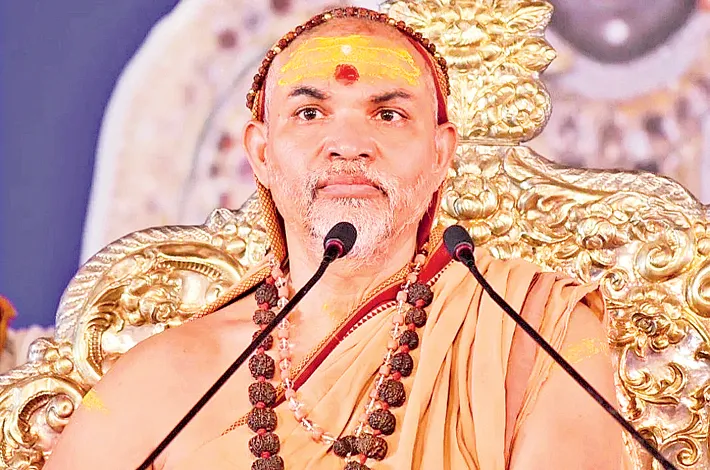
HH Shankaracharya Swami Avimukteshwaranand Saraswati Maharaj has appreciated Prime Minister Narendra Modi's recent tweet commemorating 1,000 years since the first attack on the Somnath temple. Speaking to ANI, the revered spiritual leader interpreted Modi's message as a powerful reminder of India's unbreakable spirit, emphasizing that while temples and idols can be destroyed, the essence of faith endures.
This statement, delivered amid growing discussions on cultural reclamation, underscores a broader narrative of resilience against historical invasions, particularly those led by Mahmud of Ghazni The Shankaracharya's comments directly reference Modi's post, where the Prime Minister highlighted the temple's survival despite repeated assaults. "The tweet that the Prime Minister posted, regarding a thousand years ago, expresses the pain felt when the Somnath temple was attacked," the Swami noted.
He described Ghazni's raid as an attempt to eradicate the divine presence of Somnath, but one that ultimately failed. "A man named Mahmud Ghaznavi, with a small contingent of his army, came and damaged the temple. He harmed the priests who worshipped there and injured the devotees... A thousand years have passed, and Somnath is still standing," he said, applauding Modi's intent to deter future such attempts.
The Swami went further, advocating for the removal of Ghazni's name from any public references in India, calling his actions unequivocally harmful. Prime Minister Modi's tweet, posted on January 5, marks the dawn of what he terms #SomnathSwabhimanParv—a festival of pride in Somnath's legacy. "Jai Somnath! 2026 marks 1000 years since the first attack on Somnath took place. Despite repeated attacks subsequently, Somnath stands tall! This is because Somnath’s story is about the unbreakable courage of countless children of Bharat Mata who protected our culture and civilization," Modi wrote, linking to an op-ed where he delves deeper into the temple's symbolic importance.
As Modi and the Shankaracharya both emphasize, destruction did not spell the end. The temple was rebuilt multiple times over the centuries, first by local rulers like the Chaulukya king Bhima I shortly after Ghazni's departure. By the British colonial period, Somnath lay in neglect, a poignant reminder of subjugation. The modern revival of Somnath is intertwined with India's independence movement. In 1947, Sardar Vallabhbhai Patel, as Deputy Prime Minister, spearheaded the temple's reconstruction, viewing it as a step toward reclaiming national heritage.
The new structure, blending traditional architecture with contemporary engineering, was inaugurated in 1951 by President Rajendra Prasad, despite objections from some sections who feared it might stoke communal tensions. Today, Somnath stands as a UNESCO-recognized site, attracting millions of visitors annually and serving as a testament to cultural continuity.
Shankaracharya Swami Avimukteshwaranand Saraswati Maharaj, whose voice carries significant weight in Hindu religious circles, brings a layer of spiritual authority to this discourse.
His endorsement of Modi's message aligns with his advocacy for Sanatan Dharma's preservation, positioning him as a bridge between tradition and modern nationalism. In the X thread following ANI's post, users expressed admiration for the Swami's clarity while some others questioned the relevance of seeking religious leaders' views on historical matters, highlighting the intersection of faith and politics in India.
Broader media coverage frames Modi's initiative as part of a larger effort to reclaim narratives from colonial and invasive histories, similar to renaming projects like the recent changes to Mughal-era landmarks. At its core, the Shankaracharya's call to "delete" Ghazni's name resonates with ongoing debates on decolonization and historical justice. In India, where streets, institutions, and even cities bear names tied to invaders or colonizers, such proposals reflect a push for indigenization.
Examples include the renaming of Allahabad to Prayagraj or Aurangzeb Road to APJ Abdul Kalam Road, aimed at honoring indigenous heroes over foreign conquerors. By linking this to Somnath, the Swami and Modi invoke a millennium-old struggle, urging Indians to draw strength from history while forging a unified future. As 2026 unfolds with "Somnath Swabhiman Parv" celebrations, this episode serves as a poignant reminder of India's enduring ethos.