31 August, 2026 | 7:24 PM


Sitharaman presents Rs 53.5 lakh crore budget for FY27
02-02-2026 12:00:00 AM
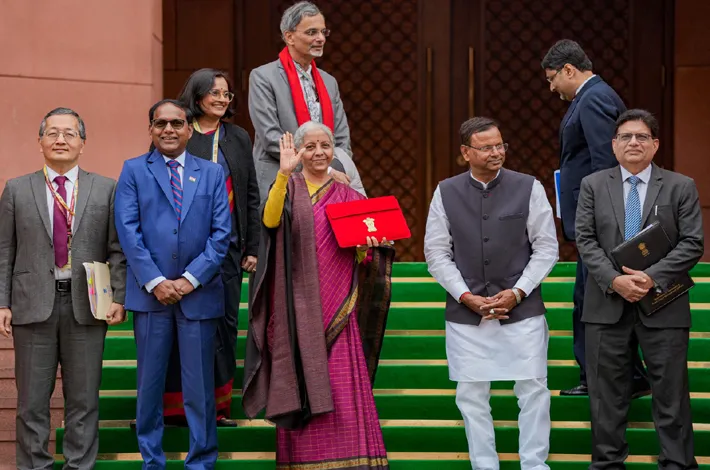
Finance Minister Nirmala Sitharaman on Sunday presented the Union Budget 2026-27, unveiling a Rs 53.5 lakh crore plan aimed at sustaining growth amid rising global risks. The Budget includes measures to promote manufacturing, agriculture, tourism, and technology while maintaining fiscal discipline despite upcoming elections in five states.
The government plans to scale up manufacturing across seven sectors, including pharmaceuticals, semiconductors, rare-earth magnets, chemicals, capital goods, textiles, and sports goods, with an emphasis on job creation and technology-driven development. Initiatives for livestock, fisheries, and high-value agriculture have been announced, alongside a Rs 10,000 crore investment over five years to develop India as a biopharma manufacturing hub. An integrated programme for the textile sector is also proposed.
Tourism development will focus on ecologically sustainable mountain trails in Himachal Pradesh, Uttarakhand, and Jammu and Kashmir, as well as 15 archaeological sites. Support for small businesses comes through a Rs 10,000 crore SME Growth Fund to create future champions by incentivising enterprises based on selected criteria.
Sitharaman highlighted that India faces global trade disruptions, rising commodity prices, and technological challenges. The government aims to reduce the debt-to-GDP ratio to 55.6 percent and the fiscal deficit to 4.3 percent in FY27, borrowing Rs 17.2 lakh crore from bond markets. Capital expenditure has been raised to Rs 12.2 lakh crore from Rs 11.2 lakh crore last year to support infrastructure-led growth.
To attract investment in digital infrastructure, the Budget offers a 20-year tax holiday for overseas data centre firms and a 15 percent safe harbour on costs for services provided by related entities. Tax measures include higher Securities Transaction Tax on futures and options trading, taxation of buybacks as capital gains, and reduced TCS on overseas tour packages, education, and medical expenses. The new Income Tax Act, 2025, with simpler rules, will be implemented from April 1.
Infrastructure projects include a Dedicated Freight Corridor connecting Dankuni to Surat, 20 new National Waterways, a Coastal Cargo Promotion Scheme, and seven high-speed rail corridors. Rs 20,000 crore is allocated over five years for Carbon Capture Utilisation and Storage technologies. Customs duty exemptions for capital goods used in lithium-ion batteries, imports for nuclear projects, and medicines for rare diseases have been extended.
Sitharaman emphasised the government’s threefold approach of accelerating growth, fulfilling aspirations, and inclusive development through structural reforms, a robust financial sector, and adoption of cutting-edge technologies. Over 350 reforms have been implemented, including GST simplification, labour code notifications, and rationalisation of quality control orders. Moody’s Ratings noted the Budget provides tactical support amid external uncertainties but cautioned that ongoing revenue erosion may affect debt affordability.