21 September, 2026 | 10:05 PM


Undermine democracy
19-12-2025 12:00:00 AM
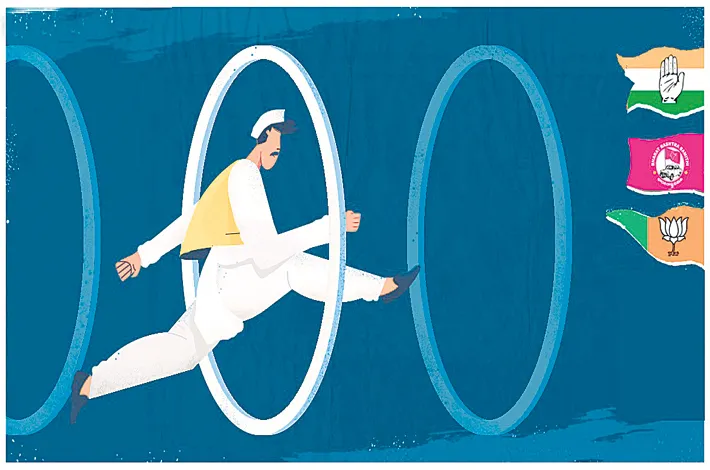
Aayarams Gayarams
Defections in Indian politics, where legislators switch parties after elections, have become increasingly common in recent years. From moving to another party due to ministerial ambitions to joining for other political advantages, the trend has become routine across parties. Public representatives, meant to act as a bridge between citizens and the government, are frequently seen prioritizing personal gains over public service. Both national and regional parties have, at different times, encouraged defections, raising questions about their moral authority to criticize similar acts by others.
In today’s political landscape, voters often cannot identify which party their elected representative belongs to, while legislators may avoid disclosing their affiliations, reflecting the decline of ethical standards in politics. In India’s early post-independence period, politicians usually remained committed to a single party, guided by ideological principles. Now, political power is often the paramount objective, and leaders switch parties with ease. Some legislators have changed multiple parties and even held ministerial positions, claiming it is for public development. However, tangible development often does not follow, while defecting leaders gain financially and in positions of authority. Meanwhile, political parties accuse each other of promoting defections, despite having done the same in the past, making all parties partly responsible for the proliferation of defections.
Defections undermine democracy and raise concerns about the effectiveness of the anti-defection law. Introduced in 1985 through the Tenth Schedule of the Constitution, the law was intended to curb defections by disqualifying legislators who voluntarily leave their party or vote against party directives. Yet, despite its existence, defections continue widely across states such as Telangana, Andhra Pradesh, Maharashtra, Tamil Nadu, Karnataka, Goa, Manipur, Madhya Pradesh, and Arunachal Pradesh. Loopholes and legal exemptions, especially regarding party mergers or splits, have allowed legislators to bypass disqualification. Delays by legislative Speakers and Chairpersons in acting on petitions further weaken the law’s effectiveness.
Defections are often justified in the name of development, but voters rarely see the promised benefits. Leaders gain ministerial posts or financial advantages, while citizens feel betrayed. Legislators are sometimes treated like commodities through “horse-trading” to secure government majorities. Parties spend heavily to win elections but find it easier to lure opposition members after polls to strengthen their ranks. This results in weak opposition, reduced debate on policy, and governance driven by opportunism rather than democratic principles.
Historically, defections are not new. In the 1960s and 1970s, legislators frequently switched parties, causing instability in state governments. The 1969 Chavan Committee report noted numerous defections, with many defectors obtaining ministerial positions. The term “Aya Ram, Gaya Ram” originated to describe legislators who repeatedly changed parties.
In Telugu states, similar trends continued after the bifurcation of Andhra Pradesh in 2014. Both Andhra Pradesh and Telangana witnessed large-scale defections, with ruling parties encouraging opposition legislators to join their ranks. In Andhra Pradesh, the Chandrababu Naidu government and the YSR Congress Party attracted legislators from other parties to consolidate power. In Telangana, the TRS merged 15 MLAs from the TDP and Congress, while some TDP Rajya Sabha members joined the BJP.
The conduct of legislative Speakers in enforcing the anti-defection law has often been controversial. In Telangana, despite over 50 MLAs defecting since 2014, Speakers have delayed action under the law. In other states, inconsistent implementation has weakened its credibility. Legal exemptions, such as mergers involving two-thirds of party members, have been exploited to bypass disqualification, allowing defectors to avoid consequences.
The anti-defection law specifies disqualification in cases where a legislator voluntarily leaves a party, votes against party directives, joins a political party as an independent, or, if nominated, joins a party six months after nomination. Exemptions include cases of splits where one-third of the party leaves, full-party mergers, or when members choose not to join a merged faction. Speakers and Chairpersons have the authority to decide disqualification petitions, provided the petitions are filed at least 15 days before voting.
While the law has had some success, especially regarding independent candidates, significant gaps remain. Between 1989 and 2011, out of 39 disqualification petitions in Haryana, Speakers disqualified legislators in only 12 cases. In Meghalaya, 18 petitions were filed between 1988 and 1990, with only five independent legislators disqualified for joining a political party. In the Lok Sabha, out of 55 petitions filed by 1986, 49 legislators were not disqualified, even though they had switched parties. These examples demonstrate the law’s limited impact and highlight the need for stricter enforcement.
Experts argue that to curb opportunistic defections, the anti-defection law must be strengthened, and loopholes removed. Legislators who defect should face disqualification and be barred from contesting future elections. Only by effectively curbing defections can stable governance be ensured, the democratic process be strengthened, and elected representatives remain accountable to the voters.