22 September, 2026 | 11:20 AM


We will fight against Palamuru injustice: KCR
23-12-2025 12:00:00 AM
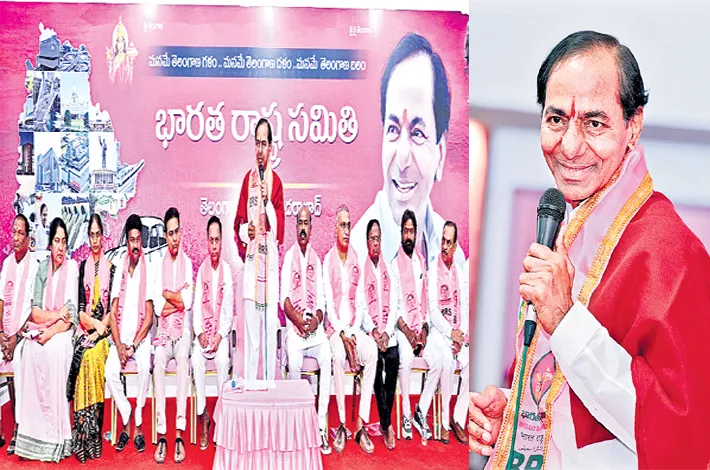
KCR accused the Congress government of completely abandoning the project, alleging that not even “a spadeful of soil” had been removed in two years
Former Chief Minister and BRS president K. Chandrashekar Rao (KCR) on Sunday declared that the Palamuru–Rangareddy Lift Irrigation Project symbolises decades of injustice inflicted on Telangana, warning that his party would no longer remain silent while the region’s water rights were “systematically looted.” Addressing a joint meeting of the BRS Legislature Party and State Executive Committee at Telangana Bhavan in Hyderabad, followed by a media interaction, KCR said the very formation of Andhra Pradesh turned into a historic curse for Telangana, with undivided Mahabubnagar district bearing the brunt.
KCR said Palamuru was the most discriminated district in the united state, despite the Krishna river entering and flowing for more than 300 km through it. He accused Congress, which ruled for 50 years, and the TDP, which ruled for nearly 20 years, of pushing Palamuru into irreversible backwardness. Under the Upper Krishna, Bhima and Tungabhadra Left Canal projects, Palamuru–Rangareddy was entitled to 174 TMC of water, but successive governments ensured that these allocations never reached farmers’ fields.
Rejecting the narrative that Palamuru Lift Irrigation is a new scheme, KCR said it was rooted in long-pending entitlements. He recalled that during the Telangana movement, the issue was taken to the Brijesh Kumar Tribunal but was dismissed on technical grounds. Earlier, the Bachawat Tribunal had suo motu allocated 17 TMC to the Jurala project after recognising Palamuru’s backwardness, yet those allocations were ignored between 1974 and 1978. Though former Chief Minister Anjaiah laid the foundation stone, Jurala was treated as an “orphan project,” built without canals, allowing Krishna waters to merely pass through without irrigating land.
KCR said that when Chandrababu Naidu claimed to have adopted Mahabubnagar district, he laid multiple foundation stones without delivering water. He recalled publicly questioning whether those stones were meant only to be “held and cried over.”
As a result, he said, mass migration took place from every Palamuru constituency to Mumbai, turning the district into a symbol of drought-driven distress. He alleged that even the RDS canal was sabotaged, deepening the region’s crisis.
After Telangana statehood, KCR said the BRS government undertook a comprehensive review of water entitlements and betrayals. Pending projects such as Nettampadu, Bhima and Kalwakurthy were converted into running projects on a war footing, bringing irrigation to 6.5 lakh acres. Through Mission Kakatiya, minor irrigation tanks were restored on priority, benefiting another 1.5 lakh acres, while multiple check dams were constructed. Since the RDS canal had been historically compromised, the Tummilla Lift Irrigation Scheme was completed on the Tungabhadra to stabilise ayacut.
Explaining the Palamuru–Rangareddy Lift Irrigation strategy, KCR said Mahabubnagar, Rangareddy and Nalgonda districts lie entirely in the Krishna basin, with every drop of rain ultimately flowing into the river. To correct historical injustice, BRS planned to secure 173 TMC of Krishna water. Initially, 90.81 TMC was earmarked for the Palamuru–Rangareddy project, with additional allocations to be attached as they materialised.
KCR cited the Bachawat Tribunal provision that allowed Andhra Pradesh to divert 80 TMC of Godavari water to the Krishna delta, while mandating compensation to upstream states—45 TMC to Telangana, 21 TMC to Karnataka and 14 TMC to Maharashtra. While Karnataka and Maharashtra utilised their shares, Telangana’s 45 TMC remained unrealised. Adding this to the 45 TMC loss suffered in minor irrigation, BRS proposed 90.81 TMC exclusively for Palamuru–Rangareddy.
He said Rs 35,000 crore was sanctioned for the project, of which Rs 27,000 crore was already spent, completing nearly 88–90 per cent of the works. To lift water quickly amid anticipated disputes with Andhra Pradesh, high-capacity pumps of 145 MW were installed, specially designed by BHEL. Despite hurdles in permissions and land acquisition, the BRS government acquired about 27,000 acres and pushed the project to an advanced stage.
Shifting to the present situation, KCR accused the Congress government of completely abandoning the project, alleging that not even “a spadeful of soil” had been removed in two years. He questioned how the state could write to the Centre claiming that only 40 TMC was sufficient for Palamuru, calling it an act of surrender that would be exposed before the people through a massive agitation across Palamuru, Rangareddy and Nalgonda districts.
After placing Palamuru–Rangareddy at the core, KCR broadened his attack on Congress governance, alleging total collapse of welfare, agriculture and law and order. He said NCRB data showed a 20 per cent rise in crime, with murders and sexual assaults occurring openly in Hyderabad and other cities. He accused Congress of winning votes through “outright lies,” making extravagant promises such as Rs 15,000 farmer assistance, Rs 2,500 for women, gold along with marriage assistance, Rs 2 lakh loan waivers, enhanced pensions and bonuses on every grain—all of which, he said, were abandoned after coming to power.
KCR said farmers were now forced to sell paddy to private traders due to procurement failures, while fertiliser shortages had returned in the form of “shoe queues.”
He mocked the government’s decision to introduce an app for urea distribution, questioning why a farmer needed an app even to buy a fertiliser bag.
He alleged that pensions and Rythu Bandhu payments were skipped multiple times, pushing vulnerable sections into distress.
Concluding, KCR said people across Telangana were openly expressing regret over trusting Congress and were demanding the return of BRS.