22 September, 2026 | 4:23 PM


100 years of communism in India At the cross roads?
29-12-2025 12:00:00 AM
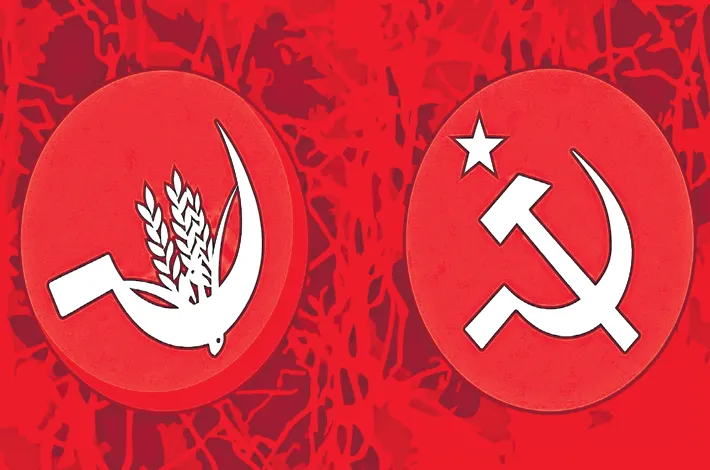
A major setback, according to a sociology professor who specialised in political movements, was the left's inability to adequately address caste — a deeply entrenched social reality in India that intersects with class exploitation
As India marks the centenary of the Communist Party of India (CPI) on December 26, 2025, the occasion prompts a deep reflection on the century-long journey of the communist and broader left movement in the country. The CPI traces its formal inception to December 26, 1925, when various communist groups from across India converged in Kanpur (then Cawnpore) for a historic conference. This gathering represented the first concerted effort on Indian soil to establish a unified, nationwide communist organization, drawing together activists from industrial centres like Bombay, Calcutta, Madras, and Lahore amid the rising tide of anti-colonial struggles.
The early decades of the movement were marked by significant momentum. In the 1950s, buoyed by global anti-imperialist waves, India's independence struggle, and supportive cultural organizations such as the Progressive Writers' Association and the All India Students' Federation, the left achieved notable electoral success. In the 1952 general elections, it emerged as the second-largest party nationally. The movement championed workers' rights, land reforms, and secularism, influencing key aspects of India's post-independence welfare framework and agrarian policies.
However, over the subsequent seven decades, the left's influence has markedly declined, now largely confined to southern states, particularly Kerala, where it continues to hold sway through coalitions like the Left Democratic Front. In a recent discussion on a TV channel, this shrinkage was attributed to several interconnected factors. First, the 1950s boom was fuelled by favourable global and domestic conditions, including widespread liberation movements worldwide. These advantages faded as time progressed.
A major setback, according to a sociology professor who specialised in political movements, was the left's inability to adequately address caste — a deeply entrenched social reality in India that intersects with class exploitation. Communist ideology traditionally prioritized class struggle, often viewing caste as a "backward" feudal remnant that would dissolve with modernization and industrialization. Yet, with limited widespread industrialization, Indian society reconciled a "mistaken modernity" where tradition and class dialectics persisted.
There is also a section of leftist thinkers who highlighted how backward caste movements, often projected by socialist rhetoric, gained traction while mainstream communist parties (CPI and CPI(M)) struggled to adapt. Leadership in these parties was predominantly from upper castes, particularly Brahmins, limiting outreach to lower and backward castes. Prominent figures like Jyoti Basu acknowledged this as a "serious failure." Efforts to ally with the Ambedkarite movement or socialist parties were hampered by mutual reluctance — including Dr. B.R. Ambedkar's early opposition to communists, whom he saw as promoting austerity that Dalits had endured for centuries under caste oppression.
The third key factor was the global rise of monopoly and finance capital, leading to wealth concentration in India as well. Regional bourgeois elements aligned with corporate interests, while the left failed to counter this with a robust new labor movement. A section of the media noted that while the global tide shifted again in the 21st century — with China's socialist model, pink tides in Latin America, and leftist gains in Southeast Asia — the Indian left has not fully capitalized on growing inequalities, acute unemployment, rural poverty, and youth frustration.
A foreign affairs expert noted that India has a broader cultural reluctance to reflect on historical anniversaries without descending into partisan contention. Unlike Western media's detailed obituaries or milestone retrospectives, Indian public discourse often neglects such moments unless driven by government agendas — and even then, they tend to be bureaucratic and uninspiring. This pattern extends to the communist movement's centenary, which has seen minimal celebration or academic debate, even from within leftist circles. Elevating ideology over political pragmatism, he said, led the left to "shoot itself in the foot" — or worse — and accelerated its decline, with subsequent losses of power in West Bengal and Tripura, and a precarious hold in Kerala.
Despite these setbacks, many politicians, political commentators and journalists, including non-leftists cautioned against prematurely declaring the Indian communist movement's obituary. Globally, left-wing ideas are experiencing resurgence in unexpected places. In the United States, where socialism was once taboo, Zohran Mamdani — a self-described democratic socialist — won the New York City mayoral election in 2025, marking a historic victory for progressives amid right-wing gains elsewhere (from Trump in the US to Putin in Russia). They pointed to similar dynamics in Europe, with figures like Jean-Luc Mélenchon in France drawing substantial support.
Organizational skills, adaptability to new realities (including social media and cultural platforms), and a shift from outdated 1930s principles to contemporary engagement are essential, they emphasize. Leftist oriented professionals in various walks of life, who are not exactly “politicians” argued that the left's traditional methods — such as street-corner meetings — are outdated in the digital age. Rapid technological changes over the last 30 years have outpaced earlier transformations, yet the left lacks a strong social media presence compared to rivals like the RSS.
As the Indian left reflects on its 100-year legacy, the centenary serves as both a remembrances of its efforts towards contributing to social justice, secularism, and anti-imperialism, and a critical call to reinvent itself amid contemporary realities. The question remains whether it can rediscover the innovative spirit that once made it a significant force in India's political landscape.