12 October, 2026 | 7:41 AM


Bigger Hyderabad Bigger Questions
02-12-2025 12:00:00 AM
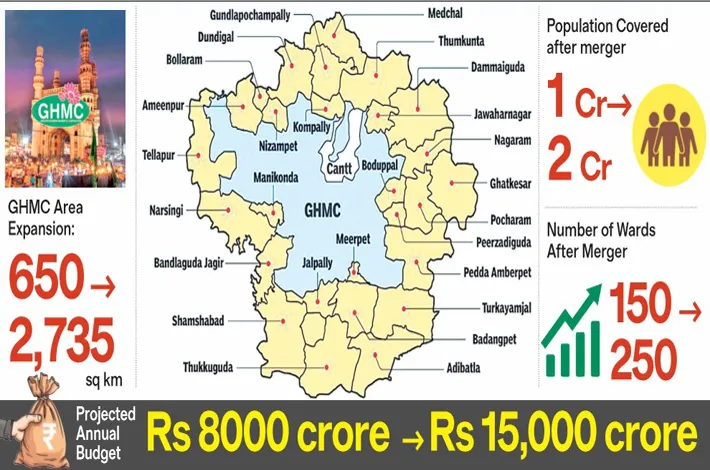
GHMC expansion
Hyderabad is set to become a mini Telangana as the Greater Hyderabad Municipal Corporation (GHMC) expands. The Outer Ring Road will now define the city’s limits, and 27 municipalities will be merged into GHMC. With this expansion, the area under GHMC will increase from 650 to nearly 2,000 square kilometers. The government aims to bring all regions under a single administrative umbrella and expand the Hyderabad brand globally. Yet, this ambitious move raises questions: will the merger solve existing challenges or merely create new ones? How will issues like staff shortages, funding gaps, and economic disparities between rich and poor municipalities be addressed? And what lessons do past mergers offer?
The Telangana government has framed this historic decision to ensure that the term “global city” reflects real geographical and infrastructural reality rather than being a slogan. On November 25, the GHMC General Body formally approved the merger of 27 municipalities and corporations within the Outer Ring Road. Experts, however, caution that while the decision looks impressive on paper, its implementation will be highly challenging. Questions remain about why the government undertook this move, what benefits it brings to ordinary citizens, and the practical difficulties that lie ahead.
Rationale and administrative challenges
The government, led by Chief Minister Revanth Reddy, identifies three key reasons for the expansion. Currently, the core city, merged areas, and peripheral municipalities develop at different rates. Even minor infrastructure projects, such as laying roads or drainage pipelines, face hurdles when crossing municipal boundaries due to approvals and funding shortages. By bringing areas up to the ORR under a single administrative roof, the government aims to implement the master plan uniformly.
Internationally, Hyderabad’s ambition to become a mega-city requires both population and area. A city spanning 2,000 square kilometers with nearly two crore residents can attract significant funding and loans from international agencies like the World Bank, Asian Development Bank, and JICA.
Politically, integrating peripheral areas allows the government greater control over administration, potentially influencing electoral constituencies and ward distributions.
Officials have already begun intensive planning. GHMC currently has 150 wards, but population disparities exist—some wards house hundreds of thousands, while others only a few thousand. The plan is to increase wards to 250 after merging the new municipalities. Circle boundaries are being realigned so that each assembly constituency has two circles, easing administrative complications. Some circles, like Kapra and Begumpet, have completed the process, while work continues in 28 others.
Despite the promise, multiple challenges loom. GHMC’s population is expected to double to two crore, nearly half of Telangana’s total population. The area will expand to 2,735 square kilometers, and the annual budget may rise from Rs 8,000 crore to Rs 15,000 crore. Staff shortages remain critical, with thousands of vacant posts in sanitation, entomology, town planning, and engineering. Even existing staff struggle with waste collection and road maintenance, and managing an additional 1,400 square kilometers may prove difficult. Hiring new staff poses financial questions, while failing to do so could compromise service delivery in both city and peripheral areas.