23 October, 2026 | 3:23 PM


BJP’s Gen Z Outreach Turns Lecture Circuit
28-08-2026 12:00:00 AM
Drawing Sneers from Young Indians
metro india news I hyderabad
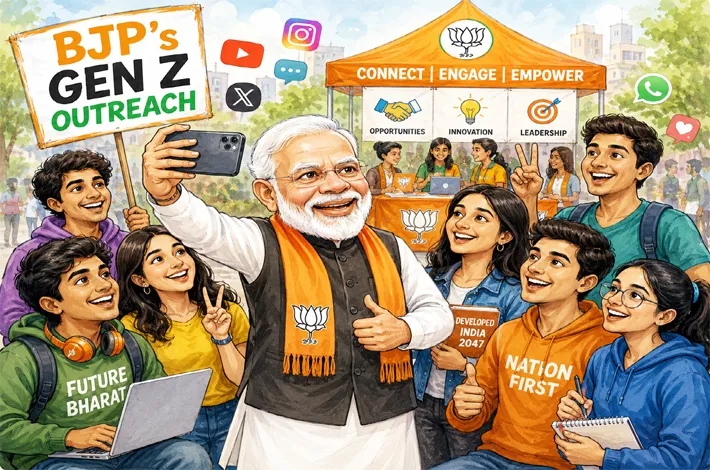
In what was intended as a quiet course correction to stem the drift of India’s youngest voters, Prime Minister Narendra Modi recently directed Bharatiya Janata Party leaders, Union ministers and elected representatives to engage directly with Generation Z.
The instruction, according to party sources familiar with the internal communication, was clear: sit with students, visit campuses and hostels, listen to their problems, aspirations and frustrations, and report back genuine feedback that could shape policy and messaging. The goal was twofold—to counter the Congress’s ongoing student outreach programme and to rebuild emotional and political connect with voters born roughly between 1997 and 2012, who will form a decisive chunk of the electorate in coming years.
Instead, what has unfolded across several states is a series of formal meetings that look more like mandatory homework than genuine dialogue. Union ministers and senior BJP leaders have summoned groups of young people, delivered speeches on the government’s achievements, and departed after photo opportunities. The approach has triggered a wave of sarcasm, memes and pointed criticism from the very demographic the party hoped to woo.“Chatron se Goonj,” the Congress’s student-focused campaign led by Rahul Gandhi, has been steadily expanding its footprint on university campuses through interactive sessions,
listening tours and digital content tailored to young audiences.
Party strategists in the BJP viewed the programme as a potential long-term threat. With Gen Z estimated to constitute nearly 27 percent of India’s population and an even higher share of first-time voters in several states, the need to reconnect was urgent. Internal assessments after recent electoral setbacks had already flagged youth disillusionment over jobs, inflation, exam delays and perceived gaps between government claims and lived reality.
Modi’s advice, as described by two senior party functionaries who spoke on condition of anonymity, was straightforward. Leaders were expected to mingle, sit among students rather than on raised platforms, spend unstructured time in colleges and hostels, and treat the exercise as feedback collection rather than publicity.
The feedback was meant to inform both policy adjustments and communication strategy so that young Indians would “stay put with the BJP.”What materialised on the ground has been markedly different. In several states, Union ministers organised closed-door or semi-public interactions that followed a predictable script: welcome remarks, a lengthy address listing schemes and infrastructure projects, questions carefully moderated or limited, and concluding photo sessions.
One minister in a northern state held a “dialogue” that lasted under 90 minutes, of which more than half was occupied by his own speech. Another leader in western India invited selected student representatives to a hotel conference room rather than visiting campuses. Videos circulating on social media show young attendees sitting in neat rows while leaders speak from the front, the body language closer to a classroom lecture than a conversation among equals.
The reaction from Gen Z has been swift and unforgiving. On Instagram, X and college WhatsApp groups, clips of these meetings have been overlaid with sarcastic captions. “Attendance marked, homework submitted to the PMO,” one popular post read beneath a photograph of a minister addressing a hall. Another meme depicted a BJP leader holding a microphone while students held placards saying “We came to talk, not to listen to a speech.” A third-year engineering student from a central university, speaking on condition of anonymity, said: “They called us for interaction.
We thought we would finally get to raise issues about placements, research funding and mental health. Instead we got a 40-minute lecture on how India is shining. It felt like they were ticking a box.” A postgraduate student in Delhi University was more pointed: “Rahul Gandhi’s people at least sit on the floor and let us rant. Here the ministers arrive with security, speak, and leave. The gap is visible.”
Humorous takes have proliferated. One viral reel compared the meetings to “parent-teacher meetings where only the teacher talks.” Another used the popular Gen Z slang “npc energy” to describe the scripted nature of the events. Data underscores why the misstep matters. According to the latest National Sample Survey and Centre for Monitoring Indian Economy figures, youth unemployment remains elevated, particularly among graduates.
The India Employment Report 2024 highlighted that educated young people face disproportionately high joblessness. At the same time, surveys by agencies such as CVoter and Lokniti-CSDS in recent years have shown that while the BJP retains significant support among older cohorts, its margins among first-time and young voters have narrowed in several states.
Digital natives consume politics primarily through short-form video and peer conversation rather than formal addresses. A lecture format, however well-intentioned, struggles to cut through that ecosystem. Party insiders acknowledge the problem. “The Prime Minister wanted raw feedback. What is being sent upstairs is mostly reports of successful meetings and photographs,” one organisational functionary said.
“The spirit of listening has been lost in the rush to show activity.” Another leader conceded that many representatives treated the directive as an assignment to be completed quickly rather than an opportunity for sustained engagement. “Some of us are not comfortable sitting in a hostel mess for two hours without a speech ready,” the leader admitted.
Not every interaction has followed the lecture template. In a few pockets, younger BJP MPs and state leaders have held more informal sessions, walking through campuses and taking unfiltered questions. Those efforts, however, have been overshadowed by the more visible, camera-friendly events organised by senior ministers. The contrast has only sharpened the mockery.
Political observers note that the episode reveals a deeper challenge. Connecting with Gen Z requires more than one-off meetings. It demands consistent presence on the platforms where young people already are, willingness to absorb criticism without defensiveness, and visible follow-up on issues such as employment, education quality, and mental health. Rahul Gandhi’s “Chatron se Goonj” has attempted to occupy that space by emphasising listening.
The BJP’s response, at least in its current form, risks confirming the stereotype of top-down politics that many young voters already associate with the establishment.As the feedback reports continue to reach the party leadership, the test will be whether the original intent is restored. For now, the Gen Z response has been clear: they can spot a homework exercise when they see one. The laughter and ridicule circulating online may prove more consequential than the formal minutes of those meetings. In an electorate increasingly shaped by digital natives, the difference between genuine conversation and performed outreach is no longer subtle—and the young are not inclined to give the benefit of the doubt.
The BJP central leadership should ensure that all the public representatives from MPs to Panchayat level should go in the midst of Gen Z spend considerable time with them listen and record their views, opinions, problems, issues and aspirations and prepare a report to make proper policies, programmes and actions by the BJP governments to not only settle the Gen Z issues but also help bridge the gap between the Gen Z and party.
The instruction, according to party sources familiar with the internal communication, was clear: sit with students, visit campuses and hostels, listen to their problems, aspirations and frustrations, and report back genuine feedback that could shape policy and messaging. The goal was twofold—to counter the Congress’s ongoing student outreach programme and to rebuild emotional and political connect with voters born roughly between 1997 and 2012, who will form a decisive chunk of the electorate in coming years.
One minister in a northern state held a “dialogue” that lasted under 90 minutes, of which more than half was occupied by his own speech. Another leader in western India invited selected student representatives to a hotel conference room rather than visiting campuses. Videos circulating on social media show young attendees sitting in neat rows while leaders speak from the front, the body language closer to a classroom lecture than a conversation among equals.