23 October, 2026 | 4:27 PM


Hyderabad’s Silent Gen Z
28-08-2026 12:00:00 AM
Apathetic, Exhausted or Simply Speaking a Different Language?
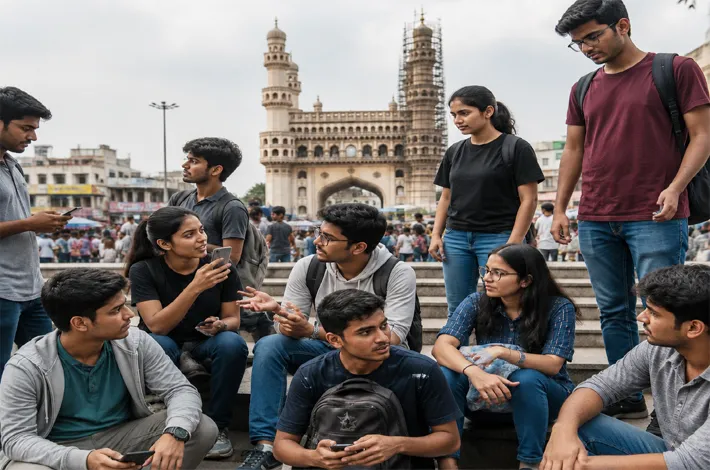
Why does Hyderabad’s Gen Z appear quieter when it comes to local politics and public accountability? Is the city’s young generation genuinely losing interest in civic affairs, or has protest simply moved somewhere older political language cannot easily see?
The answer may lie somewhere between the two. Hyderabad’s young people are not necessarily disengaged from issues. They are increasingly selective about where they spend their attention, how they express disagreement and whether they believe conventional political participation can actually change anything.
From outrage to exhaustion
For a generation overwhelmed by notifications, political debates, reels, and constant bad news, digital fatigue is growing. Academic pressure, competitive exams and demanding jobs leave little energy for online arguments or street protests. This exhaustion can resemble apathy, as many young Hyderabadis withdraw from political conversations, focusing instead on careers, finances and personal well-being, while growing increasingly cynical.
Yet the silence is selective.
Recent youth mobilization has often centred on NEET irregularities, government vacancies, recruitment notifications, scholarships, and education. The emphasis is less on party ideology and more on immediate questions affecting careers and futures.
Politics without the political stage
For many Hyderabad youngsters, Instagram, WhatsApp, memes and short videos are now key spaces for encountering and discussing public issues. The Cockroach Janta Party is a major local example, using satire to highlight concerns around unemployment, education, environmental destruction, public transport and governance. Its online humour has also translated into action, with supporters protesting in Hyderabad over examination-related concerns, showing digital mobilisation can extend beyond the virtual space..
‘We care about jobs and exams first’
The priorities are blunt. A young person worried about employment,
examination uncertainty or an unavailable government vacancy may find a party rally less relevant than a recruitment notification.
That explains why some young protesters say they do not want politicians speaking on their behalf as much as they want politicians to answer questions. Social media frequently serves as the organizing layer: a protest is discovered through Instagram or WhatsApp before it reaches the street.
At a recent Gen Z discussion at Lamakaan, the sentiment was captured in questions such as, “Why should we stay silent?” and “What if we stop watching and start standing together?” The message was not that young people had abandoned activism, but that they were questioning their own reluctance to participate.
Another Hyderabad-based student-protest post carried the defiant message, “We won’t stay…”, challenging the idea that the city’s youth will remain passive.
What young Hyderabadis say
The reactions, however, reveal a sharper divide over whether digital engagement is actually political participation.
Vagirkindi Raju, a first-year Economics student of HCU, argues that calling online activity a new form of strategy can sometimes be an excuse for avoidance. He says Gen Z has become comfortable and distant from real struggles, often convincing itself that posting is enough.
Manchala Kiran Kumar, a UGC-NET SRF scholar and PhD researcher at Osmania University, believes Gen Z has shifted “from the street corner to the screen”, rather than completely retreating from politics. But he warns that algorithmic comfort can turn participation into performance, with visibility replacing actual impact. Digital platforms, he says, should amplify accountability, not substitute for action on the ground.
Ajay Kumar Dandu, a JRF scholar at Osmania University, takes a more critical view, arguing that an Instagram story alone cannot bring local policy change. In his view, Hyderabad’s Gen Z risks becoming politically checked out and disconnected from the demands of real, ground-level struggle.
Saketh, a second-year MA History student, points to a longer process of depoliticisation. He says civic and political awareness is limited, while the absence of strong student organizations and union elections in colleges has further distanced young people from politics. He believes greater political awareness among school and college students could encourage them to raise their voices for their rights.
ArkutiAshwini, a first-year LLM student at Osmania University, says career pressure, studies, personal and family responsibilities, and a growing focus on individual goals keep many young people away from political activities and protests. While they may hold opinions on public issues, she says, these often do not translate into active participation or speaking up publicly.
The Rahul Gandhi question
This distinction becomes particularly relevant to Rahul Gandhi’s recent attempt to create a physical, women-only political space for Gen Z in Pune. The challenge for Hyderabad may not be persuading young people that issues matter. It is converting issue-based digital engagement into sustained political participation.
The city’s Gen Z may not have gone silent. It may simply be speaking in memes, private conversations, digital campaigns and occasional street protests — choosing when to make noise rather than making noise all the time.