25 October, 2026 | 10:33 AM


Bond yields are rising!
10-09-2026 12:00:00 AM
What does it mean for economy?
Metro India News | Hyderabad
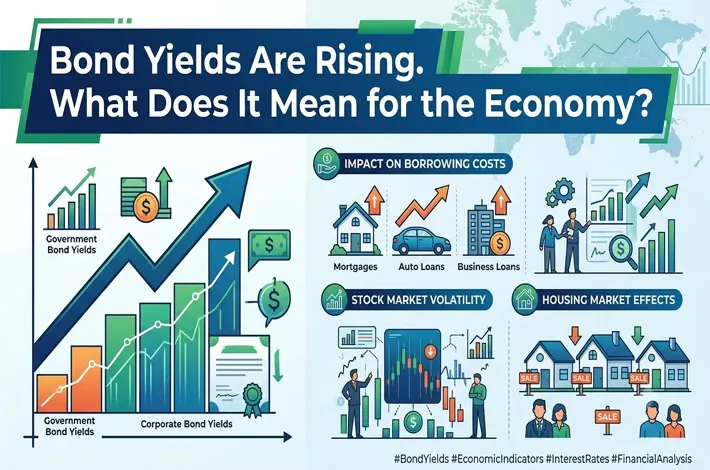
Bond yields serve as fundamental benchmarks for pricing across all other markets and asset classes. An upward movement in bond yields directly translates to an increase in interest rates. This occurs because the impact of bond yields on the market is more profound and rapid than that of policy interest rates. This swift transmission leads to higher interest costs for various loans, including personal, MSME, vehicle and mortgage loans. While an increase in interest rates typically aims to curb inflation, inadequate liquidity in financial markets can paradoxically lead to rising inflation even with higher interest rates.
Global bond market crosses US$150 trillion
The global bond market exceeds US$150 trillion, with government bonds accounting for 70 per cent and corporate bonds for 30 per cent. The United States holds the largest share, approximately 40 per cent, with US$58 trillion in outstanding bonds. China ranks second with US$28 trillion, followed by Japan with US$14 trillion. France, the UK, Germany and Canada are other significant bond markets. India ranks eighth globally, with US$2.8 trillion. When bond yields rise, the price of gold falls.
This is because gold is a non-yielding asset, offering neither interest nor dividends. Since investors generally prefer yield over capital gains, an increase in bond yields diverts funds from gold to bonds. Furthermore, rising bond yields discourage corporate investments and reduce consumer spending power. Thus, bonds play a crucial role in the entire financial system for both capital and yields.
Short-term vs long-term interest rates
Short-term interest rates are primarily influenced by policy interest rates, which are determined by prevailing inflation and expected growth. Long-term interest rates, however, are market-dependent, incorporating inflation, growth projections, risk premiums and capital flows. Rising long-term interest rates signal economic stress.
While policy interest rates can temporarily diverge from long-term interest rate trends, this separation typically lasts no more than a couple of months, as policy rates eventually align with the long-term trend. Fiscal and monetary policy measures must address both short-term and long-term interest rates. If central banks artificially suppress short-term interest rates, the yield curve steepens. This scenario might provide some economic impetus through cheaper short-term debt for personal, vehicle and credit card loans, potentially boosting bank credit growth and profitability.
However, higher interest rates on long-term debt can hinder corporate and public capital expenditure, impacting employment growth. Such a phenomenon risks creating asset bubbles, inflationary pressure, distorted market signals and economic stress. Governments globally, including India, are aware of these complexities and appear to be preparing responsive measures. While timely and appropriate measures are essential to address the challenges posed by rising long-term interest rates, markets must be prepared to endure the associated growing pains, which include moderated public spending and an increase in policy interest rates.

(-Dr. Kishore Nuthalapati is CFO at BEKEM Infra Projects Pvt Ltd, Hyderabad.)