6 October, 2026 | 4:07 AM


Earth’s habitability: A cosmic wonder
12-04-2026 12:00:00 AM
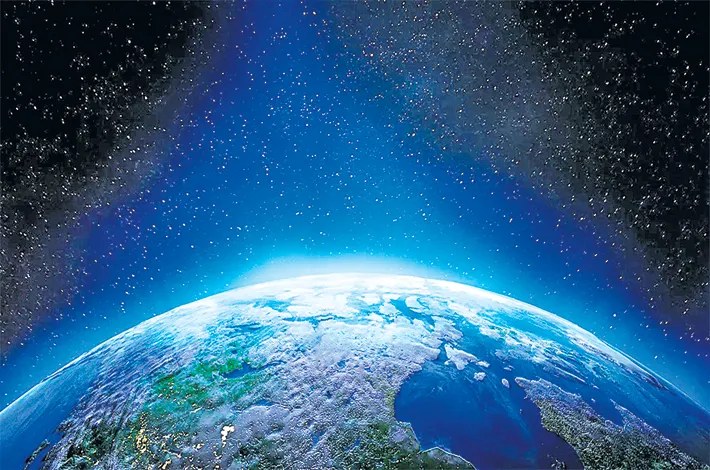
Earth’s position in space is almost impossibly precise. Shift the planet just one percent closer to the Sun and every ocean would begin to boil. Move it one percent farther away and the entire surface would freeze solid. We exist right now only because this single rock floats at exactly the right distance from our star, a distance no one can fully explain. For a moment, that fact alone should quiet any sense of cosmic importance we might feel about ourselves. In our Solar System, only one planet sits inside what astronomers call the habitable zone—the narrow band around a star where temperatures allow liquid water to exist on the surface.
Summers in Antarctica and winters at the equator would become common. Life as we know it could never have adapted quickly enough to such chaos. Far from being merely a beautiful object in the night sky, the Moon is a planetary stabilizer that keeps Earth livable. Invisible forces protect us as well. Earth’s magnetic field, generated deep within its molten iron core, acts as a shield that deflects the Sun’s dangerous radiation and charged particles. Mars once had a magnetic field too. When it disappeared, solar winds stripped away the planet’s atmosphere, turning a once-wetter world into the barren wasteland we see today.
Our core remains active, churning and shielding us every second, yet we rarely pause to acknowledge it. Equally remarkable is Earth’s system of plate tectonics. The slow dance of shifting continental plates recycles carbon dioxide through volcanic eruptions and rock weathering, functioning as a natural thermostat that has regulated the planet’s climate for billions of years. No other world in our Solar System possesses this mechanism. It is one more finely tuned feature that keeps conditions stable enough for complex life to thrive.
When all these elements are considered together—the precise solar distance, Jupiter’s protective gravity, the Moon’s stabilizing pull, the magnetic shield, and the tectonic thermostat—it becomes clear that Earth is not simply located in the Goldilocks zone. Earth is the Goldilocks zone. Every single factor had to align perfectly for life to emerge and endure. NASA has now confirmed more than 5,500 exoplanets, yet not one has been found that matches the extraordinary combination of conditions we enjoy here. In a universe that often feels indifferent, our home turns out to be an almost miraculous exception.