17 October, 2026 | 10:30 AM


‘Every Student Should Leave With an Offer Letter’
11-05-2026 12:00:00 AM
SREE DATTHA INSTITUTIONS
From Core Engineering to AI, Sree Dattha Institutions Position Themselves Industry Exposure and Discipline Shape the Institution’s Vision for Students
HEMA SINGULURI | Hyderabad
In an era where employability has become the biggest concern for students and parents alike, Sree Dattha Institutions are placing one promise at the center of their educational vision, preparing every student for a successful career with strong skills, industry exposure, and placement opportunities before graduation itself.
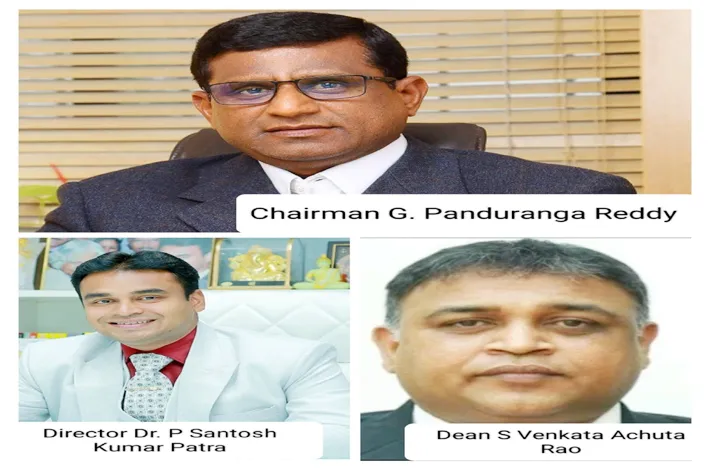
Located in Sheriguda village of Ranga Reddy district, Sree Dattha Institutions have steadily evolved into one of Telangana’s prominent educational groups by combining academics, discipline, innovation, and practical learning. Established under the Vyjayanthi Educational Society led by Chairman G. Panduranga Reddy, the institution group includes Sree Dattha Institute of Engineering and Science (SDES), founded in 2001, Sree Dattha Institute of Pharmacy (SDIP), established in 2005, and Sree Dattha Group of Institutions (SDGI), founded in 2010.
Today, the group consists of two engineering colleges, two teacher education colleges, two management colleges, one pharmacy college, and one polytechnic college, all operating with a vision of creating technically skilled, socially responsible, and industry-ready graduates.
The institutions are approved by AICTE-New Delhi, affiliated to Jawaharlal Nehru Technological University Hyderabad (JNTUH), accredited with NAAC “A+” grade and NBA accreditation. SDES and SDGI have also secured UGC Autonomous status, while SDIP is approved by the Pharmacy Council of India.
“Focus on Core Engineering First”: Chairman’s Clear
Message to Students
Chairman G. Panduranga Reddy, during an interaction, stressed that students should first build a strong foundation in core engineering before shifting focus entirely toward rapidly growing AI-based technologies.
“The students must focus on the Core Engineering then look out for the developed AI Courses to have a grip on the groundwork of Engineering,” he said.
Highlighting the growing opportunities in Electronics and Chip Manufacturing sectors, the Chairman pointed out that students must concentrate on courses that produce practical results and long-term opportunities. According to him, areas such as literacy rates, student rates, IT programming, and human resource development are becoming increasingly significant in shaping future careers.
He further observed that since only nearly 20 percent of the syllabus can officially be modified, students must think beyond textbooks and classroom learning.
The Chairman also explained that the institution strongly believes in a distraction-free academic atmosphere. “Our college is located outside the city limits, providing a distraction-free environment with multiple facilities, enabling students to focus on learning and make the best use of their valuable time on campus,” he said.
Speaking about the rise of Computer Science and emerging technologies, he said the demand for such courses is rapidly increasing and the institution provides year-long guidance to help students make informed academic and career choices.
“Year through guidance is provided for the students with careful considerations,” he added.
Early Skill Development and Zero Tolerance Towards Ragging
The institution management stated that students are introduced to soft skills and communication training from the early stages itself to prepare them for industry requirements.
Chairman Panduranga Reddy also emphasized the institution’s strict anti-ragging environment. According to him, the campus has maintained a ragging-free culture since inception, ensuring EAMCET aspirants and freshers feel secure and comfortable during their college life.
Placement Vision: “100 Percent Is the Goal”
Dr. P. Santosh Kumar Patra, Director of the institution, highlighted that consistent growth is being driven through focus on academics, industry orientation, grades, placements, and discipline.
“Students should look out for such prominent factors before joining,” he said.
He observed that while many students focus only on marks and rankings, discipline and decorum remain the institution’s highest priorities.
“The main and most important factor followed is the Decorum and Discipline,” he said.
According to him, the institution currently maintains a placement ratio above 85 percent and continues to improve industry collaborations and infrastructure to increase recruitment opportunities further. “Our placement ratio is above 85 percent and we make sure that all the key factors and demands are met,” he added.
He further explained that curriculum redesign is continuously carried out with support from JNTU experts, intercity specialists, alumni, and a dedicated academic team of nearly 14 to 18 members to keep students aligned with industry needs.
Learning Beyond Classrooms
Dean Academics S Venkata Achuta Rao explained that the institution follows several technical initiatives including “2+4” technical clubs, software testing programs, hackathons, webathons, and cybersecurity-focused training.
Special labs, additional classes, around 300 computer systems for each department, and upgraded IT infrastructure are being used to strengthen placements and practical exposure.
The institution also maintains a Board of Studies (BOS) ecosystem while continuously focusing on employment opportunities and personality development for students.
The management stated that constant paid internships, collaborations with companies, PhD-holding faculty, IIT Bombay-supported LBTN courses, and faculty development programs are being implemented regularly.
“Our faculty is trained constantly to give best classes with patience,” the team explained.
He also highlighted hostel facilities and academic monitoring systems aimed at reducing backlog rates among students.
Two Degrees in Four Years
One of the institution’s major highlights is its minor degree initiative. Students enrolling in regular courses can simultaneously pursue trending minor specializations such as Cyber Security and Data Science.
“Not just the academics but 2 degrees within 4 years of time will be given for the students,” the team said.
The long-term vision, according to the institution, is clear: “Goal is to guarantee a job, along with skill and sport education.”
For EAMCET aspirants and new joiners searching for a campus that combines placements, discipline, industry-oriented learning, and practical exposure, Sree Dattha Institutions are positioning themselves as a complete career-focused educational ecosystem.