1 October, 2026 | 12:29 PM


Hyd Sewer Overhaul Hits Funding Wall
04-02-2026 12:00:00 AM
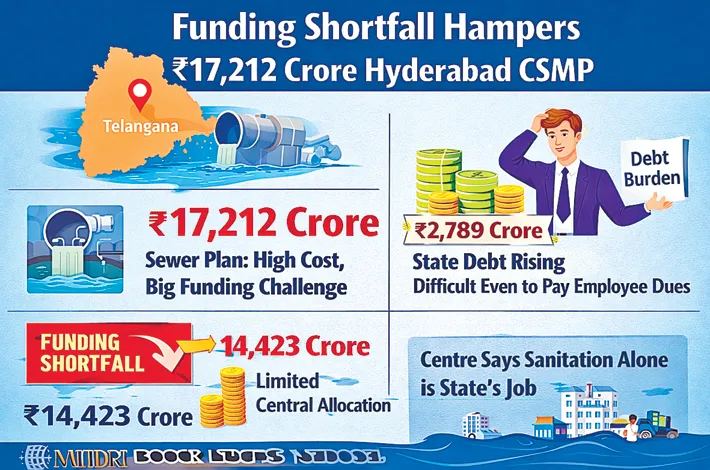
Centre calls sanitation state subject, State faces funding hurdle for Rs 17,000-Cr
The Telangana government is grappling with a monumental challenge in implementing its ambitious Comprehensive Sewerage Master Plan (CSMP) for Hyderabad, as the Central government has emphasized that sanitation is primarily a state subject, offering only supplementary assistance. With a staggering project cost of Rs 17,212.69 crore and the state's escalating debt burden making it difficult even to disburse retirement benefits to employees, funding and executing this critical infrastructure overhaul on its own appears a herculean task. The plan aims to address long-standing gaps in sewerage coverage, but limited central allocation under schemes like AMRUT 2.0—capped at Rs 2,789 crore for Telangana—means the state must bridge a massive funding shortfall, potentially straining its fiscal resources further.
The CSMP, proposed by the Telangana government, seeks to establish a comprehensive sewerage network including trunk mains and laterals in uncovered areas up to the Outer Ring Road (ORR). Covering a total length of 7,444 km, the project encompasses the core city, peripheral areas, and 27 Urban Local Bodies (ULBs) surrounding Hyderabad. A Detailed Project Report (DPR) has been prepared and submitted to the Union government for approval under AMRUT 2.0 or as a special project, requesting financial assistance of Rs 17,212.69 crore.
Telangana government, seeks to establish a comprehensive sewerage network including trunk mains and laterals in uncovered areas up to the Outer Ring Road (ORR). Covering a total length of 7,444 km, the project encompasses the core city,
peripheral areas, and 27 Urban Local Bodies (ULBs) surrounding Hyderabad. A Detailed Project Report (DPR) has been prepared and submitted to the Union government for approval under AMRUT 2.0 or as a special project, requesting financial assistance of Rs 17,212.69 crore.
According to additional details from project outlines, the DPR divides the initiative into targeted packages. In peripheral circles and the core city, it proposes 2,656 km of network, with specific allocations: Package-I covering 765.85 km in Uppal, Kapra, Malkajgiri, Alwal, and Serilingampally; Package-II spanning 643.29 km in Rajendranagar and LB Nagar; and Package-III extending 831.78 km in Kukatpally and Quthbullapur. For the core city, where an existing system is in place, additional networks include 81 km in Zone-1, 92 km in Zone-4, 77 km in Zone-5, and 174 km in Zone-6, totaling 424 km. In the 27 ULBs within ORR, lacking adequate infrastructure, the plan calls for full refurbishment with 4,378 km of new lateral lines, branch sewers, and trunk mains to prevent sewage overflow into nalas. Chief Minister A. Revanth Reddy recently handed over the DPR to Union Urban Development Minister Manohar Lal Khattar, underscoring the urgency for central funding.
In response to queries from MPs Chamala Kiran Kumar Reddy and Eatala Rajender in the Lok Sabha a few days ago, Minister of State for Housing and Urban Affairs Tokhan Sahu clarified the Centre's stance. Sanitation, including setting up Sewerage Treatment Plants (STPs) and systems, remains the responsibility of state governments and ULBs. The Union government provides financial and technical support through missions like AMRUT 2.0, but states are empowered to select, appraise, and implement projects via State Level Technical Committees (SLTC) and High Powered Steering Committees (SHPSC). Final approval comes from MoHUA's Apex Committee within the mission's framework.
Under AMRUT 2.0, allocations are based on urban population (Census 2011) and geographical area, with Telangana's total central allocation fixed at Rs 2,789 crore. The state's Water Action Plans (SWAPs), comprising 252 projects worth Rs 9,584.26 crore (including admissible central assistance of Rs 2,788.03 crore), have been approved. This includes three sewerage/septage management projects in Greater Hyderabad Municipal Corporation (GHMC) valued at Rs 3,849.10 crore, with Rs 645 crore in central assistance.
Despite this, the approved funds fall far short of the CSMP's requirements, placing the onus squarely on Telangana to mobilize the balance. Amid the state's financial crunch—marked by soaring debt and delays in employee payouts—the project's execution could face delays, highlighting the need for innovative funding mechanisms or enhanced central-state collaboration to ensure Hyderabad's sustainable urban growth.