20 September, 2026 | 10:45 PM


Millers cry foul over norms
18-05-2026 12:00:00 AM
metro india news I hyderabad
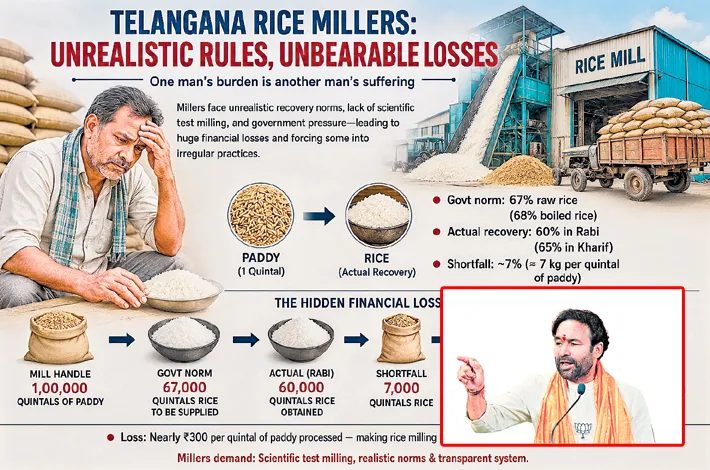
The situation of rice millers in the Telangana, they say, is similar to the proverb “one man’s burden is another man’s suffering.” While allegations are being raised about irregularities in paddy procurement and rice supply in the state, millers argue that the real pressure lies in the unrealistic conditions imposed on them and the lack of scientific testing by the government.
Millers claim that instead of conducting proper test milling during Kharif and Rabi seasons to set realistic benchmarks, the government is delaying the process and simultaneously forcing them to supply rice under impractical norms. They allege that in the name of rules, rice is being “extracted” from them under pressure, while they are also being portrayed as responsible for irregularities.
A major point of contention is the delivery target of 67 per cent raw rice and 68 per cent boiled rice, which millers say is impossible to achieve under actual milling conditions. According to them, even in Kharif season this is unachievable, and in Rabi it becomes even more unrealistic. They argue that official agencies like the FCI and Civil Supplies department are setting norms that do not match ground realities.
Taking fine variety paddy as an example, millers say that when one quintal is milled, it yields only about 65 per cent quality raw rice. This itself results in a 2 percent loss. In Rabi season, the yield drops further to around 60 per cent, leading to nearly 7 per cent loss. Based on this, they say that for every quintal of paddy, they are losing about 2 kg of rice in Kharif and nearly 7 kg in Rabi.
They further explain the financial burden at scale. Assuming a rice mill handles around 1 lakh quintals of paddy, as per government norms, 67,000 quintals of rice must be supplied. However, in reality, especially in Rabi, only about 60,000 quintals are obtained. This creates a shortage of around 7,000 quintals of rice.
To compensate for this 7,000-quintal shortfall, an additional 10,447 quintals of paddy would be required. When calculated with current procurement rates, where fine variety paddy is priced at Rs 2,360 per quintal along with a Rs 500 bonus, the total value of this additional requirement comes to about Rs 2,98,78,420, which is roughly close to Rs 3 crore.
Millers say this translates into a loss of nearly Rs 300 per quintal of paddy processed. On a large scale, this becomes a massive financial burden for rice mills, making the business unsustainable under current rules.
They also allege that the government is not taking up test milling exercises in a timely manner. According to them, no proper test milling has been conducted for the last one and a half years. Without these scientific tests, they argue, fixing a uniform recovery percentage like 67 percent is unfair and unrealistic. They also point out that rice yield varies from region to region and season to season, and a random approach does not reflect actual ground conditions.
Millers suggest that if test milling is conducted directly from samples of paddy supplied to each mill, the real yield variations will become clear. They say they have no objection to supplying rice based on scientifically determined norms, but fixing rigid percentages without testing is forcing them into losses.
They further allege that due to strict deadlines, government pressure, and fear of legal action, millers are forced to manage the shortfall of about 7 kg per quintal, which they claim is pushing some into irregular practices.
According to them, these unrealistic rules and pressure tactics are not only creating financial stress but also contributing indirectly to alleged irregularities. They argue that the entire chain—from paddy procurement to transportation and rice delivery—is becoming vulnerable to allegations due to lack of transparency and practical planning.
Millers have urged the authorities to bring in a fully transparent system using modern technology, conduct regular test milling, and frame scientifically valid guidelines so that procurement and rice supply can be carried out without disputes or losses.
Govt deceiving farmers: Minister Kishan Reddy
Union Minister of Coal and Mines G. Kishan Reddy has alleged the Congress government in Telangana is deceiving farmers over paddy procurement. Speaking at a media conference today at the state BJP office in Hyderabad, Mr Reddy said that the Central government bears every single paisa of costs for paddy procurement, including gunny bags, transportation, and storage. He alleged that, despite this, the state government is delaying procurements.