12 October, 2026 | 8:59 PM


Mining stopped to save endangered owl
05-12-2025 12:00:00 AM
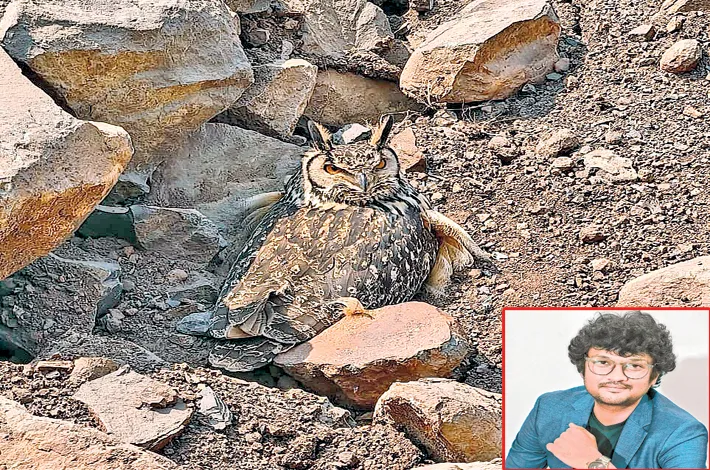
Mining has been stopped for 30-35 days till the eggs hatch. Forest department and quarry management supported
It is rare for mining operations to come to a standstill to facilitate a bird to hatch eggs. In this case Indian Eagle-Owl (Rock Eagle Owl), a nocturnal raptor that prefers nesting on rocky cliffs and scrub forests to hatch eggs. What was a casual trip by birders Manoj Kumar Vittapu and Shreeniwas Kandukuree turned out to be a major conservation effort.
As the birders were moving about, workers at the mining site at Yenkatala Grasslands pointed out a large bird on the edge of a cliff and soon, the duo were on top of the hill to find to their surprise five eggs lying exposed on the bare rock, just a few metres from active mining machinery. The Indian Eagle-Owl, a protected bird and an important natural pest controller had to be protected and the eggs hatched. What followed was nothing short of a miracle as the stone crushing machines were stopped, the forest department was alerted and within no time, DFO G. Gnaneshwar and PCCF C. Suvarna instructed their team to reach the site. Forest Section Officer Inayath Ali and Beat Officer Mahesh trekked along the quarry ridge and confirmed the eggs’ location.
In an encouraging example of on-ground conservation, the quarry contractor, Laxma Reddy, decided to fully cooperate and mining has been stopped for 30-35 days till the eggs hatch.
The credit for this rescue goes to everyone involved the JCB driver who noticed something was wrong, the birders who stepped in at the right time, and the quarry management who chose conservation over continued work. The unit owner agreed not to disturb the bird till the hatchlings fly.
The PCCF asked the Vikarabad district forest officials to quickly take safety measures.The forest department personnel who reached the site informed the stone crushing unit owner Laxma Reddy about the presence of rare bird species and the eggs, he said.
The forest department personnel have been keeping a close watch on the bird since then on a daily basis, Gnaneswar said. The rock eagle owl, which preys on insects, rats and others, is mainly found in South East Asia. Compared to other owls, it inhabits rocky areas, he said.
"It's a rare species though it is not endangered. Its sighting is rare," the official said. Yenkatala’s scrubby rocky terrains are often dismissed as “wastelands,” when in fact they support species that rely on them for survival. Though it is not known when the bird laid the eggs at the Yenkathala grassland, it is expected that hatching would happen in another 15 days. The hatchlings would fly away if protective care is taken for 20-25 days, he said.
The rock eagle owl incubates the eggs and ensures that they remain warm, he added.