25 September, 2026 | 12:07 PM


Modi on Somnath Swabhiman Parva
06-01-2026 12:00:00 AM
metro india news I new elhi
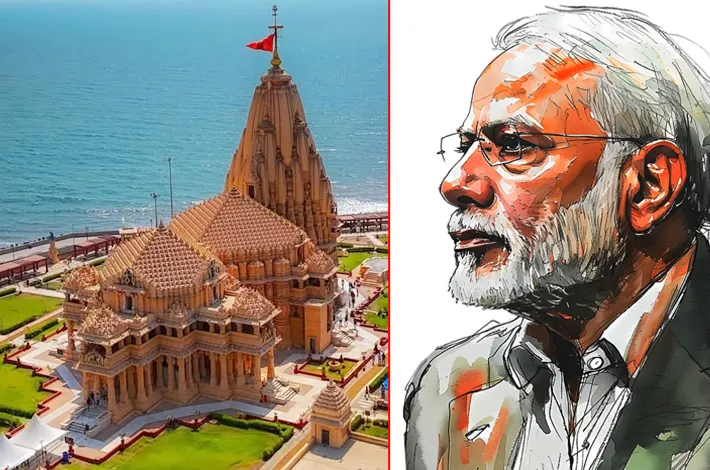
Prime Minister Narendra Modi on Monday recalled the great surviving instincts of Sri Somnath Temple which withstood the onslaught of Muslim war lords like Ghazni, exactly 1000 years ago. On the sacred occasion, PM Modi wrote on his twitter handle (X) and posted a on his Blog about the greatness of Somnath temple.
"Somnath Swabhiman Parv – A 1000 Years of Unbroken Faith (1026-2026)"
Published on his official website (narendramodi.in) on January 4/5, 2026, the piece reflects on the 1,000th anniversary of the first attack on the Somnath Temple by Mahmud of Ghazni in January 1026, framing the temple's history as a powerful symbol of India's civilizational resilience, unbreakable faith, and cultural pride rather than mere destruction.
PM Modi begins by evoking deep pride in the word "Somnath," describing it as the "eternal proclamation of India’s soul." He highlights its location in Prabhas Patan, Gujarat, on the Arabian Sea coast, and its primacy as the first of the 12 Jyotirlingas in the Dwadasha Jyotirling Stotram. For centuries, it has drawn millions in devotion, uniting people across walks of life (referencing historical figures like Jain monk Kalikal Sarvagna Hemchandracharya who visited and composed verses there).
The 1026 Attack and Repeated Destructions
He notes that 2026 marks exactly 1,000 years since Mahmud of Ghazni's violent invasion (marching in October 1025 and attacking around January 6, 1026, per historical accounts like K.M. Munshi's Somanatha: The Shrine Eternal).
The invaders' goal was demolition, not devotion, inflicting immense cruelty and devastation. This began a pattern of repeated attacks over centuries, aimed at enslaving India's people and culture.
Resilience and Rebirth Over Destruction
The core message is that Somnath's story is not defined by destruction but by the "unbreakable courage of crores of children of Bharat Mata" who protected faith and civilization.
Despite repeated assaults, the temple rose again through generations of defenders and restorers—often at great personal sacrifice. Indian civilization's belief in the eternity of spirit and ideas ensures that what is truly eternal cannot be erased. Somnath exemplifies this indomitable spirit, standing gloriously despite odds.
Post-Independence Revival
He recalls the modern reconstruction after independence: Sardar Vallabhbhai Patel, deeply moved during a 1947 visit, vowed to rebuild it at the original site. K.M. Munshi played a key role in the effort, funded by public donations (not government funds). The restored temple was inaugurated on May 11, 1951, in the presence of President Dr. Rajendra Prasad (celebrating 75 years in 2026). PM Modi notes that then-PM Jawaharlal Nehru was not enthusiastic about the project or high officials' involvement, but figures like Patel, Munshi, and Prasad prevailed, seeing it as a symbol of national pride and self-respect.
Broader Civilizational Message and Conclusion
Somnath represents the triumph of faith, goodness, and conviction over hate and fanaticism—hate may destroy momentarily, but faith creates eternally. As head of the Somnath Temple Trust, Modi ties this to contemporary India: with Lord Somnath's blessings, the nation advances toward a "Viksit Bharat" (Developed India), guided by civilizational wisdom for global welfare. The ongoing #SomnathSwabhimanParv (Self-Respect Festival) commemorates this "unbroken faith" through year-long spiritual and cultural activities.