19 October, 2026 | 10:08 AM


Ram mandir theft a major setback to RSS’s philosophy
01-07-2026 12:00:00 AM
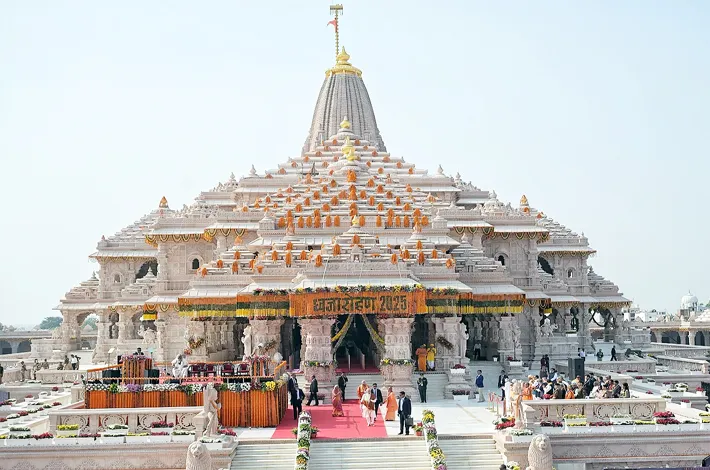
It’s not that RSS did not realise the gravity of the situation; it did, but it was paralysed in responding because it did not know how to handle it
Three fundamental questions need to be asked outright about the controversy surrounding the theft of the donation at the Ram Mandir in Ayodhya. First, why was the Ram Janmabhoomi Kshetra Trust not disbanded by the central government immediately after the theft came to light? Second, why was an FIR not lodged when the matter came to the UP police’s knowledge? Third, why did the RSS not remove Champat Rai, Anil Mishra, and Gopal Rao, the three Swayam Sevaks of the RSS, as and when it learnt how to save itself from the alleged taint?
All three steps were needed not only for a fair investigation but also to save the RSS family from any kind of damage being inflicted on their commitment to Hindutva and also to the faith of the crores of Ram bhaktas—those for whom Ram is Maryada Purushottam; Ram who asked his wife Sita to go through Agni Pariksha to dispel the doubt in the minds of the people at large in Ayodhya and neighbouring places when a common man raised a question about the purity of Maa Sita.
But when it was time for the Sangh Parivar to go through an Agni Pariksha and come out clean as Maa Sita did, it failed. And now all kinds of questions are being raised, innuendos are being thrown at them, and insinuations are being made; a few of these questions are genuine, and a few are loaded with bias. And others are guided by politics, and the Sangh Parivar is trying very hard to wriggle out, but its efforts are not proving decisive or convincing; even its own supporters are angry and questioning the motives of its leaders.
I am sure that the RSS will come out of this crisis too, as it has faced many serious crises in the past, the biggest of them all being the accusation that it had a role to play in the assassination of Gandhi. To be fair to them, this accusation lacks merit, as no evidence of their involvement has ever been found. In his letter to the then Prime Minister Nehru, Sardar Patel, the Home Minister and Deputy Prime Minister, had written that no evidence was found linking the RSS to the crime.
This was the letter in which Patel categorically wrote that people related to the Hindu Maha Sabha, led by Savarkar, were involved in Gandhi’s assassination. Still, the RSS was banned, its chief, MS Golvalker, was arrested along with thousands of volunteers, and violence was unleashed against their members; their offices were ransacked. The RSS and its other organisations carried that taint at least for two decades. This was the time when it was treated as untouchable, but it survived, and now it is at the helm of affairs, occupying the pole position in India.
But today’s crisis is grave, if not as serious as the one I mentioned above, and it will undoubtedly impact its image. This time, the attack is not from the outside but from within. It has hit at the core of its philosophy. The RSS owes its phenomenal rise to Lord Ram. It is the Ram Janmabhoomi movement launched by the Vishwa Hindu Parishad (VHP) at the instruction of Bala Saheb Deoras, the third RSS chief, in the early 1980s as a counter to the bulk conversion of Hindus at Meenakshipuram. As claimed, the Babri Masjid/Ram Mandir controversy was more than 500 years old, but it was not on the RSS agenda until the early 1980s.
The RSS did not take up the issue even after the idol of Ram Lala was placed at Babri Masjid in 1949. The RSS, in the 1960s and 1970s, was more interested in taking up the cause of cow protection, which never became a big issue for the larger Hindu population. But the Ram Mandir issue clicked. Lal Krishna Advani’s Rath yatra did wonders for the BJP, the RSS’s political wing, which was greatly instrumental in the BJP forming the government on its own in 2014, along with the Modi cult. All through, the RSS took credit for the construction of the Ram Temple.
While inaugurating the Ram Temple on January 22, 2024, PM Modi called the inauguration the Hindu Renaissance, a watershed moment in Hindu civilisation. Ram became synonymous with the RSS’s Hindutva, a reason for Hindu unity, which is the civilisational project of the RSS—to shed the sins of the past, throw away the yoke of a thousand years’ slavery, and create a new Hindu who is not timid about his Hindu identity but proud of being a Hindu. Undoubtedly, the RSS succeeded in its project to a great extent.
Nationalism is another very important factor in the RSS’s Hindutva. But unlike Gandhi’s, Nehru’s, Patel’s, and Azad’s nationalism, the RSS’s nationalism is not a pan-Indian identity; it is exclusive; it is defined by Hindu identity. And it has successfully created a new identity called Hindu nationalism, and its adherents are called Hindu nationalists. Ram, in our consciousness, is vinaysheel, i.e., a humble, modesty-personified person, but the RSS turned him into a warrior Ram, an angry Ram, who fights with Ravan to defend Dharma.
Since the 1980s, the RSS has projected that those who don’t subscribe to Ram as a marker of their national identity have no reason to call themselves Bhartiya. Certainly, this entire discourse has a serious tone of religiosity and excludes everyone who doesn’t follow this line of nationalist discourse. It has succeeded in creating a very strong supporter of this line of thinking. In the larger Hindutva debate, Ram is Hindutva, and Hindutva is Ram. It is this section of the support base that is upset by the expose on the Ram Mandir theft and wants exemplary punishment, as Ram is non-negotiable for them. The RSS’s failure to take prompt, immediate, and seemingly fair action has disappointed them.
It’s not that the RSS did not realise the gravity of the situation; it did, but it was paralysed in responding because it did not know how to handle it, as it knew a minor mistake would damage it for a long time. It took time, which opened a window of suspicion, and now it’s too late to convince its own supporters. Now, if it wants to salvage its image, it has to take exemplary actions.
The RSS faced the dilemma of choosing between the individual and the organisation. It did not realise that at the altar of organisation, individuals have to be sacrificed; if the choices are between the man and the ideology, then ideology should be the obvious choice. Organisation and ideology have to survive; individuals can come and go.