12 October, 2026 | 3:59 AM


Ram Sethu ushers a modern bridge
28-03-2026 12:00:00 AM
Sri Ram Navami, one of the most revered festivals in the Hindu calendar, commemorates the birth of Lord Rama, the seventh avatar of Vishnu and the central figure of the ancient Indian epic, the Ramayana. Celebrated with great fervor across India and among the global Hindu diaspora, the festival falls on the ninth day (Navami) of the bright fortnight in the month of Chaitra.
Devotees observe fasts, recite the Ramayana, organize processions with idols of Rama, Sita, Lakshmana, and Hanuman, and participate in vibrant cultural programs. Temples dedicated to Rama, such as those in Ayodhya and Rameshwaram, become centers of grand celebrations, symbolizing the triumph of dharma (righteousness) over adharma (unrighteousness)
The Ramayana, traditionally dated by some scholars and believers to events around 7,000 years ago or more, narrates the life of Prince Rama of Ayodhya. A pivotal episode in the epic involves the abduction of Rama’s wife, Sita, by the demon king Ravana, who takes her to his island kingdom of Lanka (identified with modern-day Sri Lanka). To rescue her, Rama, aided by his brother Lakshmana and an army of vanaras (monkey-like warriors) led by Hanuman, constructs a massive bridge across the sea.
This structure, known as Ram Setu or Rama’s Bridge, allows the army to cross into Lanka, defeat Ravana, and restore Sita. The epic describes the bridge’s construction under the guidance of architects Nala and Neela, with stones that miraculously floated due to inscriptions of Rama’s name—a tale that blends divine intervention with themes of devotion, engineering ingenuity, and unity. What makes this mythological account intriguing is its potential correlation with a real geographical feature.
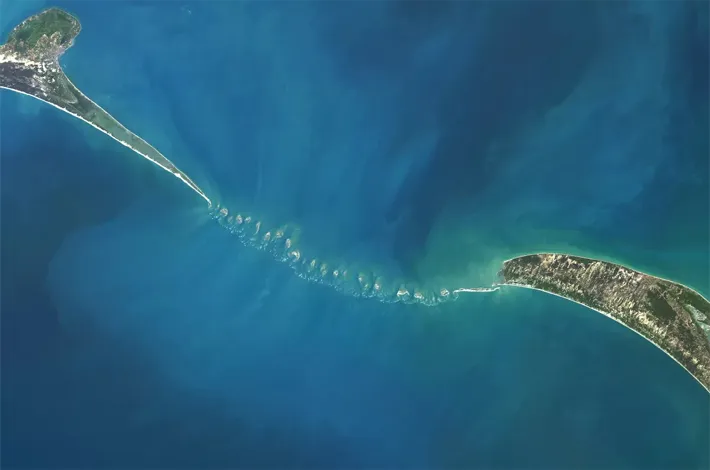
In the Palk Strait, separating Tamil Nadu in India from the Mannar region in Sri Lanka, lies a 48-kilometer-long chain of limestone shoals known as Adam’s Bridge or Ram Setu. This formation stretches between Pamban Island (near Rameswaram) and Mannar Island, acting as a natural divider between the Gulf of Mannar and the Palk Bay. The structure is approximately 100 meters wide in parts, with shallow depths ranging from 1 to 10 meters, though it varies. Satellite images and oceanographic studies have highlighted its linear alignment, prompting debates on whether it is purely natural or bears traces of ancient human intervention.
Scientists and geologists largely attribute Ram Setu to natural processes: accumulation of coral reefs, sandbanks, and limestone shoals shaped by tectonic forces, sedimentation, and marine currents over millennia. The straight-line appearance is described as a curious but explainable geological phenomenon rather than deliberate engineering.
However, proponents of the man-made theory point to the 10:1 length-to-width ratio mentioned in the Ramayana, which some claim matches the formation, along with claims of unusual stone alignments. A former Geological Survey of India official and certain documentaries have suggested possible human enhancement of a natural base. The Archaeological Survey of India, in past court affidavits, maintained there is no conclusive evidence linking it directly to a historical Ramayana event, viewing it as a natural formation.
Historical and geological observations add layers to the mystery. Records from the Ramanathaswamy Temple in Rameswaram suggest that the bridge remained walkable on foot until a massive cyclone in 1480 AD deepened the channels and submerged sections. Some oceanographic studies and carbon dating of nearby beaches near Dhanushkodi and Mannar indicate formations potentially dating back 7,000 years, aligning roughly with certain traditional timelines of the Ramayana. NASA satellite imagery has also captured the striking chain of shoals, fueling public interest since the 1980s and 1990s when such images became widely discussed.
To address this, proposals for the Sethusamudram Shipping Canal Project have emerged over decades, aiming to dredge a channel for shorter passages. However, the project has sparked intense controversy due to religious sensitivities around Ram Setu, environmental concerns over fragile marine ecosystems, and questions of economic viability. Earlier estimates placed costs in the thousands of crores, with significant expenditures already incurred in preliminary work.
Ram Setu thus embodies a unique confluence of mythology, history, geology, and modern development challenges. For millions, it remains a sacred testament to Rama’s devotion and valor, celebrated annually during Ram Navami through prayers and reflections on dharma. For scientists, it offers insights into ancient coastal dynamics and human-environment interactions. For policymakers, it poses questions of sustainable progress that honor both progress and beliefs.
- Dr. Kishore Nuthalapati
The author is CFO at BEKEM Infra Projects Pvt Ltd