22 September, 2026 | 5:38 PM


Hyderabad Metro Meltdown
23-12-2025 12:00:00 AM
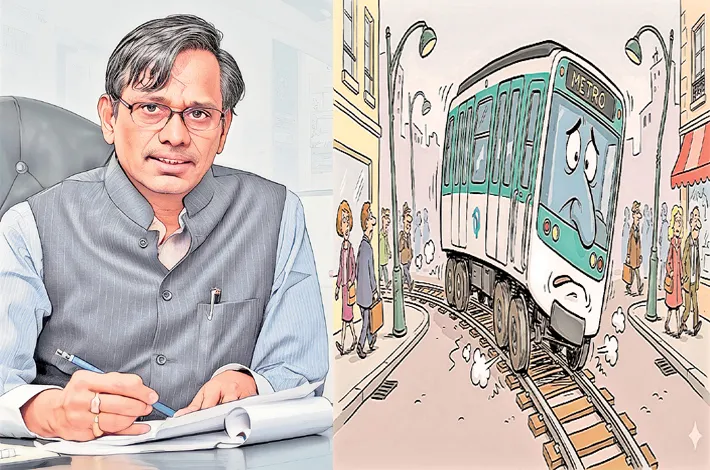
Telangana's Rash Takeover Triggers Financial Fiasco and Commuter Chaos
Who bears responsibility for the Rs 1 lakh crore-plus loss? Advisors and IAS officers, accused of rubber-stamping political whims without dissent notes. "Has anyone put up a fight?"
In the heart of Hyderabad, where traffic snarls define daily life, the Metro Rail was once a beacon of hope—a sleek, elevated escape from gridlock. But today, it's a symbol of governmental blunder. The Telangana Congress government's impulsive decision to wrest control of the Hyderabad Metro from L&T Metro Rail Hyderabad Limited (L&TMHRL) has unleashed a torrent of financial hemorrhage and commuter misery. Announced in September, with the handover set for March 2026, this move—absorbing Rs 13,000 crore in debt and shelling out Rs 2,000 crore in equity settlement—smacks of shortsighted populism. Vijayakranthi and Metro India, had sounded the alarm twice before, warning of eroded service quality, skyrocketing costs, and a public burdened for generations. Their pleas fell on deaf ears, and now, the cracks are showing even before the ink dries on the deal.
The Hyderabad Metro launched as the world's largest public-private partnership (PPP) project, with L&T holding a 90% stake and the state 10%. Spanning 69.2 km across three corridors—the Red Line from Miyapur to LB Nagar, Green from JBS to MGBS, and Blue from Nagole to Raidurg—it transformed urban mobility. Over eight years, it carried 80 crore passengers, hitting a peak of 5.5 lakh daily riders in early 2025. Revenues topped Rs 1,100 crore annually, with fares contributing Rs 703 crore in FY23. But beneath the shine lurked red ink: Cumulative losses ballooned to Rs 6,600 crore, including Rs 625 crore in FY25, fueled by Rs 429 crore in operating costs and Rs 1,273 crore in interest on Rs 12,500 crore borrowings. L&T, weary of the drain, sought an exit, and the government obliged—not by negotiating a fair split, but by swallowing the poison pill whole.
The takeover's price tag? A staggering Rs 15,000 crore, including debt absorption and settlement. But here's the kicker: The government now pays 11% interest on that debt, nearly double L&T's 6%. Add in the alleged Rs 1 lakh crore in projected losses L&T would have incurred over the contract's life, and you're looking at a fiscal black hole. Vijayakranthi and Metro India minced no words: "It's a disaster, a clear burden on the public for the next fifty years." Why bail out a private giant at taxpayer expense? Speculation swirls around corruption—did backroom deals grease this handover? Opposition parties, NGOs, and the public remain eerily silent, prompting questions: Is this the 'beauty' of Indian democracy, where colossal blunders go unchallenged?
The fallout hit hard and fast. Even pre-handover, service quality plummeted. Daily ridership cratered to 4 lakh—a 20% drop from 5 lakh mid-2025. Train frequencies stretched to 10-12 minutes in non-peak hours, up from 8-15 minutes, while the last train now departs at 11 pm instead of 11:45 pm, effective November 3, 2025. "Low footfall and cost savings," L&T claims, but commuters beg to differ. Night-shift workers like Veronica Racheal, a nursing officer from Sangareddy, now scramble for alternatives: "It's not just inconvenient; it's unsafe and exhausting." Peak-hour overcrowding has worsened, with trains stubbornly limited to three coaches despite pleas for six. Road safety expert Ramanjeet Singh blasts these cuts: "You're discouraging public transport when we need it most. This is anti-progress."
Compounding the chaos is the government's own Mahalakshmi scheme, launched by the Congress regime, offering free bus rides to women. Noble in intent, it's a metro killer in practice. Female commuters, once 40% of metro users, have migrated en masse to buses, slashing ridership further. L&T officials peg the drop from 5.5 lakh to 4.8 lakh daily on this policy alone. Revenues nosedived 21% in FY24-25, despite earlier 25% ridership growth. Once India's second-busiest metro, Hyderabad has slipped to ninth nationally. Systemic flaws exacerbate the pain: Poor last-mile connectivity means 62% of users shell out extra for buses, autos, or scant bike-sharing. Fares (Rs 10-60) dwarf bus rates (Rs 5-30), making the metro a luxury few can afford amid inflation.
Passenger voices echo the discontent. A Tata Institute of Social Sciences survey of 210 users found 62% praising time savings and convenience, with 88% of vehicle owners opting for the metro's safety. Yet, gripes abound: High fares, infrequent services, and overcrowding in reserved coaches. Women access reserved seats 81% of the time, but elderly users manage only 43%. Employee morale is in tatters amid takeover uncertainties—a special audit looms, and may interim-operate for six months. "It's like jumping from a sinking ship to a leaky boat," quips one metro staffer anonymously.
Politically, the decision reeks of malpractice. BRS leader KT Rama Rao thunders: "This burdens taxpayers with Rs 15,000 crore while gifting prime lands to L&T." Supporters counter it's a "blessing" for stability, mirroring government-run successes in Delhi and Bengaluru. But why the haste? Phase-II expansion—76.4 km at Rs 24,269 crore across five corridors—awaits central nod, yet basics like adding coaches or bolstering feeders remain ignored. Who bears responsibility for the Rs 1 lakh crore-plus loss? Advisors and IAS officers, accused of rubber-stamping political whims without dissent notes. "Has anyone put up a fight?" Vijayakranthi and Metro India demand.
The public deserves answers: Monthly losses? Interest payouts on L&T loans? Ridership dips' financial toll? Transparency is non-existent; no special assembly debate, despite the stakes. Ignoring warnings from Vijayakranthi and Metro India twice over smacks of arrogance. This isn't just a metro mishap—it's a taxpayer travesty, saddling Telangana with debt for decades while commuters suffer in silence.
As Hyderabad chokes on its growth, the metro's fate hangs in balance. Will the government reverse course, compensate L&T for genuine faults without absorbing their sins? Or will this haphazard handover cement a legacy of loss? The clock ticks toward March 2026, but the damage is already done. In a city racing toward the future, this is a screeching halt—courtesy of decisions made in haste, repented at leisure.