23 September, 2026 | 9:02 PM


IIT Hyderabad unveils air taxi prototype for urban commuting
07-01-2026 12:00:00 AM
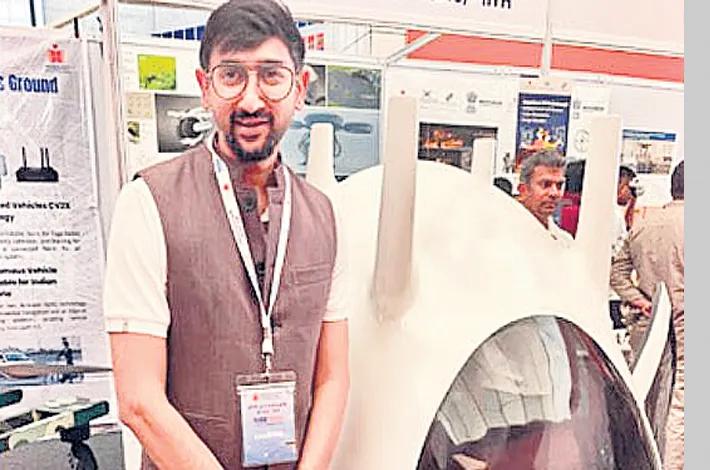
This prototype is capable of carrying a payload of around 120 kilograms and can travel at speeds ranging between 60 and 120 kilometers per hour. This makes it suitable for short urban hops
For the city commuters, who are long resigned to frustrating traffic and endless red signals, a glimpse of the future may soon come from the skies. Researchers at the Indian Institute of Technology Hyderabad (IIT-H) have revealed an air taxi prototype that could transform the way people move through congested urban spaces, provided ongoing trials and the regulatory approvals.
This prototype was showcased at IIT-H’s Kandi campus in Sangareddy district by faculty members Deepak John Mathew and Ketan Chaturmata, marking a significant step in India’s push toward advanced air mobility. Designed as a compact aerial vehicle, the air taxi aims to bypass ground congestion altogether by offering short-distance aerial travel across cities.
Unlike the traditional helicopters or piloted aircraft, this air taxi is built around the automation. It follows the pre-programmed routes between fixed destinations, eliminating the need for passenger intervention. According to the research team, this design not only reduces operational complexity but also enhances safety by minimizing human error. Once boarded, passengers would simply select their destination, with the system handling navigation, altitude, and landing.
This prototype is capable of carrying a payload of around 120 kilograms and can travel at speeds ranging between 60 and 120 kilometers per hour. This makes it suitable for short urban hops, where road journeys that typically take 30 to 45 minutes could be reduced to just a few minutes in the air. The researchers believe such a system could offer meaningful relief in cities struggling with shrinking road space and rising vehicle numbers.
Beyond the daily commuting, this air taxi has been visualized for high- priority applications. One of its most critical potential uses is the medical logistics, particularly for the rapid transport of human organs. In transplant cases where time is a decisive factor, an aerial route free from traffic delays could prove lifesaving.
While this technology has generated interest, several challenges remain. This project is currently still awaiting the regulatory clearance from the Directorate General of Civil Aviation (DGCA). Civil aviation rules, airspace management, safety certifications, and integration with existing air traffic systems will all need to be addressed before commercial deployment becomes possible.
However, the team remains cautiously positive. If testing progresses smoothly and approvals are granted, they estimate that commercial operations could begin by 2026 or 2027. Such a timeline would place India among a growing list of countries experimenting with urban air mobility solutions.
As cities continue to expand vertically and horizontally, the pressure on roads shows no signs of easing. For millions trapped daily in gridlock, IIT Hyderabad’s air taxi represents more than a technological experiment, it offers the possibility that the shortest route home might soon be through the sky.