6 October, 2026 | 8:10 AM


Is the Constitution in danger?
01-12-2025 12:00:00 AM
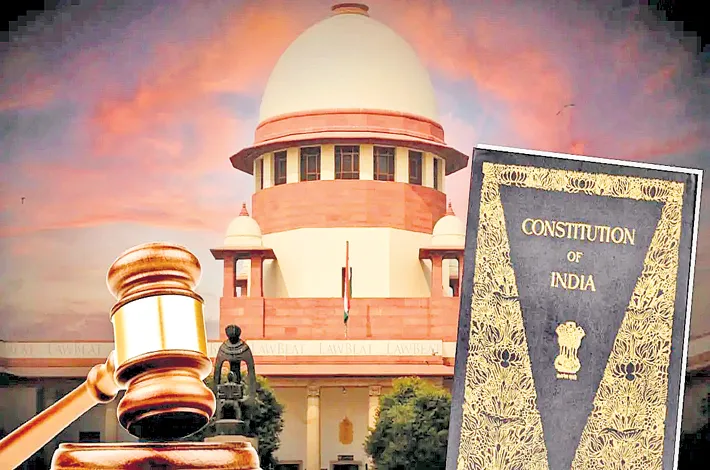
India celebrated its 76th Constitution Day recently with various ceremonies in Parliament’s Central Hall, attended by President Droupadi Murmu, Vice President Jagdeep Dhankhar, Prime Minister Narendra Modi, Leader of Opposition Rahul Gandhi, and several MPs.
The day, commemorating the adoption of the Constitution on November 26, 1949, was meant to be one of celebration and reflection. Yet, it quickly turned into a sharply polarized political and legal debate over whether the Constitution is facing an existential threat or remains the robust guardian of Indian democracy.
President Murmu, in her address, described the Constitution as a transformative document that helped India shed its colonial mindset and embrace a nationalistic outlook. Prime Minister Modi, in an open letter, paid rich tributes, noting that the Constitution had enabled a tea-seller’s son like him to serve the nation for over two decades. In contrast, Rahul Gandhi renewed his pledge to “protect and shield” the Constitution, alleging it was under “assault” and urging citizens to resist any attack on its sanctity.
Commenting on this, a section of advocates warned that both institutional and non-institutional pillars of democracy were under sustained stress. They highlighted secularism, fraternity and federalism as core values now facing daily erosion. They asked the ruling elite to “put their hand on heart and decide whether large facets of secularism are not endangered,”, adding that divisive rhetoric and the conduct of certain governors had undermined federal principles.
While acknowledging that no political party was blemish-free, including the Congress during the 1975 Emergency, they however insisted the “degree, consistency, and invariable nature” of institutional erosion over the past decade was unprecedented. They described the Constitution as inherently “anti-majoritarian” and cautioned that a parliamentary majority could not be used as a license for majoritarian governance.
Countering the narrative, another senior advocate long associated with the BJP, maintained that the Constitution had never been in serious danger except during the Emergency imposed by the Congress. He argued that periodic free and fair elections and the people’s ability to change governments remained the ultimate proof of constitutional resilience.
While conceding that institutions could always function better and that occasional “over-enthusiastic executive action” occurred, he dismissed claims of systemic capture. He contended that India’s democracy was more robust than those of the United States and United Kingdom, citing the absence of judicial packing and large-scale pardons seen abroad.
A former Solicitor General struck a nuanced tone. He unequivocally affirmed that the Constitution had served India remarkably well for over seven-and-a-half decades, accommodating governments of every ideological hue through peaceful transfers of power. However, he questioned whether Indians – particularly the political class – had always served the Constitution with equal fidelity. Citing the 1975 Emergency as the only instance when the Constitution was genuinely under threat, he emphasised that the ultimate safeguard was not any institution but the “fire of democracy” in citizens’ hearts.
He criticized the growing tendency to label the Supreme Court as either heroic or subservient depending on whether its verdicts favored one’s politics, and called for more responsible political discourse and substantive critique of judgments rather than blanket allegations. He also reiterated his long-standing criticism of the 42nd Amendment that inserted “secular” and “socialist” into the Preamble during the Emergency, echoing his veteran jurist Nani Palkhivala’s opposition to those changes.
While the opposition continues to sound alarms about democratic backsliding, the government and its legal supporters insist that periodic elections and an independent judiciary remain strong bulwarks. Between these poles, most constitutional scholars agree on one point: democracy, as Nani Palkhivala famously said, is a “ceaseless endeavour” requiring constant vigilance, debate, and introspection – a message that resonated louder than ever on this Constitution Day. As India concluded its 76th Constitution Day, the contrasting voices underscored a deeper truth repeatedly invoked during the debates: the Constitution itself has not failed the people, but the people – and especially their elected representatives – have at times failed the Constitution.