19 October, 2026 | 5:54 AM


‘PM COMPROMISED’
04-02-2026 12:00:00 AM
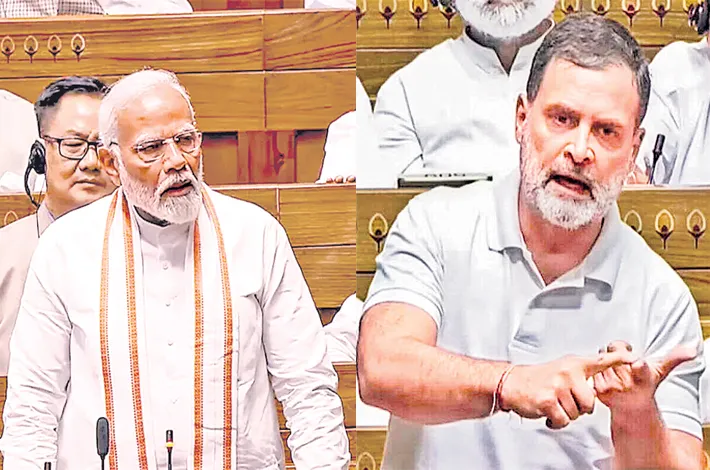
In a dramatic escalation of political tensions, the Parliament became a battleground on Tuesday as Leader of Opposition Rahul Gandhi launched a blistering attack on Prime Minister Narendra Modi. Citing excerpts from former Army Chief General M.M. Naravane's unpublished memoir, "Four Stars of Destiny," Gandhi accused Modi and Defence Minister Rajnath Singh of "letting down" the Indian Army during the 2020 standoff with China. The controversy spilled over into allegations of Modi compromising national interests in a recent India-US trade deal, painting a picture of a government under siege from both domestic revelations and international pressures. This episode not only disrupted Lok Sabha proceedings but also raised profound questions about leadership, national security, and economic sovereignty in Modi's third term.
The spark ignited when Gandhi, responding to BJP MP Tejasvi Surya's remarks on Congress's patriotism during the Motion of Thanks to the President's Address, pulled out a printout of an article from The Caravan magazine. The piece detailed passages from Naravane's memoir, which remains unpublished but has been partially excerpted. According to the memoir, in late August 2020, amid escalating tensions along the Line of Actual Control (LAC) in eastern Ladakh, Indian forces preemptively occupied the Kailash Range heights to counter Chinese advances. Naravane describes a frantic night of August 31, when reports came in of four Chinese tanks rapidly approaching Indian positions. He recounts making urgent calls to key figures: Defence Minister Rajnath Singh, National Security Advisor Ajit Doval, Chief of Defence Staff General Bipin Rawat, and External Affairs Minister S Jaishankar.
Naravane's account paints a picture of indecision at the highest levels. To each leader, he posed the same question: "What are my orders?" The responses were evasive. Rajnath Singh reportedly advised caution, emphasizing that any aggressive action could escalate into a full-scale war and urging Naravane to "hold the situation." When Naravane escalated the matter to Prime Minister Modi, the response was even more ambiguous. Modi allegedly remarked, "They have come a little forward, let them be," suggesting a reluctance to authorize forceful retaliation despite the imminent threat. Naravane interprets this as a moment of hesitation that undermined the military's momentum, potentially allowing China to consolidate positions elsewhere along the LAC.
Gandhi seized on these revelations to argue that the memoir exposes how the political leadership "let down" the Army. Speaking outside Parliament after the session was adjourned amid uproar, he stated, "Naravane ji has written about the Prime Minister and Rajnath Singh ji clearly in his book... They are scared because if it comes out, the reality of Narendra Modi ji and Rajnath Singh ji will be revealed." He questioned the government's handling of the crisis, mocking Modi's "56-inch chest" image and asking, "What happened to the 56-inch chest when China was before us and advancing?" The opposition leader framed this as a betrayal of national security, insisting that quoting the former Army Chief was essential for transparency on a matter of public interest.
The government's response was swift and vehement. Defence Minister Rajnath Singh accused Gandhi of misleading the House by referencing an unauthenticated, unpublished document, invoking Rule 349 of Lok Sabha procedures, which prohibits members from citing unverified sources. Home Minister Amit Shah and Parliamentary Affairs Minister Kiren Rijiju echoed this, labeling Gandhi's actions as "nonsense" and "lies." BJP leaders argued that such references could compromise national security and demanded authentication. Former Lok Sabha Secretary General PDT Achary later clarified that while members can quote published articles, unpublished memoirs require verification. The session descended into chaos, with multiple adjournments, highlighting the deepening rift between the ruling NDA and the opposition INDIA bloc.
But Gandhi's assault didn't stop at the border issue. He pivoted to the recently inked India-US bilateral trade agreement, announced amid Modi's visit to Washington in January 2026. The deal, aimed at boosting trade in agriculture, technology, and defense, includes concessions on tariffs for US farm products and intellectual property protections for American tech firms. Gandhi alleged that Modi signed the pact "under pressure," compromising India's interests to appease the US. "The PM is compromised. It is for the public to understand who compromised PM," he declared outside Parliament. He claimed the agreement would "bleed Indian farmers" by flooding markets with subsidized US imports and threaten financial security through relaxed regulations on data flows and investments.
This accusation ties into broader speculation about external influences on Modi. Gandhi hinted at links to ongoing US investigations into Indian industrialist Gautam Adani, whose conglomerate faces allegations of fraud and bribery in American courts. Adani's close ties to the Modi government have long been a flashpoint, with opposition parties alleging cronyism. Gandhi suggested that US pressure over Adani forced Modi into unfavorable trade terms, effectively "selling" India's sovereignty. "Prime Minister Narendra Modi has sold your hard work in this trade deal because he is compromised. He has sold the country," he charged.
The implications are far-reaching. If Naravane's memoir is fully published, it could reshape narratives around the 2020 Galwan clashes, where 20 Indian soldiers died, and question Modi's strongman image. On the economic front, the US deal's concessions—estimated to cost India $5-7 billion annually in agricultural subsidies—could fuel farmer unrest, reminiscent of the 2020-21 protests. For Modi, facing midterm pressures, these allegations compound challenges from inflation and opposition unity.