22 September, 2026 | 4:31 AM


Sonia Links MGNREGA to Gandhiji’s Gram Swaraj
27-12-2025 12:00:00 AM
Whittling budgetary allocations
- In 2020-21, the Allocation was Rs 1,11,000 crore
- In 2021-22, it was further scaled down to Rs 98,000 crore
- In 2022-23, it was further brought down to Rs 69,000 crore
- From 100 the average number of days dropped to 35 in a year
The just-concluded Winter Session of Parliament witnessed the passage of the Viksit Bharat Guarantee Rozgaar and Aajeevika Mission Gramin Act (VB G RAM G), replacing the Mahatma Gandhi National Rural Employment Guarantee Act (MGNREGA). The move comes at a time when MGNREGA had completed nearly two decades as one of the world’s largest social security programmes, widely credited with providing a safety net to rural India.
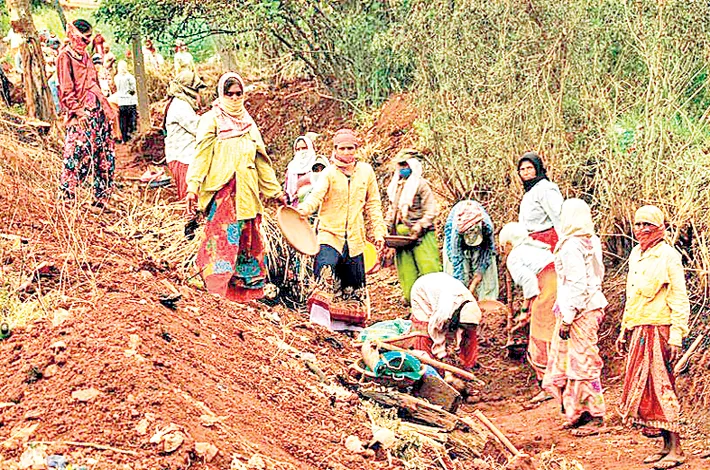
MGNREGA, conceived under the leadership of Sonia Gandhi as Chairperson of the National Advisory Council (NAC), was rooted in Gandhian principles. Its philosophy drew from Antyodaya—reaching the last person in the queue—Gram Swaraj, decentralised planning, and assured Central funding for grassroots development. The Act guaranteed at least 100 days of wage employment to rural households, empowering Gram Panchayats to identify and execute works based on local needs.
Passed by Parliament on August 23, 2005, NREGA was formally launched on February 2, 2006, at Bandlapalli village in Andhra Pradesh by Sonia Gandhi in the presence of then Prime Minister Dr Manmohan Singh. In 2009, it was renamed MGNREGA. The programme proved particularly effective in reducing distress migration, generating local employment, supplementing rural incomes, and creating durable community assets such as water tanks, roads, and school buildings. Its role during the Covid-19 pandemic in preventing widespread rural distress further underscored its importance.
Critics argue that the dismantling of MGNREGA is neither sudden nor accidental. Early indications emerged in 2015 when Prime Minister Narendra Modi described the scheme in Parliament as a “monument of failure” of the Congress in poverty alleviation, even as he said it would not be scrapped outright. Since then, gradual changes have diluted its original spirit, culminating in its replacement by the new VB G RAM G law.
A key concern with the new legislation is the shift in decision-making power. Under MGNREGA, Gram Panchayats determined the nature of works to be undertaken. The new law centralises this authority, allowing the Centre to decide where and how funds will be allocated. Additionally, the funding pattern has been altered to a 60:40 Centre-State split, placing a heavier burden on States already facing financial stress.
Another contentious aspect is the merger of schemes with fundamentally different objectives. MGNREGA, designed to provide guaranteed wage employment during the agricultural lean season, has been combined with Aajeevika Mission, which focuses on women’s livelihoods through skill development and entrepreneurship. Critics contend that merging such diverse schemes weakens both and signals an eventual withdrawal of statutory guarantees.
The most significant loss, according to detractors, is the statutory right to guaranteed employment that MGNREGA provided. With its replacement, livelihoods of lakhs of rural poor stand threatened, and the economic security painstakingly built over years is at risk. Civil society groups argue that the rollback of MGNREGA strikes at the heart of rural welfare and calls for collective resistance to protect the rights and dignity of the most vulnerable sections of society. — Venkat Parsa