10 October, 2026 | 9:50 PM


BJP traps Congress, women bill defeated
18-04-2026 12:00:00 AM
■ What the Opposition hailed as a victory was, in reality, a self-inflicted defeat that Home Minister Amit Shah—widely regarded as more than a modern-day Chanakya—had meticulously engineered. By defeating the bills, the Congress and its INDIA bloc allies have handed the BJP a powerful campaign weapon: the perfect narrative to brand them as anti-women forces standing in the way of greater female representation in Parliament. In the end, it is the women of India who have lost a historic opportunity.
■ With the quota delayed indefinitely, the BJP is poised to campaign aggressively ahead of 2029, painting the Congress and Opposition as the real obstacles to women’s progress. “They talk of women’s rights but vote against their representation,” will be the rallying cry— a trap the Opposition has unwittingly sprung on itself.
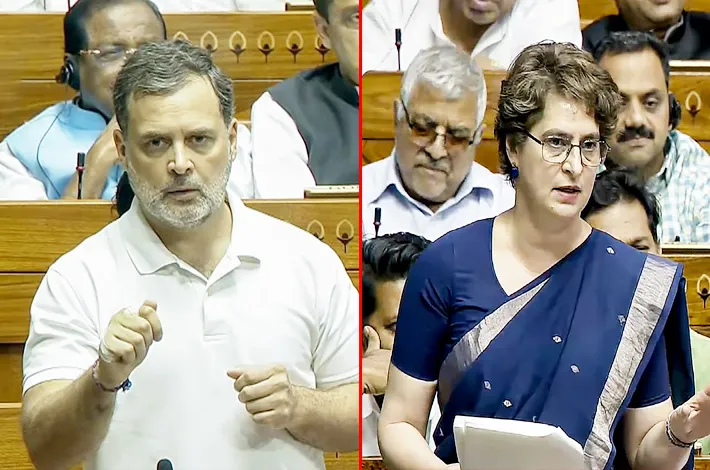
This was not a women's bill; this was an attempt to change the political and electoral structure of Hindustan, an assault on the Constitution. We have stopped it.
I want to say to the Prime Minister
If you want to bring a women's reservation bill, then implement the 2023 Women's Reservation Bill from today— the entire opposition will give you 100% support.
If this is done, then we will get the women's bill implemented immediately.
RahulGandhi, Leader of Opposition
metro india news I new delhi
In a stunning political masterstroke orchestrated by the BJP, the Congress-led Opposition parties walked straight into a carefully laid trap during a specially convened session of the Lok Sabha on Friday, voting down the government’s ambitious package of three bills aimed at fast-tracking 33% reservation for women in Parliament and state assemblies. The vote—278 in favour and 211 against, with 489 members present and voting—fell short of the two-thirds majority required for the Constitution (131st Amendment) Bill, 2026.
What the Opposition hailed as a victory was, in reality, a self-inflicted defeat that Home Minister Amit Shah—widely regarded as more than a modern-day Chanakya—had meticulously engineered. By defeating the bills, the Congress and its INDIA bloc allies have handed the BJP a powerful campaign weapon: the perfect narrative to brand them as anti-women forces standing in the way of greater female representation in Parliament. In the end, it is the women of India who have lost a historic opportunity.
The bills were designed to operationalise the landmark Nari Shakti Vandan Adhiniyam (Women’s Reservation Act) passed in September 2023, which reserves one-third of seats for women in the Lok Sabha and state legislatures. Tying implementation to the first post-census delimitation, the Modi government proposed an immediate workaround using 2011 Census data to expand the Lok Sabha from 543 to roughly 850 seats on a pro-rata basis, activating the women’s quota from the 2029 polls.
Home Minister Amit Shah and Law Minister Arjun Ram Meghwal had presented the move as long overdue justice, highlighting the stagnant voter-MP ratio since the 1976 delimitation freeze and the embarrassingly low rise in women’s representation—from just 22 in the first Lok Sabha to a mere 78 (about 14%) today.
Shah had assured the House that no state would lose seats, with southern states actually gaining in absolute numbers from 129 to 195 while keeping their proportional share intact. Prime Minister Narendra Modi publicly framed the initiative as a transformative step to give “half the population their due” and fortify Indian democracy. A companion Union Territories Laws (Amendment) Bill extended the quota to Delhi and Jammu & Kashmir.
Still the Opposition, blinded by regional and partisan calculations, chose to view this genuine empowerment measure as a “Trojan horse.” Leader of Opposition Rahul Gandhi and others in the INDIA bloc, along with regional parties, rejected the linkage to delimitation, accusing the government of electoral engineering favouring the Hindi heartland. Southern leaders from Tamil Nadu, Karnataka, Andhra Pradesh, Kerala and Telangana warned that 2011 data would somehow “punish” states with successful family planning—completely ignoring Shah’s explicit guarantees of no seat losses.
DMK MP A. Raja and Congress figures like Priyanka Gandhi demanded immediate implementation on the existing 543 seats, bypassing the very mechanism needed to make the quota meaningful. Even some NDA allies voiced unease, but the government’s strategy held firm: let the Opposition unite against the bill and expose themselves.
Amit Shah, piloting the bill with unparalleled strategic brilliance, had anticipated every move. He knew the Opposition’s obsession with the North-South divide and demands for a simultaneous caste census would lead them to block the legislation, despite near-universal support for women’s reservation in principle. By forcing the vote in a special session, Shah ensured the Congress and its allies would own the defeat—turning their “victory” into political poison.
The narrow margin (278-211) only underscores how close the government came, even as the Opposition’s unity crumbled under the weight of its own shortsightedness. What the INDIA bloc sees as validation of its federalism concerns is, in BJP eyes, proof of their anti-women stance: prioritising regional power plays over empowering mothers, sisters and daughters in the world’s largest democracy.
Politically, this outcome is a masterclass in narrative warfare.
The Modi government had convened the session with fanfare, positioning the bills as a bold reform to correct decades of imbalance. Now, with the quota delayed indefinitely, the BJP is poised to campaign aggressively ahead of 2029, painting the Congress and Opposition as the real obstacles to women’s progress. “They talk of women’s rights but vote against their representation,” will be the rallying cry— a trap the Opposition has unwittingly sprung on itself. For women’s rights advocates, the setback is tragic: a near-universal principle sabotaged by partisan rivalries, leaving the promise deferred yet again.
The vote lays bare the Opposition’s entrapment in BJP’s larger game. Delimitation, frozen since 1976 to protect family-planning successes, was being reopened fairly with 2011 data to ensure equity without penalising any region—yet the Congress and allies chose division over delivery. Southern chief ministers may have protested, but their stand has now gifted the BJP ammunition to highlight how the Opposition values electoral math over gender justice.
As Parliament adjourned amid acrimony, the real losers are clear: the women of India, whose historic opportunity for 33% representation has been snatched away not by the government, but by the very parties that claimed to champion them. The BJP, thanks to Shah’s Chanakya-like foresight, emerges stronger—ready to turn this engineered defeat into a decisive campaign advantage.