5 October, 2026 | 3:02 PM


Budget 26: Expectations galore
20-01-2026 12:00:00 AM
Foreign direct investment (FDI) and portfolio inflows have weakened, despite strong macroeconomic indicators. Chief economist of a public sector bank cautioned against over-relying on headline growth figures
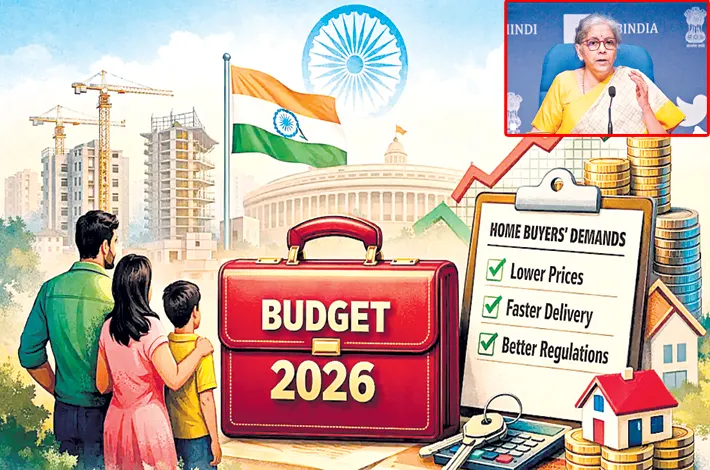
With the Union Budget 2026 just days away, Finance Minister Nirmala Sitharaman is set to present her ninth consecutive budget. This year's financial roadmap carries special significance, as it aims to advance India's long-term ambition of achieving Viksit Bharat (Developed India) by 2047 — the centenary of the nation's independence. The vision seeks to transform India into a fully developed, prosperous, inclusive, and self-reliant economy, with strong emphasis on economic growth, social equity, environmental sustainability, and good governance.
Veterans from various fields such as retired bureaucrats, agriculture experts, corporate representatives, economists, etc shared their perspective on the current economic landscape and the key priorities the Finance Minister should address. A former Finance Secretary noted that while India's economy boasts a robust headline GDP growth rate of around 8%, several underlying factors are concerning. Export growth remains weak, widening the trade deficit, and foreign investments have declined.
Domestic investment, particularly government capital expenditure after a strong cycle in recent years, has slowed. These issues highlight the need for targeted interventions to revive momentum. He noted that while India's economy boasts a robust headline GDP growth rate of around 8%, several underlying factors are concerning. Export growth remains weak, widening the trade deficit, and foreign investments have declined. Domestic investment, particularly government capital expenditure after a strong cycle in recent years, has slowed. These issues highlight the need for targeted interventions to revive momentum.
A top executive of a manufacturing firm noted that the key area of concern is India's export performance amid external pressures, including heavy reliance on imports from China for critical goods like renewable energy products, solar modules, electric vehicles, semiconductors, and IT-related items. He argued that China dominates technology, rare earth minerals, and manufacturing in these sectors. He presented a pragmatic policy choice: rather than continuing heavy imports from China, India should consider allowing Chinese investments to produce these goods domestically.
This approach, in his view, would create jobs, share profits, and provide greater strategic control in case of geopolitical tensions. He observed that the government has so far resisted Chinese investments, but shifting to this model could better address the export and import imbalance. On the trade front with the United States — where India faces high tariffs (up to 50% in some cases) despite reduced oil purchases from Russia — he highlighted stalled progress on a potential trade deal.
The primary sticking point remains access to agricultural products such as dairy, corn, and soybeans. A representative of food processing industry suggested India could make tough concessions, such as importing corn for ethanol production or allowing dairy imports, to unlock better terms from the US. Additionally, he advocated for more bilateral and regional trade agreements, as the era of large multilateral deals has waned.
Foreign direct investment (FDI) and portfolio inflows have weakened, despite strong macroeconomic indicators. Chief economist of a public sector bank cautioned against over-relying on headline growth figures, suggesting that real growth may be lower than reported. He pointed out that modern FDI flows into emerging sectors like semiconductors, AI, renewables, and electric vehicles — areas where the US and China hold advantages. To attract such investments, India must open these sectors more decisively to foreign players. He also highlighted currency depreciation concerns: while many global currencies strengthened against the US dollar in recent periods, the Indian rupee depreciated, deterring foreign investors in debt and equity markets due to forex risks.
A senior Chartered Accountant expressed reservations about further tax concessions for the middle class, such as additional income tax relief or deeper GST cuts. He noted that last year's measures — raising the effective tax-free threshold to around Rs12.75 lakh for salaried individuals under the new regime and GST reductions on consumption goods — aimed to boost spending. However, tax collections (both direct and indirect) have stagnated or declined in the first eight months, potentially causing a revenue loss of Rs 2-3 lakh crore, with limited visible impact on consumption growth.
He raised concerns about the shrinking tax base: while around 11 crore people file returns, actual income taxpayers may now number fewer than 2 crore in a population of 144 crore. Continuing "blunt" tax giveaways, he argued, could prove excessively costly without proportional economic benefits. Instead, Garg stressed the need to expand the taxpayer base and avoid further rate reductions that might hurt long-term fiscal health.
Ultimately, the ex- Finance Secretary advised the Finance Minister to balance political and economic objectives in the budget. He urged a clearer definition of Viksit Bharat, moving beyond aggregate GDP growth to focus on raising per capita income, reducing inequality, and ensuring inclusive welfare — particularly for the bottom 50% of the population. Metrics like poverty reduction based on outdated low-income thresholds (e.g., $3 a day) are insufficient for a middle-income country like India.