29 September, 2026 | 11:28 PM


Polavaram: Mega Catastrophe in the Offing?
03-02-2026 12:00:00 AM
Given MEIL's history and these unresolved technical flaws, the government's approach must shift from reactive to proactive. Experts argue for deploying dedicated quality control teams to conduct layer-by-layer testing, with records forwarded to CWC
metro india news I hyderabad
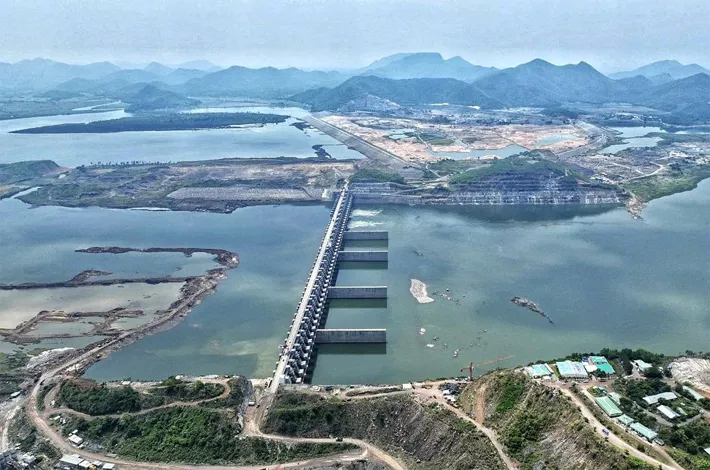
The Polavaram Multipurpose Project, envisioned as Andhra Pradesh's lifeline for irrigation, hydropower, and flood control on the Godavari River, has long been mired in controversy. With costs ballooning to ₹62,436 crore as of January 2026 and repeated delays pushing completion targets to December 2027 or March 2028, the project now faces mounting technical red flags that raise serious questions about its structural integrity.
At the heart of the current concerns is the project's main contractor, Megha Engineering & Infrastructures Limited (MEIL), which has handled critical components including the spillway, Gap-3 concrete dam, and sections of the Earth-Cum-Rock-Fill (ECRF) dam. But MEIL's has a backdrop of past failures in other high-stakes irrigation works.
EIL's track record includes significant collapses in Telangana projects. The retaining wall of the Sunkishala intake well and pump house complex collapsed in August 2024 due to alleged shortcuts in construction, drawing sharp criticism. Similarly, during floods, the Kannepalli pump house in the Kaleshwaram Lift Irrigation Scheme—where MEIL executed major underground pump houses—suffered severe damage, with retaining walls failing and pumps destroyed. These incidents underscore recurring issues with structural stability under pressure, fuelling fears that similar vulnerabilities could plague Polavaram.
A January 19–22, 2026, inspection by an independent panel—including foreign dam safety experts David B. Paul (USA), Sean Hinchberger (Canada), Gian Franco Di Cicco (USA), alongside Central Water Commission (CWC) engineers—has amplified these worries. The panel flagged misalignment between CWC observations and the ECRF dam design proposed by consultant AFRY. Key issues include "bleeding" in walls, deficiencies in compaction methodology, and grave risks of internal erosion and piping in the core, filter, shell, and foundation—even under extreme floods.
Piping, where internal erosion creates voids leading to sinkholes or blowouts, has been a recurring failure mode in Indian dams, as seen in the Medigadda barrage collapse in the Kaleshwaram project in 2023.
The Polavaram panel explicitly warned that without protection, these could become "potential failure mechanisms." Recommendations include rigorous remedial measures for bleeding, comprehensive compaction data from sample ECRF sections, and a fresh derivation of the diaphragm wall's top elevation using detailed seepage and piping analysis. If necessary, the clay cap thickness above the wall must increase to prevent under-seepage and core-foundation blowouts.
Seismic risks loom large. The panel called for stringent analysis under Maximum Credible Earthquake (MCE) conditions to verify dam stability and deformations, warning against reliance on "non-conservative or insufficiently explained assumptions." While specific parameters like a low earthquake factor (e.g., 0.83g versus recommended minima) are not detailed in public reports, the push for bedrock-derived seismic studies echoes longstanding CWC scrutiny of Polavaram's design.
The diaphragm wall itself has been a persistent Achilles' heel. Damage—attributed to inefficient planning and failure to close cofferdam gaps—has triggered massive seepage issues and added thousands of crores in costs, with estimates exceeding Rs 1,000 crore for repairs alone. Political blame-shifting between the current TDP-led government and the previous YSRCP regime has overshadowed technical fixes, with accusations flying over who caused the delays and escalations.
Given MEIL's history and these unresolved technical flaws, the government's approach must shift from reactive to proactive. Experts argue for deploying dedicated quality control teams to conduct layer-by-layer testing, with records forwarded to CWC. Contractors should certify compliance with specifications per bill, while a standing legal team handles day-to-day correspondence to prevent responsibility-shifting claims. Bank guarantees must be rigorously enforced, and monthly CWC minutes maintained to document accountability.
Polavaram is no ordinary project: it promises irrigation for millions of acres, drinking water, and power generation in a flood-prone basin. But with costs spiraling, designs under fire, and a contractor shadowed by past collapses, the risk of a mega-failure—potentially devastating downstream communities and erasing decades of investment—cannot be dismissed. Recent progress is encouraging, but the expert panel's warnings demand urgent, transparent action. Without it, Polavaram risks becoming not a triumph of engineering, but India's costliest cautionary tale.
Hence, CM Chandrababu should think before he leaps!