21 October, 2026 | 6:28 AM


Canada at Davos- Destroy old order
22-01-2026 12:00:00 AM
Abroad, Carney highlighted rapid diplomatic moves, including a comprehensive strategic partnership with the European Union (including joining European defense procurement), new deals across four continents in recent months, and efforts to bridge frameworks like the Trans-Pacific Partnership
For decades, middle powers like Canada thrived within a rules-based international system. By participating in multilateral institutions, upholding shared principles, and benefiting from predictability, these nations pursued value-driven foreign policies. They placed their "sign in the window," joining rituals of cooperation that assumed mutual benefit through integration, international law, public goods, and collective security.
That bargain, however, no longer holds. Crises in finance, health, energy and geopolitics over the past two decades have exposed the vulnerabilities of extreme global interdependence. Great powers now exploit dependencies through tariffs, supply chains and other levers, turning integration into a source of subordination rather than shared prosperity.
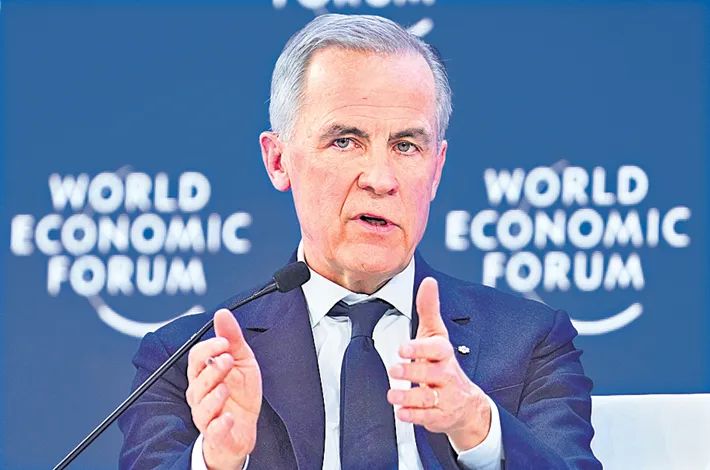
Canadian Prime Minister Mark Carney delivered a stark and widely discussed address at the World Economic Forum in Davos, Switzerland, on January 20, 2026, declaring that the world is experiencing a fundamental "rupture" in the international order rather than a mere transition. In a speech that earned a standing ovation, Carney described the end of what he called a "pleasant fiction"—the long-held belief in a rules-based global system where integration and mutual benefit prevailed—and the emergence of a harsher reality dominated by unconstrained great-power geopolitics.
Drawing on Czech leader Václav Havel's famous essay about living within a lie under communist systems, Carney likened past participation in the old order to "putting the sign in the window"—a ritual of conformity that sustained the system but masked its fragility. He declared that this no longer works: "We are taking the sign out of the window. We know the old order is not coming back." Nostalgia, he emphasized, is not a strategy. Instead, middle powers must recognize that sovereignty today is increasingly defined by the ability to resist pressure and reduce vulnerabilities, rather than relying solely on geography or alliances.
In response to this shift, Carney outlined Canada's evolving approach: a blend of principled commitment to core values—such as sovereignty, territorial integrity, the prohibition of force inconsistent with the UN Charter, and respect for human rights—and pragmatic engagement with partners who may not share all those values. He termed this "value-based realism," inspired by Finnish President Alexander Stubb. Canada is building strength at home through massive investments in energy, AI, critical minerals, trade diversification and defence—doubling defence spending by the end of the decade while bolstering domestic industries.
Abroad, Carney highlighted rapid diplomatic moves, including a comprehensive strategic partnership with the European Union (including joining European defense procurement), new deals across four continents in recent months, and efforts to bridge frameworks like the Trans-Pacific Partnership and the EU to create larger coalitions. He stressed collective action among middle powers to share the costs of strategic autonomy, warning that bilateral negotiations from weakness lead only to subordination. "If we're not at the table, we are on the menu," he cautioned, urging likeminded countries to forge a "third impact" through cooperation, legitimacy, integrity, and rules—rather than competing for the favor of great powers.
The power of less powerful nations—the "power of the less powerful"—begins with honesty about the world as it is. It means rejecting compliance or performative sovereignty, where countries compete for great-power favor. Instead, middle powers can choose cooperation: naming reality, building collective strength, and acting together. Canada possesses unique assets—an energy superpower status, vast critical mineral reserves, the world's most educated population, sophisticated pension funds, fiscal capacity, and a stable, pluralistic society committed to sustainability and long-term relationships.
Following the speech, in a Q&A session moderated by an interviewer (referred to as Larry), Carney fielded questions on key themes. He reaffirmed that the old world is gone and Canada is adapting proactively, not waiting for restoration. On NATO, he described it as under test but stressed robust reinforcement of the alliance's northern and western flanks through Canadian investments in radar, submarines, aircraft, and personnel. Regarding relations with China—Canada's second-largest trading partner—he defended recent strategic partnerships as building guardrails and mutual benefits, not decoupling or dependence. He condemned Russia's aggression in Ukraine and threats in the Arctic, while supporting Greenland and Denmark's self-determination amid external pressures.
On other global issues, including Gaza, Carney welcomed progress toward ceasefires but called for immediate humanitarian aid, improved governance, and a path to a two-state solution. He positioned Canada as a reliable partner with vast resources—energy superpower status, critical minerals, an educated workforce, sophisticated pension funds, fiscal capacity, and a stable, pluralistic society—to lead in building a more just, cooperative future.