20 October, 2026 | 1:10 AM


SIR is legal political genocide-Parakala Prabhakar
25-01-2026 12:00:00 AM
Prabhakar dismantles official justifications. Claims of removing "foreigners" or "infiltrators" (often implying Bangladeshis) fall apart: Assam, with its history of anti-foreigner agitations and NRC processes identifying 19 lakh people (including more Hindus than Muslims), has no SIR
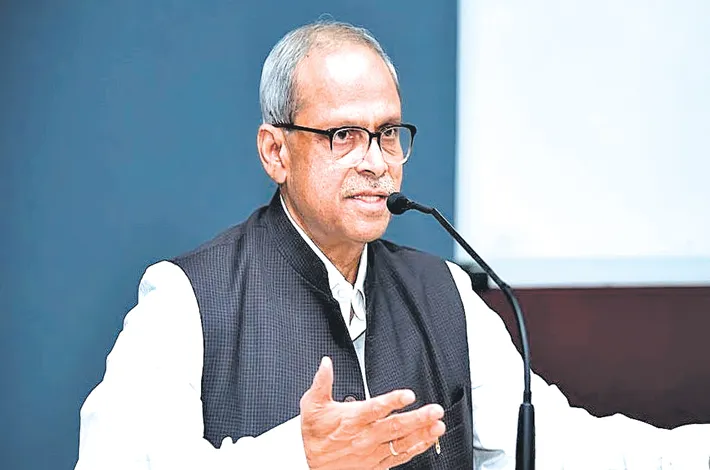
The speech delivered by Parakala Prabhakar at the CJS Discourse, organized in memory of the late science activist and founder of the Kerala Shastra Sahitya Parishad initiative, Shankaran Master, addresses a critical concern facing Indian democracy today. Prabhakar begins by expressing humility and privilege in speaking on the topic, acknowledging the legacy of Shankaran Master and the enduring relevance of rational, scientific temper in an era marked by widespread anti-science sentiments and superstition—even among high offices, judiciary, doctors, and advocates.
He pays tribute to the audience of committed individuals upholding democratic, secular, and constitutional values such as justice, liberty, equality, fraternity, and secularism, which he argues are under severe threat. The core of his address focuses on the Special Intensive Revision (SIR) of electoral rolls, currently underway in multiple states and union territories following its initiation in Bihar. Prabhakar contends that this exercise, marketed as a routine "cleaning up" of voter lists to remove dead, shifted, absent or duplicate entries (often abbreviated as S-A-D), conceals a far more sinister purpose.
Prabhakar highlights procedural irregularities and lack of transparency surrounding the SIR. The Election Commission of India (ECI) justified it based on an unnamed study's finding that prior Summary Special Revisions (SSR) were inadequate. However, repeated requests—including through RTI—for details on the study, its organization, report, recommendations, and internal file notings have gone unanswered. Notably, the ECI's principal secretary reportedly stated in writing that the Commission had not decided to conduct the SIR, raising questions about who authorized it.
Focusing on Bihar as a case study, Prabhakar notes that pre-SIR, the state had approximately 7.79 crore voters, already below the estimated adult population of around 8.22 crore (based on surveys projecting from the 2011 Census). Post-SIR, the figure dropped to 7.42 crore—a reduction of about 80 lakh voters. Disproportionately affected were women (16 lakh deletions) and Muslims (initially 25% contraction relative to their 17% population share, later netting at 33%). He argues this pattern targets groups less likely to support the ruling dispensation, effectively allowing the government to decide who qualifies as a voter rather than voters deciding the government—a reversal of democratic principles after seven decades of universal adult franchise.
Prabhakar dismantles official justifications. Claims of removing "foreigners" or "infiltrators" (often implying Bangladeshis) fall apart: Assam, with its history of anti-foreigner agitations and NRC processes identifying 19 lakh people (including more Hindus than Muslims), has no SIR. Nationally, over 11 years of the current government, only 15,000 foreigners have been deported, with more from Nigeria than Bangladesh recently. In Bihar, scrutiny revealed virtually no deletions for being foreigners—only a handful of cases (e.g., three eligible Muslim names after layers of review), despite 67 lakh deletions overall. Objections totalled 3.75 lakh, with just 1,087 citing foreigners, leading to examination of 390 and confirmation in far fewer.
He also addresses duplication and other S-A-D categories. The ECI admitted lacking usable de-duplication software, yet absurd entries persisted (e.g., 509 people at one non-existent address in Pipra constituency, gibberish names, or fathers/husbands listed as "Election Commissioner of India"). Live people received "dead" notices, and prominent figures like retired naval officers or academics faced demands to prove eligibility despite long-standing citizenship.
Prabhakar contrasts this with past revisions, noting that in 2003–2004, no ordinary voters were required to submit documents or prove citizenship at offices—unlike now. The SIR has expanded to nine states and three union territories, with significant proposed deletions: 2.89 crore (18.7%) in Uttar Pradesh, 97.37 lakh (15.9%) in Tamil Nadu, 24.88 lakh (12.88%) in Kerala, and others averaging around 14% nationwide, totalling roughly 6.5 crore people—equivalent to the population of most countries worldwide.
This scale, he warns, amounts to massive disenfranchisement, threatening the unique feature of India's universal adult franchise from day one—unlike mature democracies that gradually extended voting rights. Prabhakar frames SIR not as an electoral tactic but as an existential assault on India's nationhood. Unlike European nation-states that historically defined "the nation" by language, religion, race, or culture—often excluding or eliminating outsiders—India's Constitution uniquely embraced all residents within its territory as full citizens with equal rights, without discrimination based on religion, gender, education, or tax payment.
Yet today, narratives of India as a "Hindu Rashtra" exclude minorities, evident in the absence of Muslim representation in the Union Cabinet, the ruling party's parliamentary wings, and long-ruling state assemblies. Prabhakar describes SIR as a mechanism for "peaceful political genocide"—killing citizenship (and thus political community membership) without physical violence, by stripping franchise from dissenters, minorities, and others. If unchecked, it could render India a majoritarian state where only certain groups remain voters, effectively achieving exclusionary goals without declaration.
He appeals specifically to the Kerala audience, noting the state's vulnerability despite its progressive traditions. Historical RSS efforts since the 1930s targeted Kerala for its "three mortal enemies" (communists, Muslims, Christians). Recent electoral shifts, including BJP's gains, stemmed partly from artificial vote inflation (e.g., 6.17% in 2024, translating to margins in key seats). He urges speaking out, writing, mobilizing, and supporting those resisting—warning that without organized defense of constitutional values, akin to the century-long dedication of opposing forces since 1925, the idea of India may reach a point of no return in the coming months.